
 TESTED WITH REAL MONEY
 FTMO
80%–90% by product split · CFD day 14; Futures 4–5 qualifying days payouts
Visit firmAffiliate link. It never changes my rating or verdict.
⌄Inside the platform
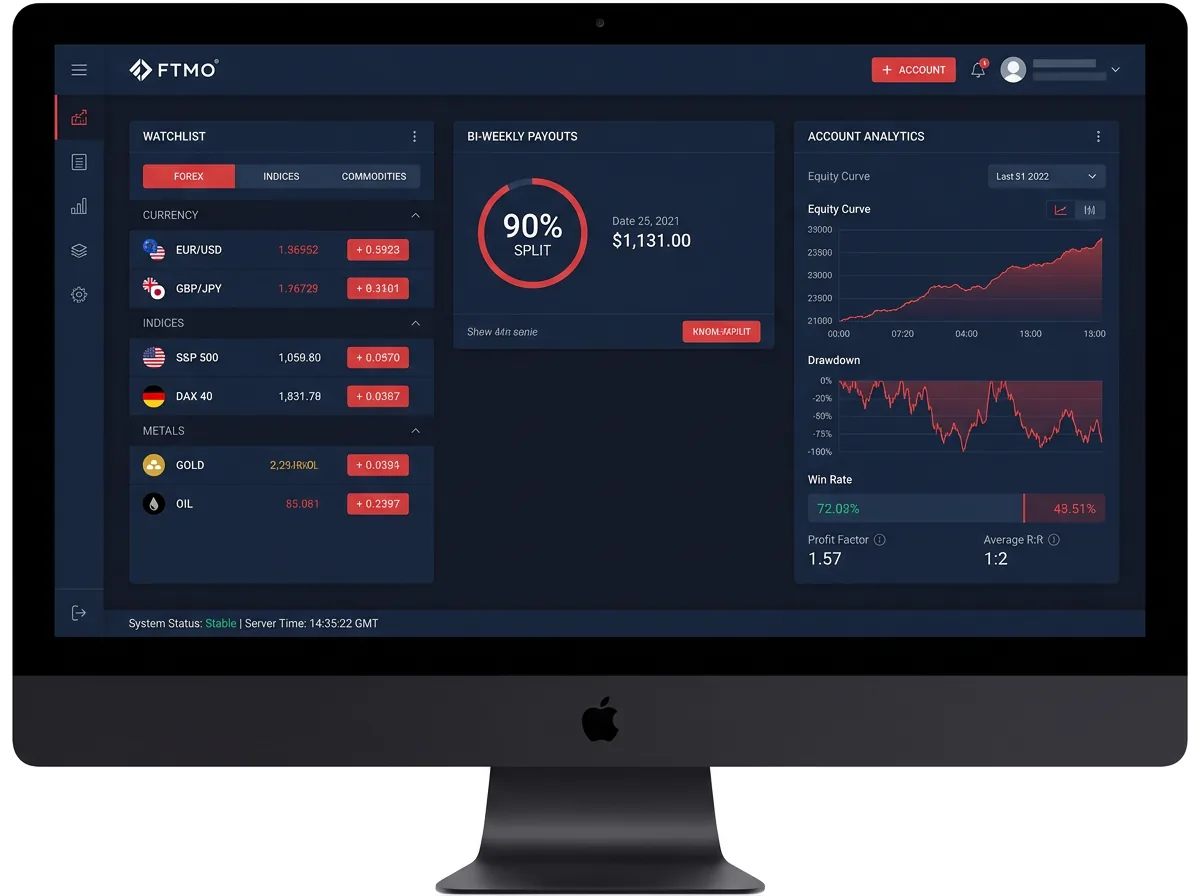
FTMO is one of the few operators where I can combine a long CFD account history with a current two-product comparison. The company now serves CFD traders through 1-Step and 2-Step and futures traders through a separate Growth and Pro Beta. The evidence boundary is strict: my Standard CFD history supports the operator verdict. It does not prove FTMO Futures execution, stability or payouts. Personal fit update: futures are my main market, and FTMO is materially more interesting to me now that it has a dedicated Futures product. In my own setup as a German trader, the bookkeeping and tax administration is substantially easier to handle than it is with US firms. That is a personal administrative assessment, not a general tax rule.

Pricing checked against FTMO current process owner on
Ratings & Reviews
About four years of personal operator experience on Standard CFD accounts
What are the real FTMO pros and cons?
FTMO now offers distinct CFD and Futures products. The strength is product choice backed by a long-running operator; the limitation is that the new Futures Beta has not yet earned the same PTV first-hand evidence as the CFD line.
| Pros | Cons |
|---|---|
| Established CFD operator record | Futures line is still Beta |
| Static CFD 2-Step option | CFD and Futures rules are easy to mix up |
| Futures Growth and Pro choices | Futures Evaluation is a monthly subscription |
| Futures has no activation fee | No FTMO Futures Free Trial |
| Detailed official rule owners | Futures lacks Level 2 DOM with provided credentials |
What I personally tested at FTMO
I have traded FTMO for about four years on Standard CFD accounts. My history includes multiple 50K and 100K accounts and recurring CFD payouts. That is enough time to judge the day-to-day process beyond one successful evaluation.
FTMO has been easier for my own bookkeeping and tax administration than several US firms. That is a personal operational assessment based on my setup as a German trader living in Spain. It is not tax advice and should not be generalized to another trader's residence or company structure.
What held up over time
The strongest part of my FTMO experience is consistency: the account workflow, evaluation logic and payout process have been predictable enough for me to return across several account generations. I do not need to inflate that into an exact public payout count or amount.
Where my evidence stops
I have not traded FTMO Futures Growth or Pro, have not tested their current platform credentials and have not completed a Futures payout. The Futures cards, rule explanations and provisional ranking are research-based. My CFD result cannot prove a separate Beta product.
What I would test first
I would start with one Futures account, verify the data and order-routing workflow, and trade small enough to observe the drawdown and qualifying-day behavior. Only after a complete payout cycle would I compare the Beta's real operating feel with the established CFD side.
Which FTMO account should you choose?
| Route | Best fit | Main trade-off |
|---|---|---|
| 1-Step Standard | Trader prioritizing one evaluation phase | 3% daily, EOD trailing loss, Best Day, non-refundable fee |
| 2-Step Standard | Day trader prioritizing static risk | Second 5% phase and funded holding/news restrictions |
| 2-Step Swing | Trader needing funded-stage holding and news freedom | Must choose Swing at purchase and verify its checkout price |
For most risk-first traders, 2-Step is easier to model because the maximum-loss floor stays static. For a disciplined trader who values speed and distributes profit naturally, 1-Step can still be efficient.
What does FTMO cost?
| Size | 1-Step Standard | 2-Step Standard |
|---|---|---|
| $10K | €79 | €89 |
| $25K | €199 | €250 |
| $50K | €319 | €345 |
| $100K | €499 | €540 |
| $200K | €999 | €1,080 |
The table shows base EUR Standard prices from FTMO's public widget. Conditional 100K offers can appear, and Swing needs to be priced in its configurator. There is no verified public PTV coupon code.
The 1-Step fee is non-refundable. The 2-Step fee is reimbursed with the first Reward, so successful-path economics differ from the sticker-price comparison.
How does FTMO Futures fit into the lineup?
| Futures plan | $50K | $100K | $150K | Billing |
|---|---|---|---|---|
| Growth | $119 | $169 | $229 | Monthly |
| Pro | $139 | $199 | $269 | Monthly |
FTMO Futures subscriptions are separate from the one-time CFD Challenge fees. Growth and Pro have optional reset fees and no activation fee. The existing FTMO affiliate destination is not verified for Futures.
Which FTMO rules matter most?
| Rule | 1-Step | 2-Step |
|---|---|---|
| Targets | 10% | 10%, then 5% |
| Daily loss | 3% | 5% |
| Maximum loss | 10% EOD trailing | 10% static |
| Best Day | 50% in Challenge and FTMO Account | None |
| Minimum days | None published | 4 in each phase |
The percentages alone hide the main difference. The 1-Step floor can rise after profitable end-of-day balances. The 2-Step floor does not. A strategy with a volatile equity curve may prefer the extra phase.
How do FTMO Rewards work?
Reward requests begin from day 14 after the first trade when positions and pending orders are closed and the account is profitable. FTMO publishes one to two business days for review and another one to two after invoice confirmation for processing.
1-Step pays a 90% share but keeps Best Day eligibility and does not refund the fee. 2-Step begins at 80%, can progress to 90% and reimburses the Challenge fee with the first Reward.
How do holding rules differ?
Evaluation accounts can hold overnight and through weekends. On an FTMO Account, Standard restricts selected news and positions crossing weekends or market breaks longer than two hours. Swing removes those restrictions and exists only inside 2-Step.
Which FTMO Futures rules matter most?
| Rule | Growth | Pro |
|---|---|---|
| Evaluation daily loss | None | $1K / $1.5K / $2K hard |
| EOD trailing max drawdown | $2K / $3.5K / $5K | $3K / $4.5K / $6K |
| Evaluation consistency | 40% | 50% |
| Sim-Funded consistency | None | None |
| Daily flat time | 4:10 p.m. ET or earlier close | 4:10 p.m. ET or earlier close |
Futures Sim-Funded rules differ again: Growth uses a soft daily-loss control, Pro keeps a hard limit, and neither has a profit target or consistency rule. The full Futures owner carries the size-specific mechanics.
Which FTMO platform should you choose?
Platform choice begins with the asset line. CFD accounts currently use MetaTrader, cTrader and TradingView routes. FTMO Futures uses NinjaTrader and Tradovate. A platform available under the FTMO brand is not automatically available for both businesses.
For CFD traders
MetaTrader remains the familiar route for established indicators and EAs. cTrader is useful for traders who prefer its order interface and automation ecosystem. TradingView works for a chart-first workflow, but the exact account and regional availability still need confirmation.
For futures traders
NinjaTrader suits desktop futures workflows. Tradovate is the browser-first route and is usually the cleaner choice for traders who move between devices. FTMO Futures does not currently turn the entire CFD platform stack into a futures stack.
Test the operational details
- Confirm the platform for the exact product and region.
- Check market data, session times and any separate cost.
- Test bracket orders and flatten controls with minimum size.
- Verify automation, copying and device rules before connecting tools.
I would not buy the Futures Beta because the FTMO name feels familiar and then assume the platform behaves like my CFD account. It needs its own test.
Which FTMO account should you choose?
Choose the asset line first. Only then compare the account paths. CFD 1-Step versus 2-Step and Futures Growth versus Pro answer different questions.
CFD 1-Step
The single evaluation can shorten the route, but it concentrates the decision into one set of conditions. Use it when the loss limits and profit-distribution requirement already match your normal trading.
CFD 2-Step
Two-step is the more familiar FTMO route and the one closest to my own tested history. The extra phase is not automatically a disadvantage if it produces a rule set you can repeat without changing size.
Futures Growth
Growth should be evaluated from its funded-stage drawdown and payout conditions, not from the Beta label or the FTMO reputation. It is one of the two current futures routes and needs its own account-level check.
Futures Pro
Pro is the alternative when its rule and payout trade-off fits a more experienced workflow. “Pro” does not mean objectively better; it means a different set of constraints.
My decision
For CFDs, I would still begin from the tested Standard-style workflow that matches my risk plan. For futures, I would use the Data Core to model both Growth and Pro, choose one small test account and withhold a final product verdict until I had completed the full cycle.
Is FTMO legitimate?
FTMO is one of the few firms on this site where my trust assessment rests on years of direct use rather than one recent account. Multiple Standard CFD accounts and recurring payouts support a strong operator verdict.
That does not remove product-specific risk. FTMO Futures is new and explicitly separate. The established CFD history is evidence about the company and its operating discipline; it is not evidence that the Beta has identical execution, support load or payout behavior.
The cleanest trust signal is the ability to trace each claim to the right product owner. CFD rules should link to CFD sources. Futures rules should link to the Futures comparison and policy pages. The source register keeps those scopes separate.
I would keep the purchase receipt, current rule page, dashboard values and payout documents. For tax or bookkeeping treatment, use a qualified adviser familiar with your own residence and business structure rather than copying my personal fit assessment.
How does FTMO compare with newer prop firms?
FTMO's advantage is the combination of a long-tested CFD operation and a new futures line under one recognizable brand. Most rivals are stronger in one lane and absent in the other.
For CFD traders, The5ers is the closer established-firm comparison, while FundingPips offers a newer multi-product alternative. For futures, Topstep, Lucid Trading and Apex all have deeper product-specific histories on PTV.
I would choose FTMO for its established operating record, international CFD workflow and the administrative fit it has in my own setup. I would choose a futures specialist when direct evidence on the current futures product matters more than the parent brand.
The comparison should stay asset-specific. A four-year CFD record cannot be placed beside a competitor's futures payout record as if they measure the same product.
Frequently Asked Questions
Is FTMO legit?
FTMO is one of the longest-running modern prop evaluation operators. I have traded FTMO for about four years across multiple Standard accounts with recurring payouts. The accounts themselves are simulated.
Do I still recommend FTMO?
Yes for traders who deliberately choose between 1-Step speed and 2-Step static risk. The recommendation is conditional on strategy fit, not the brand name alone.
Have I tested FTMO 1-Step for four years?
No. I have about four years of FTMO operator experience, but that history predates the current 1-Step product. Current 1-Step coverage is based on FTMO documentation.
What FTMO account sizes Have I traded?
I have traded multiple $50K and $100K Standard accounts with a scalping style. No personal payout dollar total is published.
What is the easiest FTMO challenge?
There is no universal easiest route. 1-Step has one phase but tighter daily loss, trailing maximum loss and Best Day. 2-Step has another target but static maximum loss and more daily room.
How much does FTMO cost?
Current global Standard base prices start at €79 for 1-Step and €89 for 2-Step. Prices rise through the $200K size and checkout controls the final amount.
Does FTMO refund the fee?
FTMO reimburses the 2-Step fee with the first Reward. The 1-Step fee is non-refundable.
What is the FTMO payout split?
FTMO CFD 1-Step pays 90%, while CFD 2-Step starts at 80% and can reach 90%. FTMO Futures uses a 90/10 payout ratio after Growth or Pro request conditions and caps are applied.
Can US traders join FTMO?
Yes, through two product-specific routes. FTMO/OANDA handles US CFD access. FTMO Futures is separate and excludes residents of Arkansas, Delaware, Louisiana, Montana and South Carolina.
Does FTMO allow weekend holding?
Evaluation accounts can hold. Funded Standard accounts have weekend and long-rollover restrictions; 2-Step Swing does not.
What platforms does FTMO use?
FTMO CFDs document MT4, MT5, TradingView and cTrader, with regional variation. FTMO Futures uses NinjaTrader, Tradovate and TradingView. Platform lists are not interchangeable across products.
Are FTMO accounts simulated?
Yes. FTMO describes Challenge and FTMO Account trading as simulated. Eligible traders can receive real monetary Rewards based on performance.
Does FTMO offer futures trading?
Yes. FTMO Futures is a separate Beta product with Growth and Pro Evaluations in $50K, $100K and $150K sizes. I have not personally tested this product; current coverage is based on official FTMO documentation checked September 1, 2026.
Key details
- Asset classes
- Forex, Indices, Commodities, Metals, Crypto, Futures
- Platforms
- Tradovate, NinjaTrader, TradingView, cTrader, MetaTrader 5, MetaTrader 4
- Profit split
- 80%–90% by product
- Payout frequency
- CFD day 14; Futures 4–5 qualifying days
- Max funding
- CFD $200K; Futures up to 3 × $150K simulated
I may earn a commission if you sign up through my link. It never changes my rating or verdict. I tested this firm with my own money.