
Table of contents
- My current futures top five is #1 Lucid Trading, #2 Apex Trader Funding, #3 Topstep, #4 FTMO Futures and #5 MyFundedFutures.
- FTMO enters at #4 because its Growth and Pro rule set fits my futures focus and its established CFD-side operator record matters.
- FTMO Futures is still Beta and not personally payout-tested by me, so the placement is provisional.
- Choose by drawdown, payout conditions, platform and billing rather than rank alone.
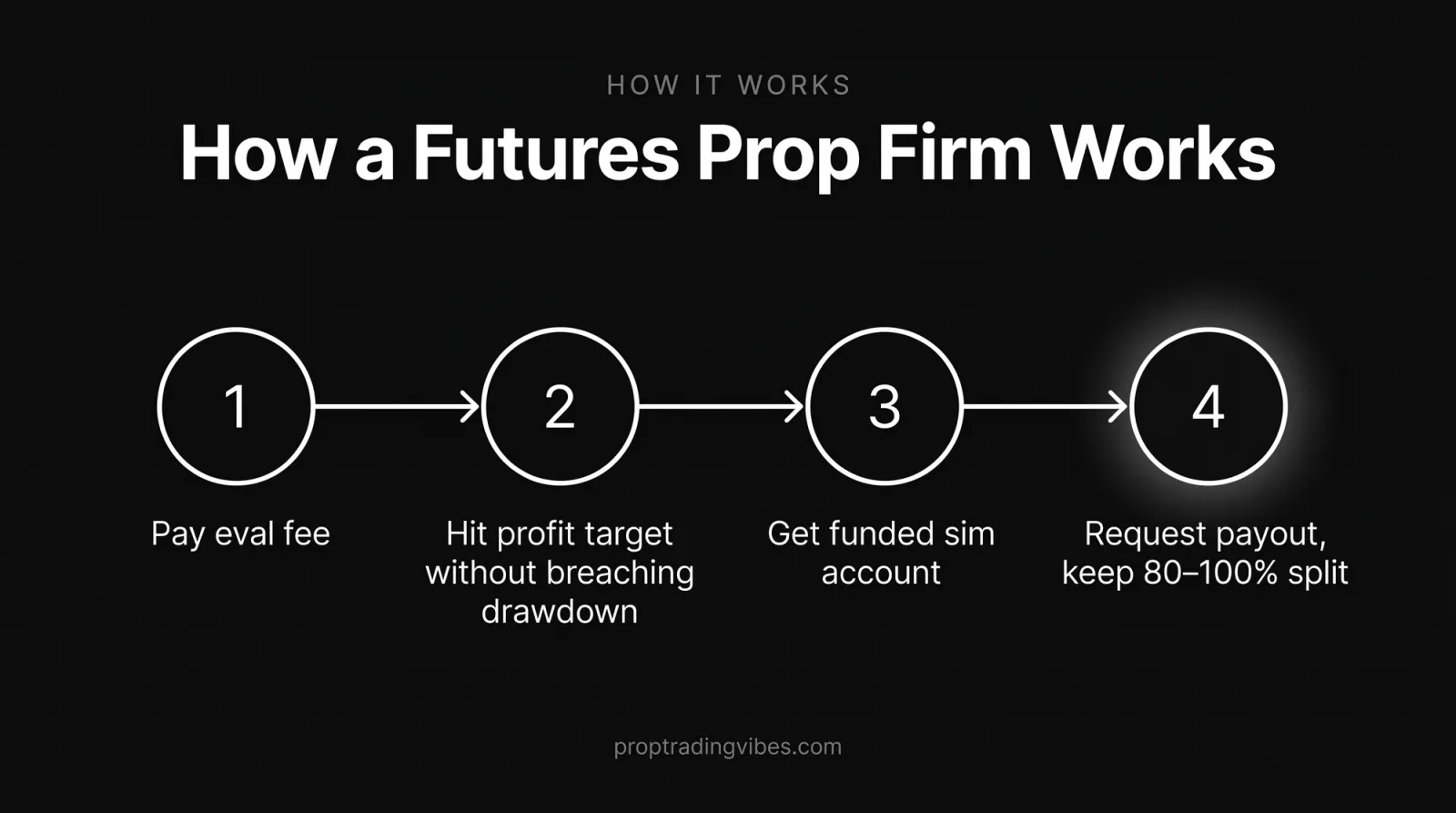
A futures prop trading firm funds you to trade CME futures contracts like the E-mini S&P 500 (ES), Nasdaq-100 (NQ), gold (GC) and crude oil (CL) after you pass a simulated evaluation, then pays you a split of the profit instead of you risking your own brokerage capital. The best futures prop firms in 2026 are not the ones with the loudest discount codes. They are the ones whose drawdown rules, payout speed and platform support actually match the way you trade.
This ranking combines first-hand testing with clearly marked research-only entries. I have run evaluations, funded accounts and payout cycles across the established firms below. FTMO Futures is the exception: its number-four placement is based on current official rules, my long FTMO CFD-side operator experience and personal fit, not on a Futures payout I have received.
The short version: Lucid Trading remains number one, Apex is the scale pick, Topstep is the incumbent and onboarding pick, FTMO Futures enters provisionally at number four, and MyFundedFutures completes the current top five. TradeDay remains a strong format-specific alternative. The right one depends on how you trade, not the badge beside its name.
What makes a futures prop firm worth using in 2026?
A futures prop firm is worth using in 2026 when its drawdown mechanic, payout cadence and supported platform line up with your strategy, not when its eval is cheapest. The futures-prop space has matured past the "pass a challenge" gimmick into a real funding layer for retail traders.
The market backdrop explains the surge in options. CME Group reported a record annual average daily volume of 28.1 million contracts in 2025, up 6% year over year, with Micro E-mini equity index futures alone averaging 2.8 million contracts a day and making up 40.5% of all equity-index volume, growth the exchange attributes directly to rising retail participation. More retail futures traders means more firms competing to fund them.
The broader prop industry has scaled with it. Finance Magnates and other financial-media coverage placed the global prop-trading market in the rough $10 billion to $20 billion range across 2025, with most firms headquartered in the United States and a clear shake-out of weaker operators during the year. The survivors are the firms with real risk management and proven payout track records, which is exactly the filter this ranking applies.
Three things separate a keeper from a coin-flip:
- Drawdown type. EOD trailing, intraday trailing, or static. This single setting decides whether you fail on a rule or on a bad trade.
- Payout reality. Not the advertised split, but how fast the money clears and whether a consistency rule can block it.
- Platform and account fit. Whether your charting platform is supported, and how many accounts you can run at once.
This guide is futures-only. If you also trade forex or crypto, start from the broad prop firm comparison guide, then come back here for the futures-specific picks. For the full decision framework, see how to choose a prop firm and the breakdown of trailing drawdown explained.
What are the best futures prop trading firms right now?
My current futures prop-firm ranking is #1 Lucid Trading, #2 Apex Trader Funding, #3 Topstep, #4 FTMO Futures and #5 MyFundedFutures, with TradeDay as the next format-specific alternative. FTMO is the only research-only product in the top five; every placement should still be filtered by drawdown type, payout conditions, platform and billing.
| Rank | Firm | Why it sits there | Evidence boundary |
|---|---|---|---|
| #1 | Lucid Trading | Best first-hand payout record and strong EOD product fit | Personally traded and paid |
| #2 | Apex Trader Funding | High-volume scaling and established futures depth | Personally tested; current claims source-checked |
| #3 | Topstep | Incumbent track record and onboarding | Personally traded |
| #4 | FTMO Futures | Growth/Pro fit plus established CFD-side operator record | Research-only Futures Beta |
| #5 | MyFundedFutures | Funded-stage flexibility and platform range | Personally tested |
| #6 | TradeDay | Quick Pay and Fast Pass choices | Personally tested |
As of June 2026. Figures verified against each firm's help center and Proptradingvibes' own testing; pricing and rules change frequently, so confirm at checkout. Only Proptradingvibes' own codes are listed.
Why is Lucid Trading the fastest-payout futures prop firm?
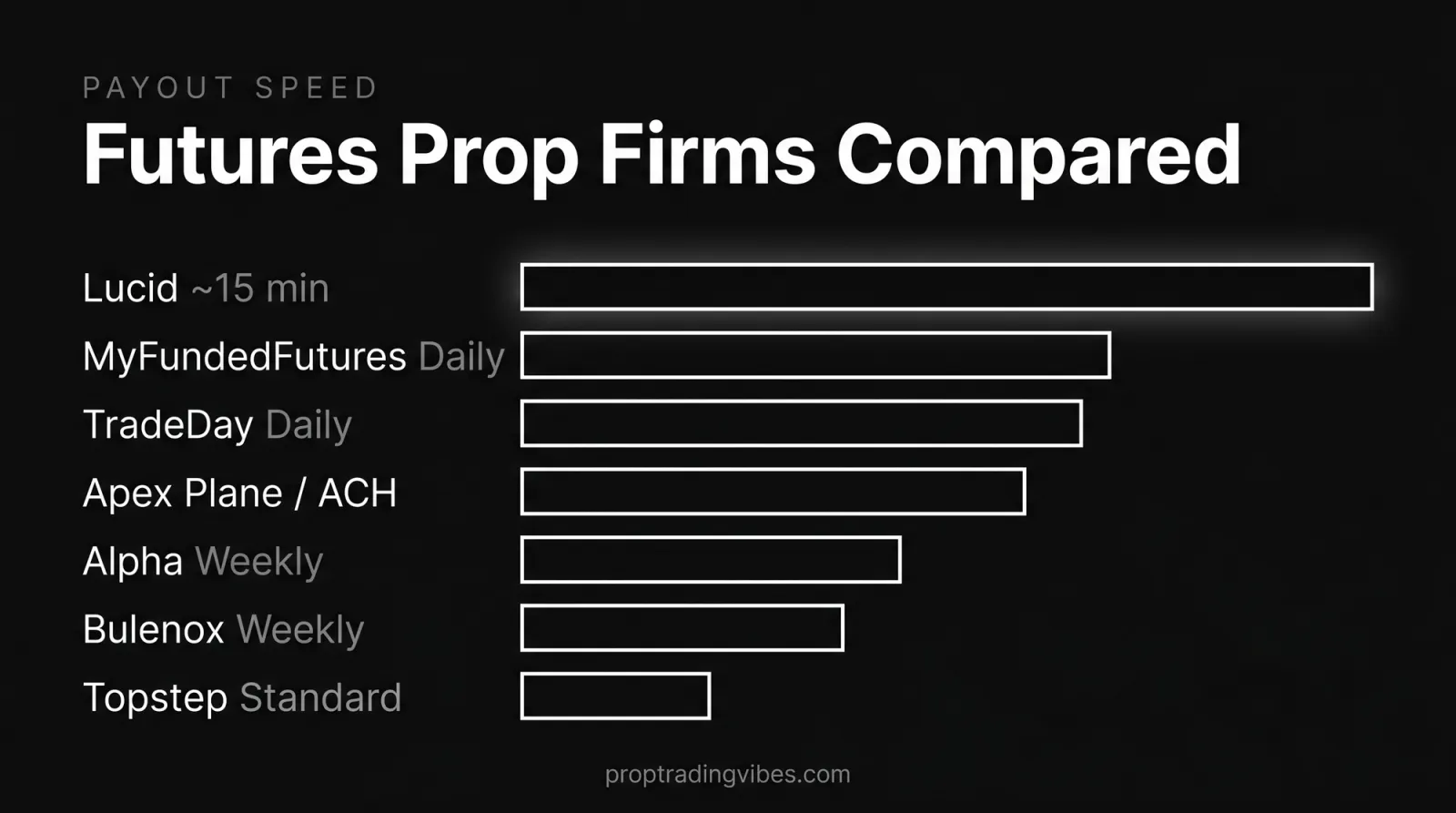
Lucid Trading is the fastest-payout futures prop firm in this ranking because it processes withdrawals in around 15 minutes on average, faster than any other firm here. As of July 2026, Lucid offers five account types, four of them purchasable (LucidPro, LucidFlex, LucidDaily, LucidDirect), from $47.40 one-time with the code VIBES, and it is the single biggest traffic and payout source among the firms Proptradingvibes has tested.
The drawdown is EOD trailing, meaning the maximum loss limit only moves up at the end-of-day close and never trails down intraday. Once it reaches your starting balance it locks there, so the trailing mechanic stops pulling the limit up further. That is what makes Lucid forgiving for traders who give back open profit during a session, though you can still breach by trading below the locked limit. The exception is LucidDaily, whose funded accounts trail intraday.
Lucid's consistency rules vary by product: LucidFlex and LucidDaily run a 50% rule in the evaluation only, LucidPro carries a consistency rule into the funded phase, and funded Flex and Daily accounts have none. LucidFlex needs five profitable days within a cycle to withdraw; Lucid's pricing page advertises three-day Pro payout cycles. Current Pro accounts use a 90/10 split; 100% on the first $10,000 applies only to accounts purchased or reset before November 28, 2025. There is also LucidDirect, a straight-to-funded instant product with no evaluation at all.
LucidDaily, added in July 2026, is the fourth purchasable type: payout requests every eligible day once funded, no funded consistency rule, and an intraday-trailing funded drawdown. The LucidDaily breakdown has the full rules.
I have pulled multiple payouts from Lucid across dozens of cycles over several years, which is why it sits at the top of this list. For the deeper read, see the Lucid Trading review.
How do Topstep and Apex compare as the futures incumbents?
Topstep and Apex Trader Funding are the two longest-running, highest-volume futures prop firms, and they appeal to different traders. Topstep is the beginner-and-platform pick; Apex is the high-volume, multi-account pick.
Topstep is the longest-running futures prop firm in this list, operating out of Chicago. It runs the Trading Combine evaluation plus its proprietary TopstepX platform, which traders consistently rate as one of the smoother prop interfaces. After Topstep's February 2026 pricing update there are two purchase paths, and both are monthly subscriptions: the Standard Path at $49, $99 or $199 per month plus a one-off $149 activation fee for each Express Funded Account you earn, and the No Activation Fee Path at $95, $149 or $229 per month with no activation fee. There is no one-time-fee route to funding. On a $50K Express Funded Account each payout request is capped at 50% of the account balance, up to $2,000 on the Standard Path or $3,000 on the Consistency Path, and the profit split is a flat 90/10 from the first dollar. The 100% on your first $10,000 arrangement is a legacy rule for accounts that were on the new Topstep dashboard before January 12, 2026. Topstep does not offer a Proptradingvibes discount code; its value is the incumbent track record, not a promo.
Apex took a different turn with its Apex 4.0 overhaul on March 1, 2026, which removed six older rules (the MAE rule, the 5:1 risk-reward rule, the one-direction rule, the seven-day minimum, monthly billing and manual payout review). Current PA accounts pay a 100% profit split on every approved payout, run an EOD-trailing drawdown by default, and carry a 50% consistency rule. Apex's defining edge is scale: up to 20 funded accounts copy-traded simultaneously, the highest in the space. The firm reports more than $700 million paid out since 2022 per its own reporting and holds a 4.2 Trustpilot rating across roughly 18,000 reviews. Apex also has no Proptradingvibes code; its promo cycles already run 80% to 90% off retail, so the value comes from buying on the right week.
For a head-to-head, the Lucid vs Apex vs Topstep comparison is the most-trafficked cross-firm page Proptradingvibes maintains.
Why FTMO Futures enters my top five at #4
FTMO Futures enters at number four, behind Lucid Trading, Apex Trader Funding and Topstep. Growth removes the Evaluation daily-loss limit and costs less; Pro adds drawdown room and larger payout caps. Both use EOD trailing drawdown, remove Sim-Funded consistency and pay 90/10 on approved requests.
The personal reason matters too. Futures are my main market, and as a German trader FTMO is materially more interesting to me now. In my own setup, bookkeeping and tax administration is substantially easier to handle with FTMO than with US firms. That is my administrative experience, not a blanket tax conclusion; residency, legal status, contract terms and professional advice still control the answer.
The ranking remains provisional because I have not traded or withdrawn from FTMO Futures. FTMO's established CFD-side record raises my confidence in the operator, but it cannot prove the Beta product's execution or payout workflow. Read the full FTMO Futures review for the Growth-versus-Pro rules and the evidence boundary.
Which futures prop firms are best for funded-account flexibility?
MyFundedFutures and TradeDay are the best futures prop firms for funded-account flexibility because both drop the consistency rule entirely once you are funded and offer fast, frequent payouts. They reward traders who pass an eval cleanly and then want to trade without an artificial daily cap.
MyFundedFutures, based in Fort Worth, Texas, runs a four-plan lineup (Rapid, Flex, Pro and Builder) plus two secondary tiers. The Rapid plan moved to a 90/10 split in January 2026 and pays daily, with intraday trailing on the sim-funded stage. Crucially, the 50% consistency rule applies on the evaluation only, with none on funded accounts, and there is no daily loss limit on any plan except Pro Live. MyFundedFutures supports seven platforms, the widest set here, including Tradovate, NinjaTrader, TradingView, Quantower and DeepChart. There is no Proptradingvibes code; the firm's own promo codes rotate frequently. I have run MyFundedFutures for three years with multiple real payouts collected, and rate it a top pick.
TradeDay’s current decision point is the funded stage. Quick Pay EOD applies only during evaluation; every Quick Pay Funded Sim account is intraday. Fast Pass remains EOD. I confirmed trading since December 2024 and three currently funded 50K accounts on August 25, 2026; that is bounded experience, not a universal result.
For the format-specific picks, see best prop firms for day trading and best prop firms for swing trading.
What is the catch with cheaper futures prop firms?
The catch with cheaper futures prop firms is the consistency rule, which can deny a payout you have legitimately earned. A low eval price means nothing if the firm blocks your withdrawal because one good day broke a ratio.
Bulenox is a useful stage-specific example. Qualification leads to Master and, after three successful Master payouts, a discretionary Funded review. Master payout requests use a 40% best-day calculation; an ineligible request waits while trading continues and is not an account violation. I have tested both options and multiple sizes, and all of my Bulenox payout requests cleared.
The lesson generalizes: model a typical winning day against the exact stage's consistency percentage before buying. Bulenox uses 40% on Master payout requests, Apex uses 50% on its payout account, and MyFundedFutures Builder uses 50% at its documented stage. Lucid and TradeDay vary by product.
How should you pick your first futures prop firm?
Pick your first futures prop firm by matching the drawdown type to your trading style first, then filter on payout speed and platform. Price is the last tiebreaker, not the first filter.
Start with the drawdown. If you scalp and give back open profit, an EOD-trailing firm like Lucid protects you from intraday wicks. If you trade the open and exit clean, a static-drawdown plan is the most predictable; note that TradeDay retired its own Static option in May 2026. Intraday trailing, like MyFundedFutures Rapid on its sim-funded stage, is fine if you bank profit and do not let trades round-trip.
Then check whether your platform is supported, since it locks at purchase on most firms. Tradovate and NinjaTrader are nearly universal; TopstepX is Topstep-only; WealthCharts is Apex; DeepChart and Quantower point you toward MyFundedFutures.
Finally, run the consistency-rule test. Picture your best realistic day as a fraction of a normal week's profit. If that fraction exceeds the firm's rule, you will eventually fight it. New traders should compare Lucid's payout record, Topstep's onboarding and FTMO Growth's softer Evaluation structure, then choose by drawdown and evidence boundary.
The bottom line
My current 2026 order is Lucid Trading first, Apex Trader Funding second, Topstep third, FTMO Futures fourth and MyFundedFutures fifth. Lucid leads on my first-hand payout evidence, Apex on scale, Topstep on incumbent onboarding, and FTMO on the combination of a serious Growth/Pro rule set with an established CFD-side operator record.
FTMO's number-four place is provisional: the Futures line is still Beta and I have not personally traded or withdrawn from it. The top-five position reflects my futures focus, operator confidence and personal administrative fit, not a tested Futures payout. Choose by your own drawdown, payout, platform and legal setup.
Frequently Asked Questions
What is a futures prop trading firm?
A futures prop trading firm gives you a simulated funded account to trade CME futures like ES, NQ, GC and CL after you pass an evaluation, then pays you a split of the profit, typically 80% to 100%. You trade the firm's capital under a drawdown limit instead of risking your own money on a live brokerage account.
Which futures prop firm pays out fastest?
Lucid Trading is the fastest-paying firm in this list at around 15 minutes. TradeDay Quick Pay pays from day one after EOD settlement, Fast Pass needs five profitable days, and Apex processes through its published rails. Bulenox processes eligible Master requests weekly on Wednesdays after at least 10 individual trading days.
Which is the best futures prop firm for beginners?
Topstep is the most beginner-friendly futures prop firm because it is the longest-running major futures prop firm and built its Trading Combine and TopstepX platform around new traders. Lucid Trading is also beginner-friendly thanks to a forgiving EOD-trailing drawdown on its core account types that locks at the starting balance.
How much does a futures prop firm evaluation cost?
TradeDay list prices currently start at $131. Code VIBES remains valid according to Paul; verify the current value at checkout.
What is the difference between EOD trailing and intraday trailing drawdown?
EOD trailing moves the loss limit at the session close, while intraday trailing follows unrealized peaks. Lucid uses EOD on core products apart from LucidDaily funded, and MyFundedFutures Rapid uses intraday trailing on its sim-funded stage. Bulenox Option 1 is real-time trailing; Option 2 uses EOD drawdown, scaling, and a daily-loss limit.
Do futures prop firms let you trade through the news?
News policies are firm- and program-specific. TradeDay and MyFundedFutures publish restrictions around tier-one events. No current public source checked on August 7, 2026 establishes a general Bulenox news-trading policy, so verify live rules before holding through a release.
What is a consistency rule and which firms have one?
A consistency rule caps one day as a share of total profit. MyFundedFutures, TradeDay, Lucid, Apex, and Bulenox apply different percentages at different stages. Bulenox uses 40% only for Master payout requests; exceeding it delays the request but is not an account violation.
How many futures prop accounts can I run at once?
Apex allows up to 20 funded accounts under its published rules. TradeDay permits up to six total accounts, with stage-specific limits. Bulenox states up to 11 active Master accounts, with three initially activatable and conditions before adding more; active Masters consolidate into one Funded account after transition.
Are futures prop firms legit?
Established futures prop firms are legitimate sim-funded businesses, though they are not brokers and traders remain in simulation until graduation. Payout eligibility still depends on the exact stage rules. For Bulenox, the 40% Master request calculation is not an account violation when missed.
Which futures prop firm has the best profit split?
Apex 4.0 offers 100% on every approved payout for current PA accounts. TradeDay reaches 90/10 in Funded Live, Lucid tops out at 90%, and Bulenox Master pays the first $10,000 without company commission before moving to 90/10.
What platforms do futures prop firms support?
Most futures prop firms support Tradovate, NinjaTrader and TradingView. Topstep is the exception and runs only its proprietary TopstepX, with a Quantower connection available for the Trading Combine and Express Funded Account. Apex offers Rithmic and WealthCharts, and MyFundedFutures supports seven platforms including Quantower and DeepChart. The platform is usually locked at account purchase.
Can I get a futures prop account with instant funding?
Yes, some futures-adjacent firms offer instant funding without an evaluation. Lucid's LucidDirect is straight-to-funded with no evaluation. Most pure-futures firms still require a one or two-step eval.

Where to go next
The most useful next decision from this page.