
Table of contents
Quick Answer, ES vs NQ, the short version
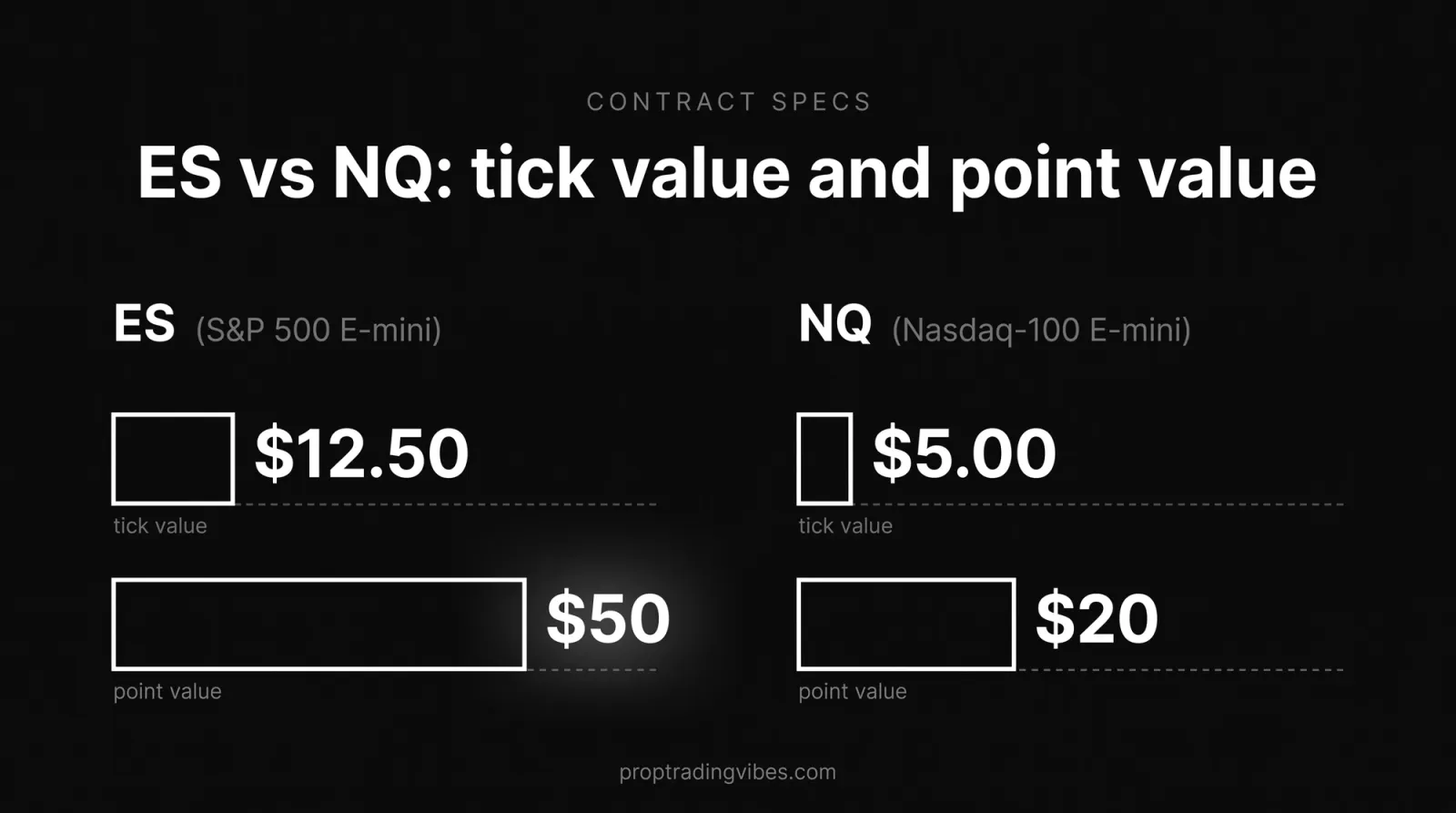
- • ES is the E-mini S&P 500 ($50 per point, $12.50 per 0.25 tick); NQ is the E-mini Nasdaq-100 ($20 per point, $5.00 per 0.25 tick).
- • NQ is more volatile and tech-heavy; ES is broader and steadier, so its daily range in points is smaller.
- • A smaller dollar-per-point does not mean NQ is cheaper to be wrong on, because NQ moves many more points per day.
- • Beginners and small accounts should start on the micros: MES (1/10 of ES) and MNQ (1/10 of NQ).
- • Pick ES for slower, structured intraday work; pick NQ if you want bigger ranges and can size down to handle them.
ES vs NQ is the choice between two CME equity-index futures: ES is the E-mini S&P 500, worth $50 per index point, and NQ is the E-mini Nasdaq-100, worth $20 per index point. ES tracks 500 large-cap US companies and tends to move steadily. NQ tracks the 100 largest non-financial Nasdaq names, leans heavily into tech, and swings through a much wider range. The smaller dollar-per-point on NQ does not make it the safer contract, because NQ covers far more points in a normal session.
Both are the most-traded index futures in the world, both trade nearly around the clock, and both have one-tenth-size micro versions (MES and MNQ). The real decision is not "which is better" but "which volatility profile fits your stop, your account, and the way you actually trade."
I trade both, and I reach for them in different conditions. Here is how they differ on the numbers, on the screen, and in the risk you take per click.
What is ES and what is NQ?
ES is the E-mini S&P 500 future, and NQ is the E-mini Nasdaq-100 future. They are the two flagship US equity-index contracts on the CME.
ES represents $50 times the S&P 500 index value. Because the S&P 500 holds 500 companies across every sector, ES behaves like a broad read on the whole US market. It is the deepest, most liquid index future by volume.
NQ represents $20 times the Nasdaq-100 index value. The Nasdaq-100 holds the 100 largest non-financial companies listed on Nasdaq, and it is concentrated in technology. That concentration is why NQ moves more: when big tech runs or breaks, the whole index goes with it.
Both expire quarterly (March, June, September, December) and roll on the same schedule, so the futures trading for beginners workflow looks identical for either contract. For a deeper primer on each, see our ES futures explained and NQ futures trading guides.
ES vs NQ: tick value and point value
ES and NQ share the same 0.25 tick size but have different dollar values per tick and per point. This single table is the most important thing to memorize before trading either one.
| Contract | Index tracked | Tick size | Tick value | Point value (multiplier) |
|---|---|---|---|---|
| ES (E-mini S&P 500) | S&P 500 | 0.25 | $12.50 | $50 |
| NQ (E-mini Nasdaq-100) | Nasdaq-100 | 0.25 | $5.00 | $20 |
| MES (Micro E-mini S&P) | S&P 500 | 0.25 | $1.25 | $5 |
| MNQ (Micro E-mini Nasdaq) | Nasdaq-100 | 0.25 | $0.50 | $2 |
Source: CME Group contract specifications, 2026. Both full contracts move in 0.25 increments; micros are exactly one-tenth of the full size.
A few things fall straight out of this table. One ES tick is worth two and a half times one NQ tick. A 10-point move is $500 on ES and $200 on NQ. And the micros let you trade the exact same index for a tenth of the dollar exposure, which is why most people learn on MES and MNQ first. Our micro futures trading guide covers the micros in full.
Is ES or NQ more volatile?
NQ is the more volatile of the two. The Nasdaq-100 is concentrated in high-beta technology names, so it moves through a wider daily point range than the broader, more balanced S&P 500.
This is the part that trips people up. NQ has the smaller tick value ($5 vs $12.50), which makes it feel cheaper to be wrong on. But NQ routinely travels several times the point distance of ES in the same session. A day where ES covers 40 points might see NQ cover 200 or more. Multiply those ranges by their point values and the dollar swing on NQ is frequently the larger of the two.
Why the dollar move matters more than the tick
A trader who sizes ES and NQ identically by contract count is not taking identical risk. They are taking much more risk on NQ, because NQ's range is bigger.
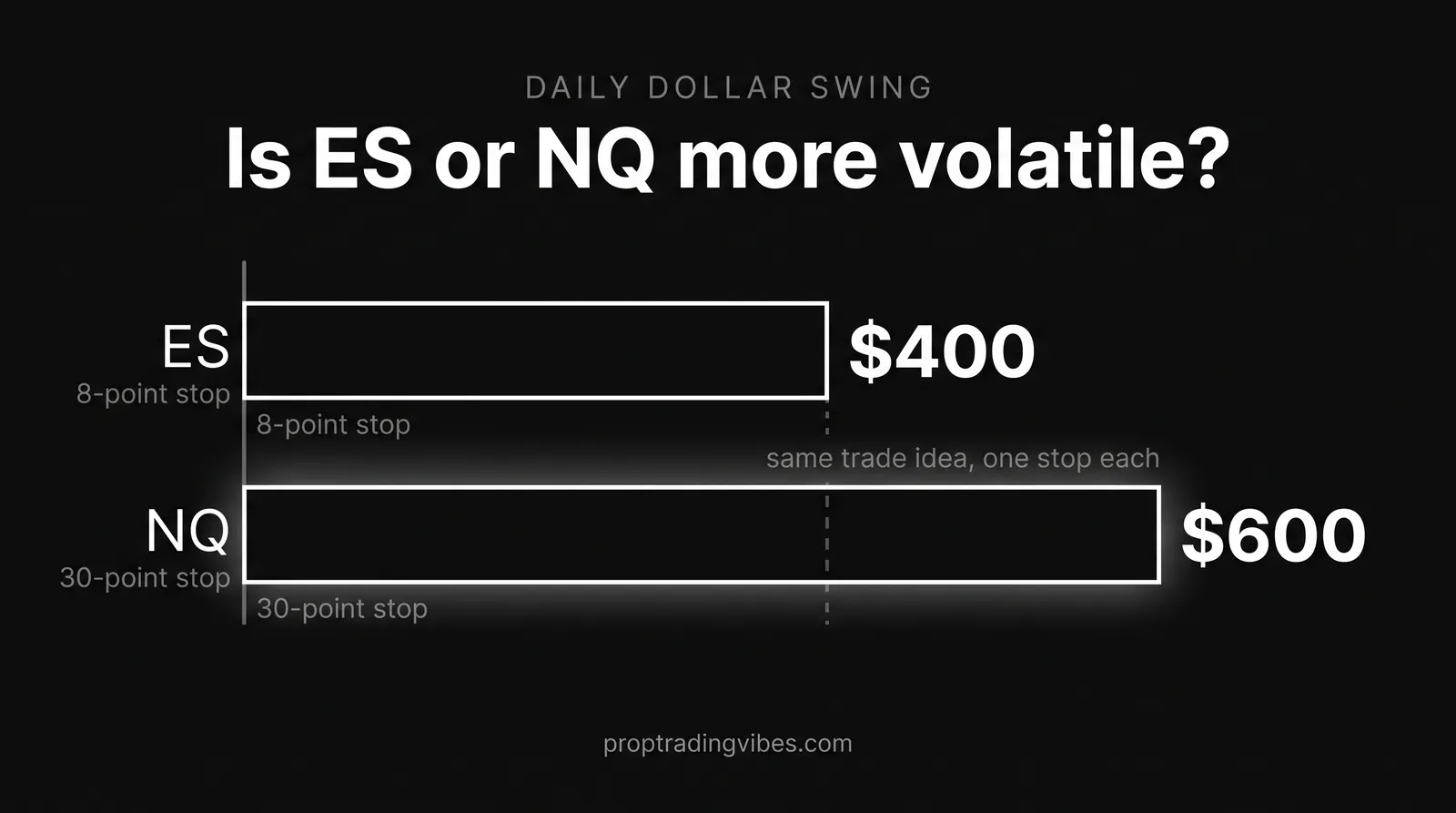
The right way to compare them is in dollars per typical move, not in tick value. If your stop on ES is 8 points, that is $400 (8 × $50). An equivalent structural stop on NQ might be 30 points, which is $600 (30 × $20). Same trade idea, larger dollar risk on NQ, purely because the index moves more.
This is also why NQ pairs so well with the micros. Trading one MNQ instead of one NQ keeps the bigger range inside a small account. The same logic shows up when you compare across instruments in our best futures contracts to trade breakdown and when you pick the right indicators for futures trading to read these ranges.
ES vs NQ margin and account requirements
Margin on ES and NQ is set by the exchange and your broker, changes with volatility, and should be checked live before every session. As of mid-2026 the structure is straightforward: NQ usually carries higher margin than ES at any given moment because it is more volatile, but exact numbers move around.
Three points matter for an evaluation or funded account:
- Day-trade margin is lower than overnight (initial) margin. Most prop traders only ever use intraday margin and flatten before the close.
- Prop firms apply their own contract limits on top of broker margin. A firm's sim account caps how many ES or NQ contracts you can hold, independent of CME margin. See our futures contract specifications reference for the underlying numbers.
- Micros need far less margin. MES and MNQ require roughly one-tenth of the full-size requirement, which is what makes them realistic for small accounts.
If margin is your constraint, that is usually a signal to drop to the micros rather than to force the full-size contract on too little capital.
When I reach for ES vs NQ
I trade both ES and NQ, and the choice comes down to what the session is offering and how tight my risk has to be.
When I want structure, a slower tape, and a stop that sits comfortably inside a trailing drawdown, I reach for ES. The smaller daily point range means my stop in points translates into a predictable, contained dollar number. ES rarely surprises me with a 50-point candle out of nowhere.
When the market is trending hard and I want range to work with, I reach for NQ, but I cut size to match. That almost always means trading MNQ instead of NQ, or trading a single NQ where I would have taken two or three ES. The volatility that makes NQ attractive is the same volatility that ends evaluations when traders size it like ES.
The difference changes my stops directly. On ES I think in single-digit-to-low-teens points. On NQ I have to give the trade room, often two to four times the points, or I get stopped out by normal noise. Wider stop, smaller size, same dollar risk. That translation is the whole game.
My one rule for choosing
Pick the contract whose worst realistic day still fits inside your account's max loss. If a normal NQ swing would blow your drawdown at the size you want to trade, that is not a reason to white-knuckle it. It is a reason to trade MNQ, or to trade ES instead.
ES vs NQ: which should you trade?
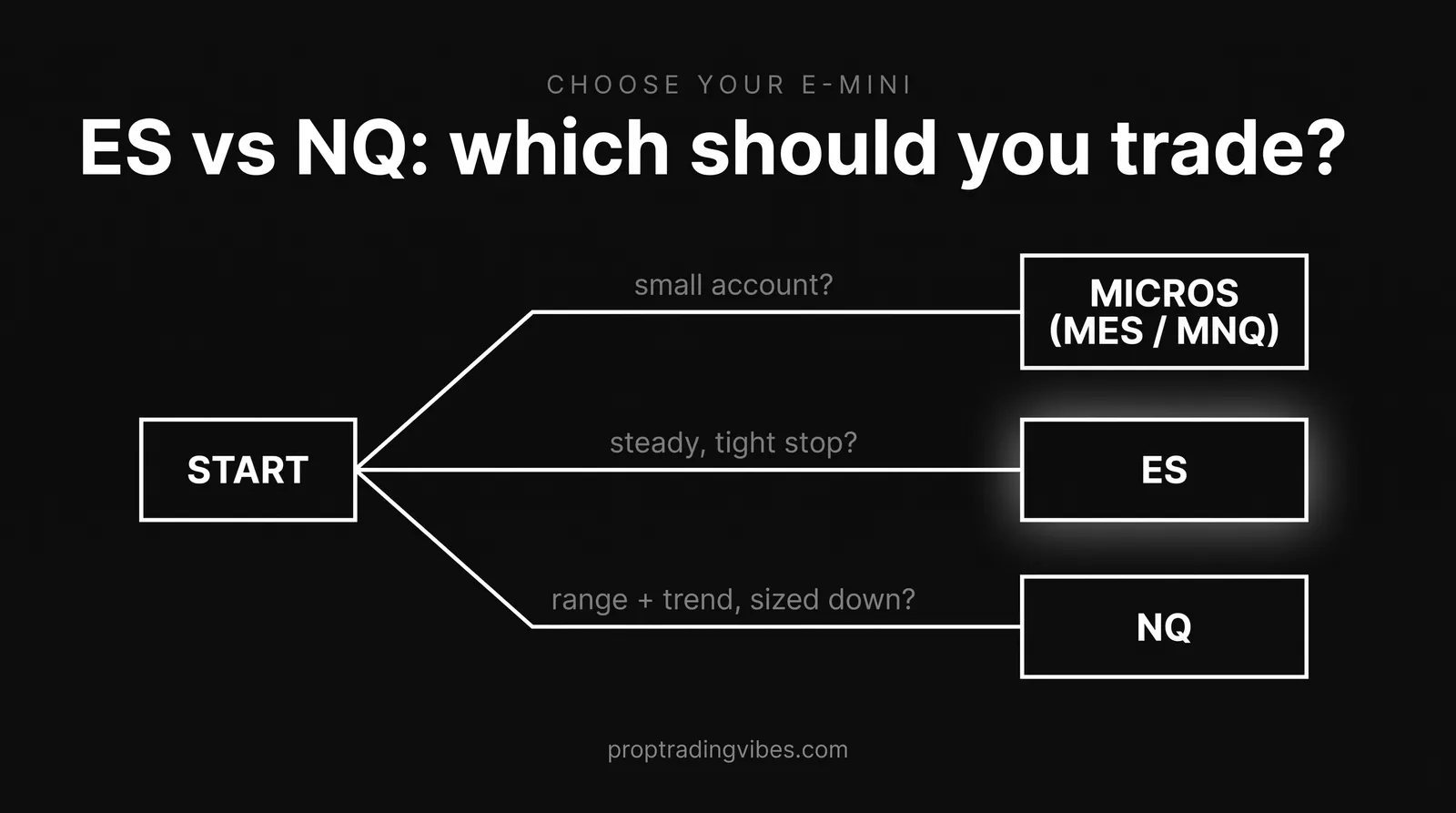
The right contract depends on your style, your account size, and how much daily range you can stomach. Here is the quick decision framework.
| Trader profile | Better fit | Why |
|---|---|---|
| New trader / small account | MES or MNQ | One-tenth the dollar risk; learn the index before scaling up |
| Wants steady, structured intraday | ES | Smaller point range, tighter stops, deepest liquidity |
| Wants big range and trends | NQ (sized down) | More points to capture, but must shrink size to survive |
| Tight trailing drawdown | ES | Contained daily range keeps the stop inside the limit |
| Scalping a few ticks | ES | $12.50/tick rewards small moves more per contract |
If you are choosing a firm to trade either contract through, the best prop firm for beginners guide and our step-by-step futures starter will help you match the account to the instrument. Most futures-focused firms support both ES and NQ plus their micros.
The bottom line
ES vs NQ comes down to volatility versus dollar-per-point. ES (E-mini S&P 500) is $50 per point with a $12.50 tick and a smaller daily range, which makes it the steadier, more forgiving choice for structured intraday trading and tight trailing drawdowns. NQ (E-mini Nasdaq-100) is $20 per point with a $5 tick but moves through far more points per day, so its dollar swings are often larger despite the smaller tick.
ES is right for traders who want a contained range, reliable fills, and predictable stop dollars. NQ is right for traders who want range and trend and are disciplined enough to size down, usually to MNQ, to handle it. If you are new or short on capital, skip the debate and start on the micros: MES and MNQ track the same indexes at one-tenth the risk while you learn which personality fits you.
Frequently Asked Questions
What is the difference between ES and NQ futures?
ES is the E-mini S&P 500 future and NQ is the E-mini Nasdaq-100 future. ES tracks 500 large-cap US companies and moves $50 per index point. NQ tracks the 100 largest non-financial Nasdaq companies, is heavily weighted toward tech, and moves $20 per index point. NQ is the more volatile of the two.
Is ES or NQ more volatile?
NQ is more volatile than ES. The Nasdaq-100 is concentrated in high-beta tech names, so it tends to swing through a wider daily point range than the broader S&P 500. ES has a higher dollar-per-point ($50 vs $20), but NQ usually covers enough extra points to make its dollar range per day larger.
What is the tick value of ES vs NQ?
ES has a minimum tick of 0.25 index points worth $12.50 per contract. NQ has the same 0.25 tick size but each tick is worth $5.00 per contract. So one ES tick is $12.50 and one NQ tick is $5.00.
What is the point value of ES and NQ?
One full index point is worth $50 on ES (the $50 contract multiplier) and $20 on NQ (the $20 contract multiplier). Both contracts move in 0.25-point increments, which is why an ES tick is $12.50 and an NQ tick is $5.00.
Should a beginner trade ES or NQ?
Most beginners should start on the micro versions rather than the full ES or NQ. MES is one-tenth of ES and MNQ is one-tenth of NQ, so a wrong trade costs a fraction as much while you learn. Between the two full contracts, ES tends to be more forgiving because it moves through fewer points per day.
What are MES and MNQ?
MES (Micro E-mini S&P 500) and MNQ (Micro E-mini Nasdaq-100) are the micro versions of ES and NQ, each one-tenth the size. MES is $5 per point with a $1.25 tick; MNQ is $2 per point with a $0.50 tick. They track the same index and trade nearly the same hours, so they let small accounts size precisely.
Does NQ have higher margin than ES?
Margins are set by the exchange and your broker and change with volatility, so check live numbers before you trade. As a rule, NQ often carries higher day-trade margin than ES at a given time because it is more volatile. Prop-firm sim accounts apply their own buying-power and contract limits on top of broker margin.
Can I trade ES and NQ at the same time?
Yes, many traders watch both ES and NQ because they often move together, but NQ leads on risk-on days and lags hardest on tech-driven selloffs. Trading both at once doubles your exposure to a single macro move, so size each leg as if it could go against you simultaneously.
Which has tighter spreads, ES or NQ?
ES and NQ are both highly liquid and usually trade one tick wide during regular hours. ES is typically the deepest equity-index contract by volume, so fills are very reliable. NQ is also liquid but can widen faster during fast tech-driven moves.
Why does NQ feel riskier than ES if the tick is smaller?
NQ's tick is smaller in dollars ($5 vs $12.50), but NQ travels through many more points in a typical session. A normal NQ swing can be several times the point distance of an ES swing, so the total dollar move per trade is often larger even though each individual tick is worth less.
Do ES and NQ trade the same hours?
Yes, both ES and NQ trade nearly 24 hours a day, Sunday evening through Friday afternoon US Central time, with a short daily maintenance halt. Liquidity is deepest during the US cash session, which is when most intraday traders focus their activity on either contract.
Which contract should I trade for a prop firm evaluation?
Pick the contract whose daily range fits the firm's drawdown and your stop. ES suits traders who want a smaller point range and steadier behavior inside a tight trailing drawdown. NQ suits traders who can size down (often to micros) to keep its larger swings inside the same limit. The right answer is the one that keeps your worst day inside the account's max loss.