
Table of contents
Quick Answer — Futures contract rollover in 5 bullets
- • Rollover means closing your position in the expiring contract and reopening it in the next one, so you don't get caught at expiry.
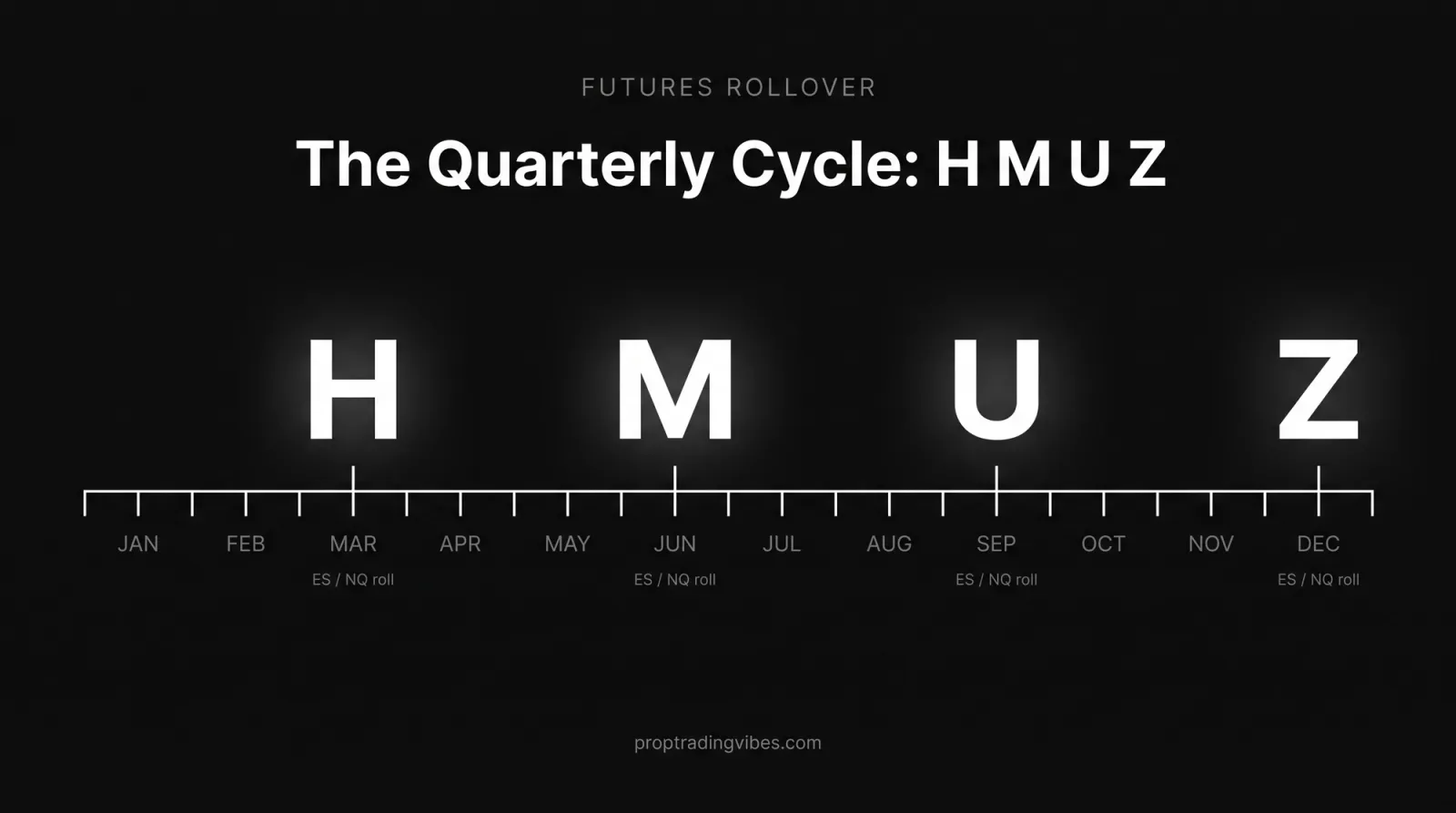
- • Equity index futures (ES, NQ) roll on a quarterly cycle coded H=March, M=June, U=September, Z=December.
- • Volume migrates to the next contract roughly the Thursday before the second Friday of the expiry month, about 8 days before expiry.
- • You roll to avoid expiry and settlement, and to follow liquidity into the new front-month where spreads are tightest.
- • On prop-firm sim accounts the data feed switches contracts automatically, but your open position usually does not, you still close and reopen yourself.
Futures contract rollover is the process of moving an open position out of the expiring front-month contract and into the next contract in the cycle, so you avoid expiry and stay in the contract that carries the most liquidity. You close the position in the contract about to expire and reopen the same exposure in the new one. For equity index futures like the E-mini S&P 500 (ES) and Nasdaq-100 (NQ), this happens four times a year on a quarterly cycle.
If you trade ES or NQ, the roll matters every quarter, and September is one of the big ones. Miss it and your chart "gaps" overnight, your fills get worse, or your platform quietly switches contracts under you. None of that is a market move. It's the roll.
What does futures contract rollover mean?
Rollover means closing your position in the expiring contract and reopening it in the next one. The futures contract you trade has an expiry date. As that date approaches, the trading world moves on to the next contract in the cycle, and you move with it.
Two things drive the roll. First, you avoid expiry and settlement: an equity index future cash-settles against a reference price at expiry, which is not where most active traders want to be. Second, you follow liquidity. Once volume migrates to the next contract, the expiring one gets thin and spreads widen, so staying put means worse fills.
The position doesn't physically "move." You close the old contract and open the new one. That's the whole mechanic, the rest is timing.
What is the quarterly futures cycle (H, M, U, Z)?
For equity index futures, the active contracts expire quarterly, coded by single letters: H = March, M = June, U = September, Z = December. Those four months carry the liquidity for ES and NQ.
| Code | Month | Example symbol |
|---|---|---|
| H | March | ESH26 |
| M | June | ESM26 |
| U | September | ESU26 |
| Z | December | ESZ26 |
So ESU26 is the September 2026 E-mini S&P 500, and ESZ26 is the December 2026 contract. When the September contract expires, the world rolls to December (the Z contract). The two-digit suffix is the year.
Not every futures market uses this cycle. Crude oil rolls monthly, and agricultural contracts follow seasonal months. The H/M/U/Z quarterly cycle is specific to the equity index futures most prop traders use, so check the contract specifications for anything else you trade. If you're newer to the symbols and tick sizes, our guide on es futures explained and the futures contract specifications breakdown cover the basics.
When is the futures roll window?
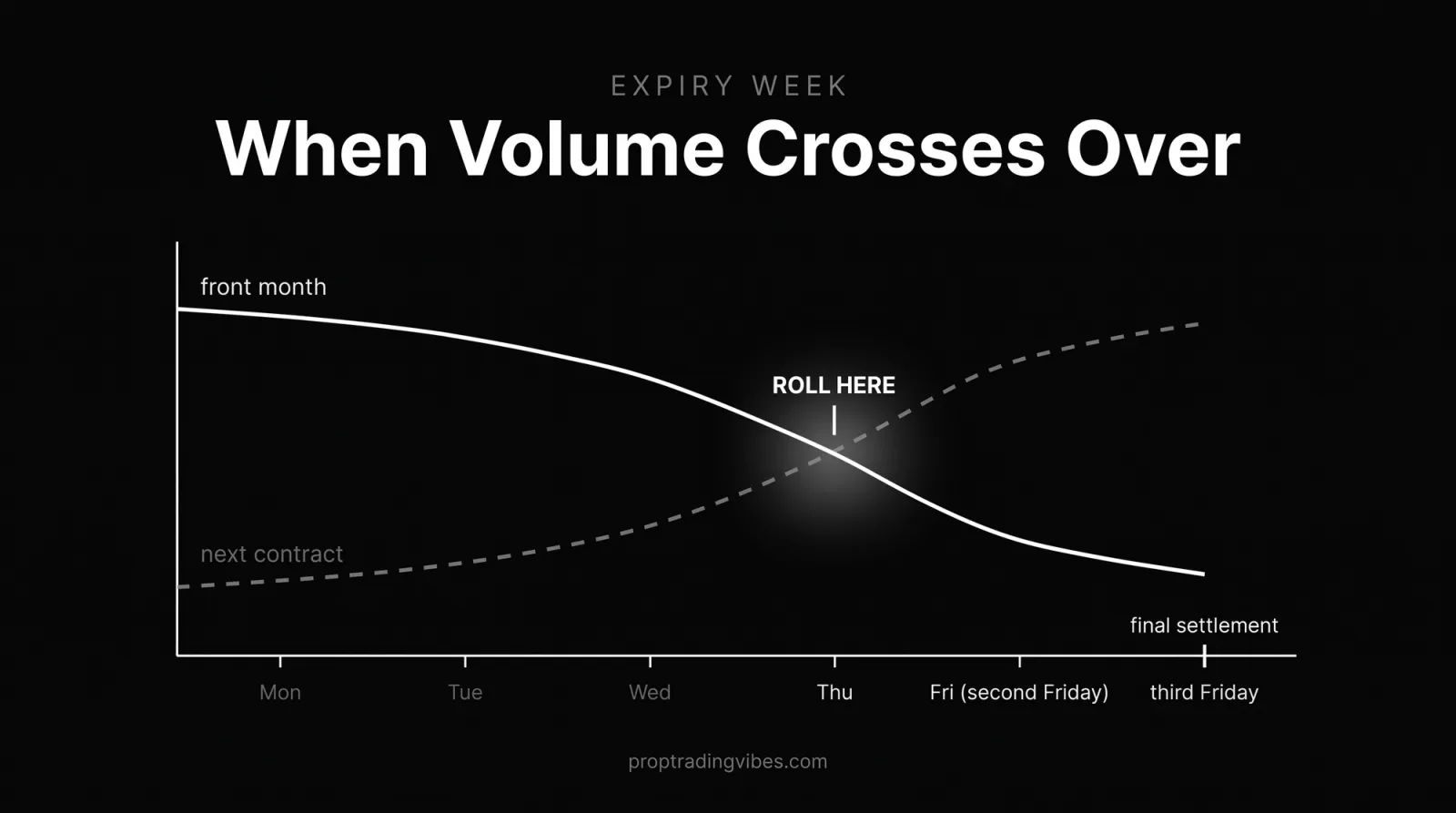
The roll window runs in roughly the eight days before expiry. For equity index futures, volume and open interest start migrating from the front-month to the next contract around the Thursday before the second Friday of the expiry month, and the contract makes its final settlement on the third Friday.
That Thursday-before-the-second-Friday point matters because it's when most active traders shift. CME Group designates a Roll Date for the index futures a few business days ahead of expiry, and in practice the liquidity crossover happens around that window. Before the crossover, the front-month has more volume. After it, the next contract does.
Here's the simple read: when daily volume in the next contract overtakes the front-month, the roll has effectively happened, and you want to be in the new contract.
How do you know volume has migrated?
Watch the daily volume and open interest on both contracts. Most platforms let you pull up the front-month and the next contract side by side. When the next contract's volume crosses above the front-month's, the market has rolled. That's your cue, not the calendar date alone.
Some traders use open interest as the confirming signal, since open interest builds in the new contract as positions are rolled forward. When open interest in the next contract surpasses the front-month, the migration is mature.
Why do you roll instead of holding to expiry?
You roll for two reasons: to avoid expiry and settlement, and to follow liquidity into the contract where fills are best.
On expiry, an equity index future cash-settles. You don't take delivery of anything, but you also lose control of your exit, your position is closed at a reference settlement price rather than where you choose. For an active trader, that's a loss of control you don't want.
The liquidity reason is the one you feel daily. Once volume leaves the expiring contract, the order book thins, the bid-ask spread widens, and slippage on entries and exits gets worse. Rolling keeps you in the deep, tight market. For day traders watching futures market hours and trading the open, a thin contract is a real cost on every fill.
How do you roll a futures position?
There are two ways to roll: close-and-reopen, or a calendar spread.
Close-and-reopen is the straightforward method. You flatten your position in the expiring contract, then open the same position in the next contract as a separate order. Simple, works on every platform, but you carry the risk that price moves between the two fills.
Calendar spread (roll spread) is the cleaner method. It's a single order that simultaneously sells one contract month and buys the other, so both legs fill together at a defined spread price. You close the old and open the new in one transaction, removing the slippage risk between legs. Most futures platforms support a spread order type for exactly this.
| Method | How it works | Best for |
|---|---|---|
| Close-and-reopen | Two separate orders: flatten old, open new | Small size, simple platforms |
| Calendar spread | One order, both legs fill together | Larger positions, minimizing slippage |
If you're just starting out, close-and-reopen during liquid hours is perfectly fine. Our futures trading for beginners walkthrough and the step-by-step beginner guide cover order types if any of this is new.
What about the chart gap on roll day?
The front-month and next contract trade at slightly different prices, so a raw roll creates a visible gap on the chart. That gap is not a market move, it's the price difference between two contracts. Most platforms offer a continuous or back-adjusted contract that stitches the series so your historical levels line up. Trade the live front-month for execution, but use the continuous series for longer-term technical levels.
How rollover works on a prop-firm sim account
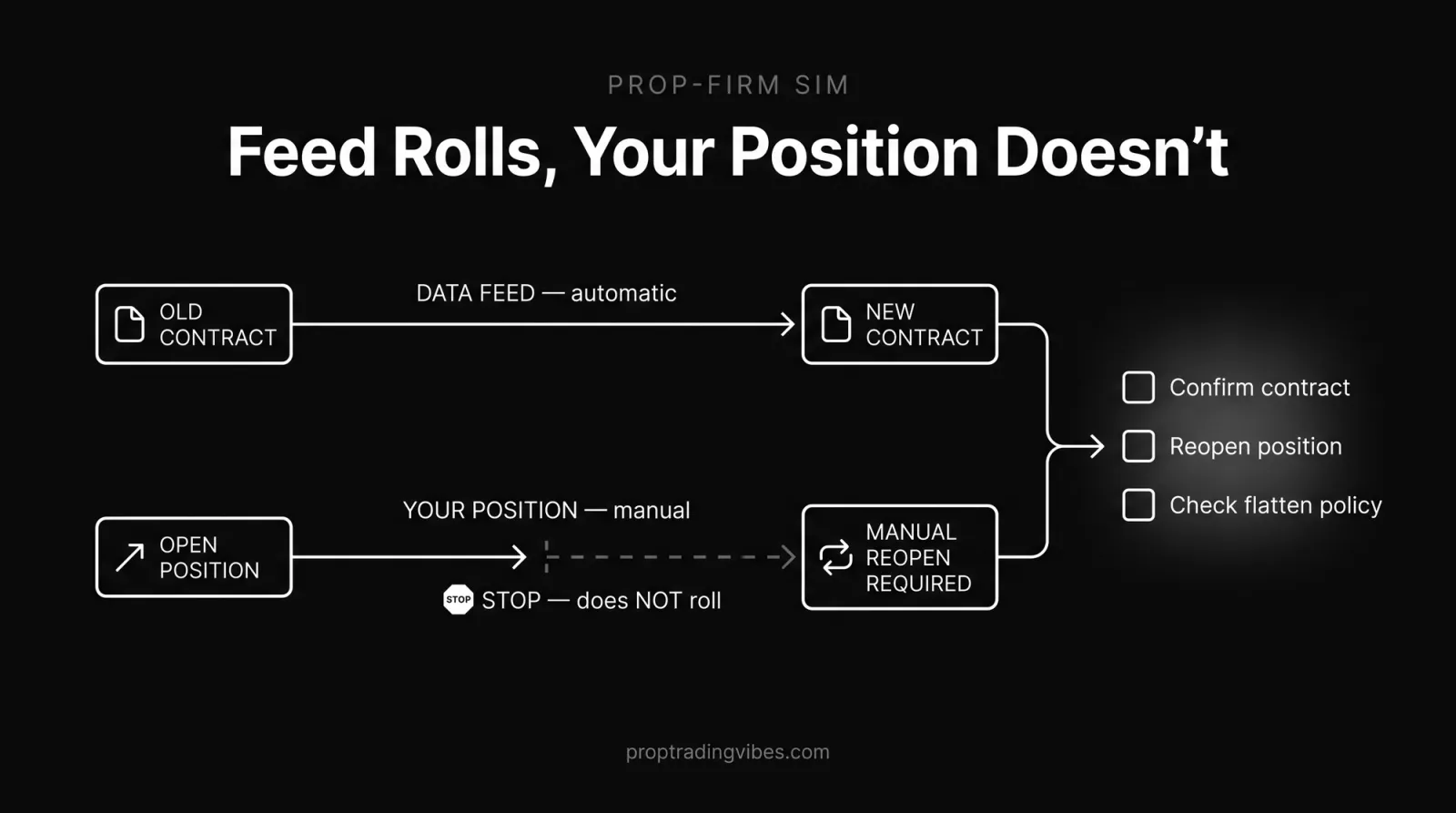
On most prop-firm sim accounts, the platform switches its data feed to the new front-month contract automatically around the roll date, so your charts jump to the next contract. Your open position usually does not move with it. You still close the expiring contract and reopen in the new one yourself.
This is the part I see catch funded traders during evaluations. I'll be running a position into roll week, the chart switches to the December contract, and the position is still sitting in September. The platform didn't roll my trade, it rolled my view. Two different things.
A few things I check every roll week on any sim account:
- Whether the firm flattens open positions before expiry (some do, some don't).
- Which contract my working orders are attached to, because resting orders on the old contract won't trigger once everyone moves to the new one.
- That my charts and my position are on the same contract before I size up again.
Most prop firms run on the same standard CME data, so the roll behaves the same whether you're on a Lucid Trading, Alpha Futures, or Topstep sim. The mechanic doesn't change, only your firm's flatten policy might. When you're picking where to get funded, our best prop firm for beginners and best futures contracts to trade guides help you match the firm and the instrument.
The bottom line
Futures contract rollover is moving your position from the expiring front-month into the next quarterly contract, coded H (March), M (June), U (September), Z (December) for equity index futures. You roll to avoid expiry and to follow liquidity, and the window opens around the Thursday before the second Friday, roughly eight days before expiry. Roll with a calendar spread if you want clean fills, or close-and-reopen if you keep it simple.
This matters most for two groups. If you swing-trade ES or NQ across days, you have to roll deliberately, or you'll get caught in a thin contract or cash-settled at expiry. If you trade a prop-firm sim account, remember the platform switches your chart but usually not your position, so close and reopen yourself and check your firm's flatten policy. If you only scalp the front-month intraday and flatten every session, the roll barely touches you, just make sure you're trading the contract with the volume once the quarterly crossover happens.
Frequently Asked Questions
What is futures contract rollover?
Futures contract rollover is the process of moving an open position out of the expiring front-month contract and into the next contract in the cycle. You close the position in the contract that is about to expire and reopen the same exposure in the new contract. Traders roll to avoid expiry and settlement, and to stay in the contract carrying the most liquidity.
What are the quarterly futures month codes H, M, U, and Z?
For equity index futures, the four quarterly contract months use single-letter codes: H is March, M is June, U is September, and Z is December. So ESZ26 is the December 2026 E-mini S&P 500 contract. These four months carry the active liquidity for ES and NQ, which is why they define the roll cycle.
When is the futures roll window?
The roll window for equity index futures runs in the roughly eight days before expiry. Volume and open interest start migrating from the front-month to the next contract around the Thursday before the second Friday of the expiry month, and most active traders have rolled by the official Roll Date a few business days before final settlement on the third Friday.
Why do you roll futures contracts instead of holding to expiry?
You roll to avoid expiry and settlement, and to follow liquidity. Holding an equity index future to expiry triggers cash settlement against the Special Opening Quotation, which is not what most active traders want. More practically, once volume migrates to the next contract, the expiring one gets thin, spreads widen, and fills get worse. Rolling keeps you in the liquid contract.
How do you actually roll a futures position?
There are two common ways to roll. The simple method is close-and-reopen: you flatten your position in the expiring contract and open the same position in the next contract as two separate orders. The cleaner method is a calendar spread (roll spread), a single order that simultaneously closes the old contract and opens the new one, locking in the price difference and reducing slippage between the two legs.
Does rollover cause a gap on the chart?
Yes, the front-month and next contract almost always trade at slightly different prices, so a raw rollover creates a visible gap or jump on the chart on roll day. Most platforms offer a continuous or back-adjusted contract that stitches the series together so historical levels line up. Trade the actual front-month for execution, but use the continuous series for longer-term technical analysis.
What happens to my prop-firm sim account at rollover?
On most prop-firm sim accounts the platform switches its data feed to the new front-month contract automatically around the roll date, so your charts move to the next contract. Your open position usually does not move with it. You typically still need to close the old contract and reopen in the new one yourself. Always check whether your firm flattens positions before expiry.
What is the difference between the front-month and the next contract?
The front-month is the nearest-to-expiry contract that currently carries the most volume and the tightest spreads, and it is the one most active traders trade. The next contract is the following quarterly expiry. During the roll window, liquidity shifts from the front-month to the next contract, and once that migration completes, the next contract becomes the new front-month.
Do all futures contracts roll on the quarterly H/M/U/Z cycle?
No. The quarterly H/M/U/Z cycle applies to equity index futures like the E-mini S&P 500 and Nasdaq-100. Other markets have different cycles: crude oil rolls monthly, and agricultural contracts follow their own seasonal months. Always check the contract specifications for the specific product you trade, because the roll timing differs by market.
Will rollover close my position automatically?
Not by default on most retail and sim platforms. The data feed switches to the new contract, but an open position in the expiring contract stays open until you close it or until the contract reaches its last trading day. If you do nothing, an equity index future will go to cash settlement at expiry. Roll deliberately rather than relying on the platform to do it for you.
Can I trade through the roll window or should I be flat?
You can trade through the roll window, but be aware that liquidity is split across two contracts during that period, so the expiring contract thins out as the next one builds volume. Many active traders simply switch to trading the new front-month once volume crosses over, around the Thursday before the second Friday. If you hold swing positions, plan the roll rather than getting caught in the thin contract.
What is a calendar spread roll?
A calendar spread roll is a single order that buys one contract month and sells another simultaneously, so you close your expiring position and open the new one in one transaction. It is the cleaner way to roll because both legs fill together at a defined spread price, removing the slippage risk you get when closing and reopening as two separate market orders.
How far before expiry should I roll?
Most active equity index traders roll when volume migrates, roughly the Thursday before the second Friday of the expiry month, which is about eight days before the third-Friday expiry. Rolling at the volume crossover means you move into the contract where fills are best. Waiting until the last day before expiry leaves you in a thinning contract with worse spreads.