
Table of contents
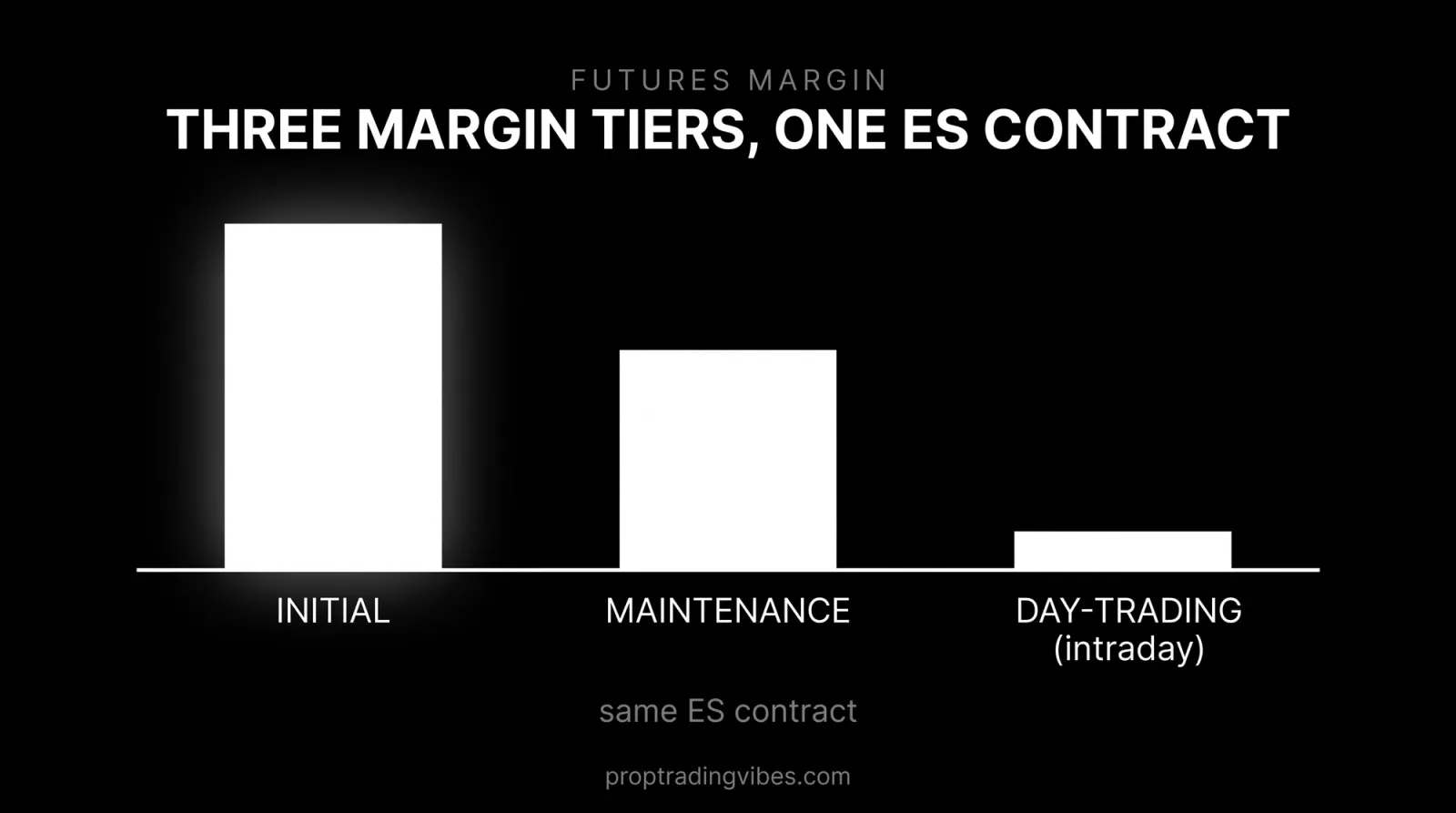
Quick Answer, Futures margin requirements, the short version
- • Initial margin is what you post to open a futures position; maintenance margin is the lower floor your account must stay above before a margin call (the exchange sets both per contract)
- • Day-trading (intraday) margin is set by your broker and is far lower than exchange margin, often a few hundred dollars per contract, but only while the position is open during the session
- • The CME calculates exchange margin with SPAN (a risk model that sizes margin to cover roughly 99% of expected one-day moves), so figures change with volatility and are not fixed
- • Micro contracts (MES, MNQ) need about one-tenth the margin of their full-size cousins (ES, NQ) because they are one-tenth the contract size
- • Prop-firm buying power is a firm risk rule, not a real margin requirement, you are not posting your own capital against a live exchange position
Futures margin requirements are the amount of money you must hold in your account to open and keep a futures position. Margin in futures is not a loan. It is a good-faith performance bond, a deposit that guarantees you can cover your losses as they settle every day. For US index futures, the exchange that sets these requirements is the CME, and it quotes two numbers per contract: initial margin to open, and maintenance margin as the floor you must stay above.
That single distinction, performance bond versus loan, is where most stock traders trip up when they move to futures. You are not borrowing capital and paying interest. You are posting collateral against daily settlement. Get that right and the rest of the margin picture falls into place fast.
What is futures margin, really?
Futures margin is collateral, not purchase price. When you buy a stock on margin, you borrow money and pay interest. When you post futures margin, you deposit a small slice of the contract's notional value as a guarantee, and you pay nothing to hold it. The CME settles gains and losses to your account every day, and the margin is what proves you can keep covering them.
That is why the numbers look so small relative to the contract. One E-mini S&P 500 (ES) contract controls a notional value worth far more than the few thousand dollars of margin you post against it. The gap is leverage, and it cuts both ways.
If you are still learning how a contract is built before you size one, the futures contract specifications guide breaks down tick size, multiplier and notional value, and futures trading for beginners walks the whole mechanic from the start.
What is the difference between initial and maintenance margin?
Initial margin is what you post to open a position. Maintenance margin is the lower amount your account must stay above to keep it open. The exchange sets both, per contract, and maintenance always sits below initial so that ordinary price swings do not trigger a call the moment you enter.
The relationship is the durable fact here, not any single dollar figure:
| Term | What it is | Set by | When it bites |
|---|---|---|---|
| Initial margin | Deposit to open a position | Exchange (CME, via SPAN) | At entry, and again if you fall below maintenance |
| Maintenance margin | Floor your equity must stay above | Exchange (CME, via SPAN) | When losses pull equity under it, triggering a margin call |
| Day-trading margin | Reduced intraday deposit | Your broker | Only while the position is open during the session |
When equity drops below maintenance, you get a margin call: add funds back up to the initial level, or the broker liquidates. There is no negotiation in a fast market. The position closes.
How does day-trading (intraday) margin work?
Day-trading margin is a reduced deposit your broker lets you post to trade a contract while the session is open, on the condition that you close before settlement. It is set by the broker, not the exchange, and it is often a fraction of the overnight number, sometimes a few hundred dollars per contract on liquid products like ES and NQ.
The logic is risk-window length. A position you flatten before the daily close never faces an overnight gap, where price can jump while liquidity is thin. Less risk to the broker, less margin required.
Two catches come with that low intraday number:
- The broker can force-liquidate you as the session cutoff approaches if you are still open.
- Any position held past the cutoff snaps back to the full exchange initial margin instantly. If your account cannot cover it, you get liquidated into the close.
Low day-trading margin feels like buying power. It is really leverage handed to you for the length of a session, which is the next section.
What is SPAN margin?
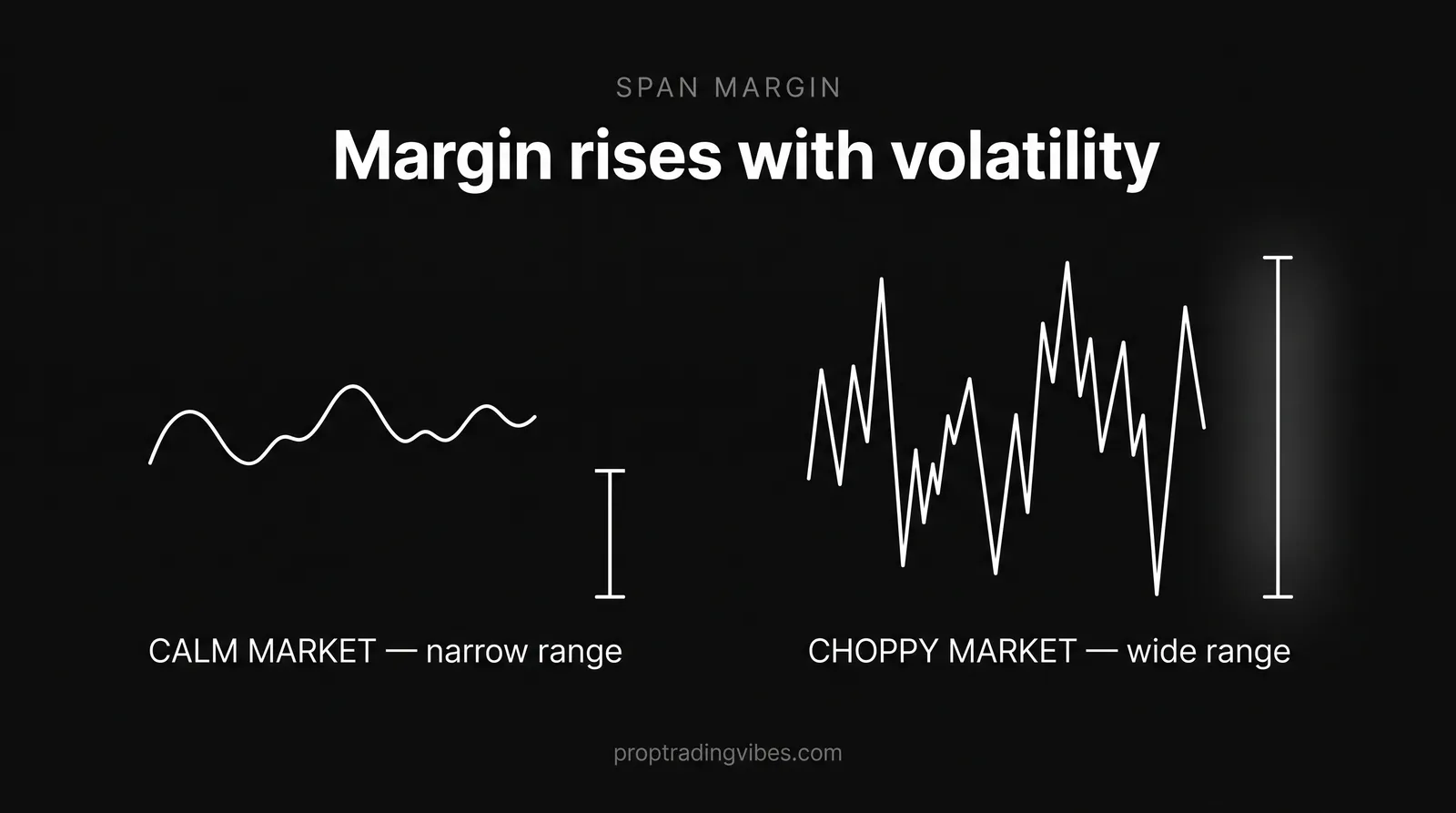
SPAN, the Standard Portfolio Analysis of Risk, is the model the CME uses to set exchange margin. Instead of a flat percentage, SPAN simulates how a position would lose value across a grid of price and volatility scenarios, then sets margin to cover roughly 99% of expected one-day moves. The output is a per-contract margin that reflects current risk, not a fixed rate.
Because SPAN is volatility-driven, exchange margins move:
- They rise when expected daily ranges widen, so choppy markets cost more to hold.
- They fall when volatility settles.
- Exchanges raise them ahead of known risk events.
This is the single most important reason to never memorize a margin figure. The CME's own margins page carries the live number, and it can be different next week. Treat any dollar amount in any article, including this one, as a snapshot of structure, not a permanent value. (Representative figures below are illustrative and unverified at time of reading, always confirm on CME.)
How do margins differ for full-size vs micro contracts?
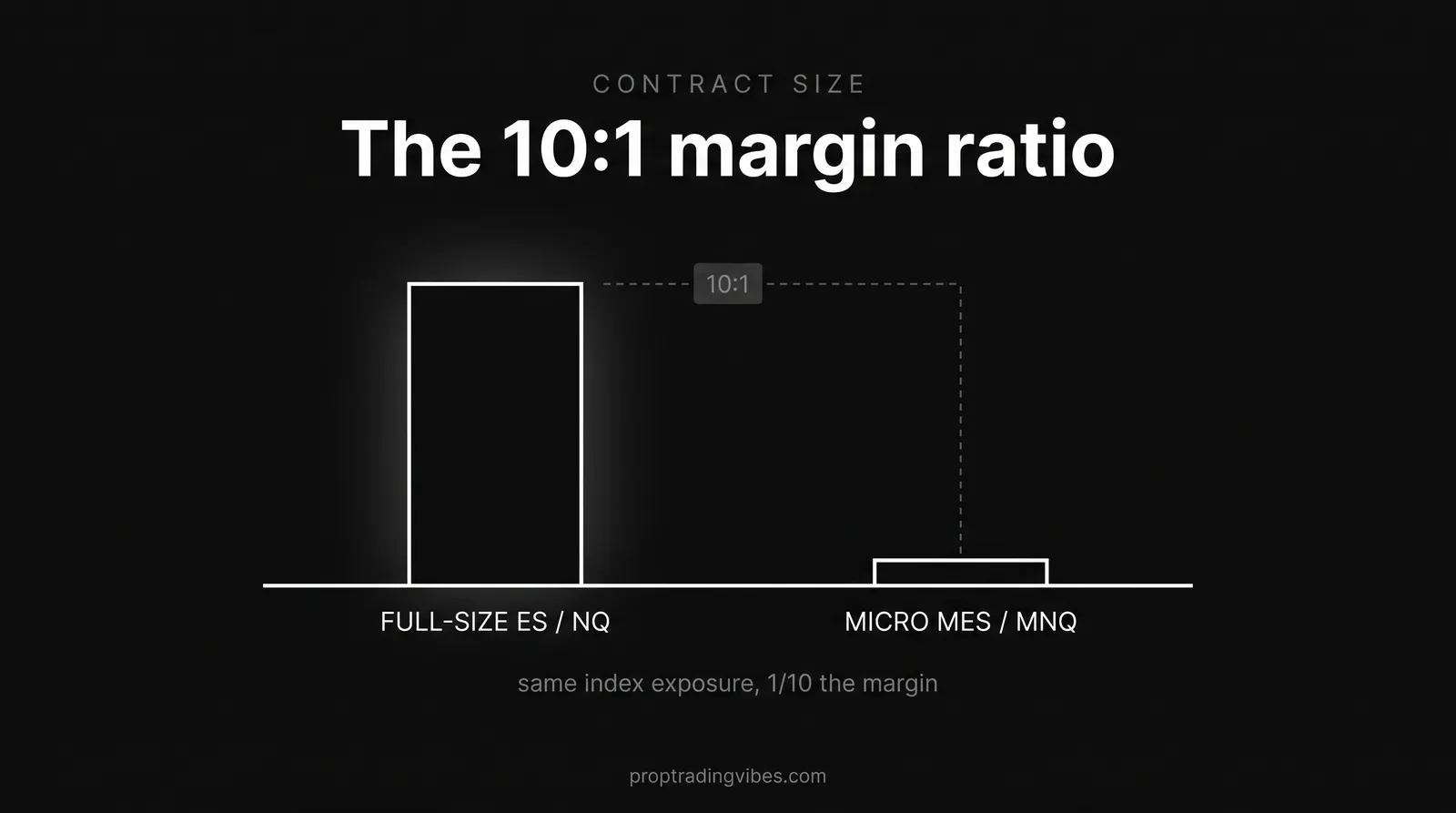
A micro contract needs roughly one-tenth the margin of its full-size cousin, because it is one-tenth the contract size. The Micro E-mini S&P 500 (MES) is a tenth of ES; the Micro E-mini Nasdaq-100 (MNQ) is a tenth of NQ. Both the exchange margin and the broker's day-trading margin scale down in the same proportion.
| Contract | Relationship | Effect on margin |
|---|---|---|
| ES (E-mini S&P 500) | Full size | Highest per-contract margin of the pair |
| MES (Micro E-mini S&P 500) | 1/10 of ES | ~1/10 the margin |
| NQ (E-mini Nasdaq-100) | Full size | Highest per-contract margin of the pair |
| MNQ (Micro E-mini Nasdaq-100) | 1/10 of NQ | ~1/10 the margin |
That ten-to-one ratio is why micros are the standard way to size down. You take the same index exposure at a tenth of the margin and a tenth of the dollar-per-point risk. For the full breakdown of each product, see ES futures explained, NQ futures trading, and the dedicated micro futures trading guide. If you are still choosing what to trade, best futures contracts to trade ranks them by liquidity and accessibility.
As a representative, unverified snapshot (confirm live on CME before relying on any of these): exchange overnight margin on ES sits in the low five figures per contract, MES around a tenth of that, with NQ higher than ES and MNQ a tenth of NQ. Intraday day-trading margins set by brokers run far lower, sometimes a few hundred dollars per full-size contract. The exact numbers change with volatility.
How is prop-firm buying power different from real broker margin?
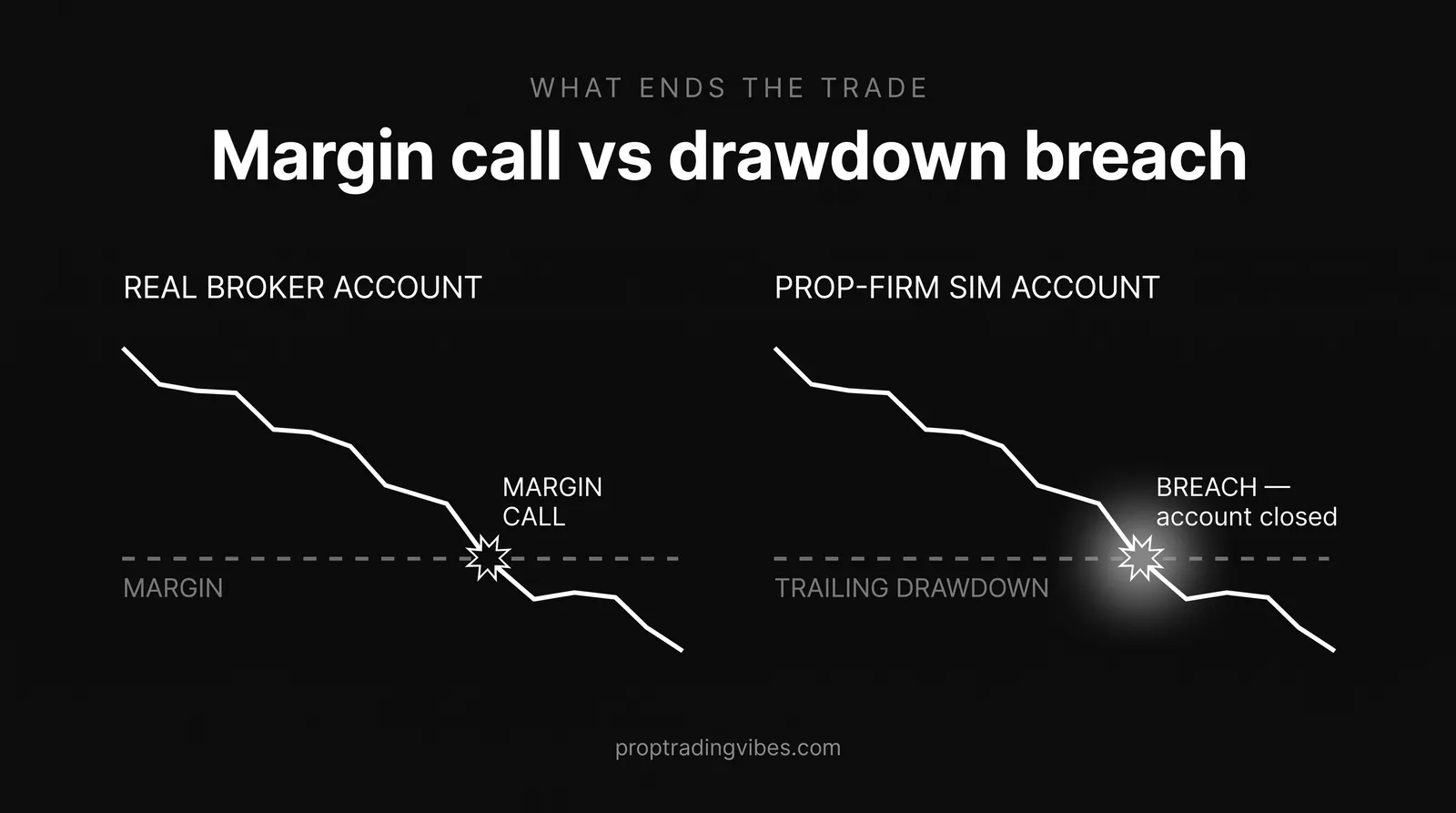
Prop-firm buying power is a risk rule the firm sets, not an exchange margin requirement. On a futures prop account you trade a simulated account with firm-defined contract limits and a drawdown threshold. You are not posting your own capital against a live CME position, so there is no margin call from a broker, only the firm's own rules deciding when the account ends.
The practical differences:
- What limits you. On a real brokerage account, exchange margin and your broker's day-trading margin decide your maximum size. On a prop account, the firm's contract limit per tier decides it.
- What ends the trade. On a real account, falling below maintenance margin triggers a call. On a prop account, hitting the drawdown threshold ends the account.
- Whose money is at risk. On a real account, your posted margin. On a prop account, the firm's simulated capital and your evaluation fee.
Same SPAN-shaped products, different governing rule. This matters when you size positions: a prop firm might let you trade more contracts than your account size would justify on a real broker, or fewer, because the cap is a risk decision, not a margin calculation.
This is also why a margin table tells you nothing about how many contracts a prop firm will let you run. That is set by the firm. Apex Trader Funding publishes explicit contract limits per account, and other firms structure it differently. If you are weighing futures against other products entirely, futures vs options from a prop trader's perspective covers the trade-offs.
A few firms worth knowing when you are comparing how buying power and scaling actually work in practice: Lucid Trading runs EOD-trailing drawdown with fast payouts (code VIBES), Tradeify's instant and evaluation accounts show two different risk-rule structures side by side. None of those is margin in the exchange sense. All of them are the firm's risk parameters.
Why margin is leverage, and how to size around it
Margin and leverage are the same number read two ways. The smaller the margin relative to the contract's notional value, the more leverage you carry and the faster your account moves on every tick. Day-trading margin gives you very high leverage intraday, which is exactly why a small adverse move can clear the posted margin in seconds.
A simple discipline that has saved me more accounts than any indicator: size off the contract's dollar-per-point risk and your stop, never off how many contracts the margin lets you hold. The margin is the floor the exchange or firm requires. It is not the position size you should take. Those are different questions, and conflating them is how leverage quietly ends accounts.
If you want a deeper read on how leverage interacts with funded-account drawdown specifically, FundingPips' dynamic leverage, on the CFD side rather than in futures, is a useful example of a firm stepping leverage down as position size grows: since 16 March 2026 it applies tiered leverage to metals, indices and energies on funded Master Accounts, a change it labels temporary.
The bottom line
Futures margin is a performance bond, not a loan: initial margin to open, maintenance margin as the floor, both set per contract by the CME through SPAN and both moving with volatility. Day-trading margin is your broker's much lower intraday number, real leverage for the length of a session and nothing more. Micros need about a tenth of the full-size margin for the same index exposure. And prop-firm buying power is a firm risk rule, not exchange margin at all, governed by contract limits and a drawdown threshold instead of a margin call.
If you trade a real brokerage account, the CME margins pages are your source of truth and they change often, so check them live. If you trade a funded account, ignore the margin table for sizing and read the firm's contract-limit and drawdown rules instead. Either way, the discipline is the same: size off your stop and your risk per point, never off the maximum the margin happens to allow.
Frequently Asked Questions
What are futures margin requirements?
Futures margin requirements are the amount of money you must have in your account to open and hold a futures contract. Unlike stock margin, futures margin is not a loan, it is a good-faith performance bond that guarantees you can cover daily losses. The exchange (for US index futures, the CME) sets initial margin to open and maintenance margin as the floor you must stay above, and both are quoted per contract.
What is the difference between initial and maintenance margin in futures?
Initial margin is the amount you must post to open a futures position. Maintenance margin is the lower amount your account must stay above to keep that position open. When your balance falls below maintenance margin, you get a margin call and must add funds back up to the initial level or your broker liquidates the position. Maintenance is always set below initial margin so normal price swings do not trigger a call instantly.
What is day-trading margin in futures?
Day-trading margin (also called intraday margin) is a reduced margin your broker lets you post to trade a futures contract while the session is open, as long as you close before the daily settlement. It is set by the broker, not the exchange, and is often a small fraction of the exchange's overnight margin, sometimes a few hundred dollars per contract on liquid products like ES or NQ. If you hold past the cutoff, the full exchange initial margin applies.
Why is day-trading margin so much lower than overnight margin?
Day-trading margin is lower because the risk window is shorter. A position you close before settlement never faces an overnight gap, where price can jump while the market is thin or closed. Brokers absorb less risk on intraday positions, so they require far less margin. The trade-off is that the broker can force-liquidate you near the session close, and any position held past the cutoff snaps back to the full exchange initial margin.
What is SPAN margin?
SPAN (Standard Portfolio Analysis of Risk) is the risk model the CME uses to set exchange margin. Rather than a flat percentage, SPAN simulates how a portfolio would lose value across a range of price and volatility scenarios, then sets margin to cover roughly 99% of expected one-day moves. Because it is volatility-driven, SPAN margins rise when markets get choppy and fall when they calm down, which is why exchange margin figures are never fixed.
How much margin do I need to trade one ES contract?
For the E-mini S&P 500 (ES), the CME publishes initial and maintenance margin per contract on its margins page, and the numbers move with volatility, so always check the live figure. As a structural rule, exchange initial margin on ES runs into the low five figures per contract for overnight positions, while a broker's intraday day-trading margin on ES can be a few hundred dollars per contract. The exact current values are on the CME E-mini S&P 500 margins page.
How much margin does a micro futures contract (MES, MNQ) need?
A micro contract needs roughly one-tenth the margin of its full-size version, because it is one-tenth the notional size. The Micro E-mini S&P 500 (MES) is one-tenth of ES, and the Micro E-mini Nasdaq-100 (MNQ) is one-tenth of NQ, so both their exchange margin and their broker day-trading margin scale down accordingly. Micros are the standard way to take a smaller, lower-margin position on the same index.
Is futures margin a loan like stock margin?
No. Stock margin is money you borrow from your broker to buy shares, and you pay interest on it. Futures margin is a good-faith deposit, a performance bond, that guarantees you can cover losses as they are settled daily. You do not borrow anything and you pay no margin interest. This is why futures margin is a small fraction of the contract's notional value rather than a down payment on a loan.
What happens if I fall below maintenance margin?
If your account equity drops below the maintenance margin for your open futures position, your broker issues a margin call. You must deposit funds to bring the account back up to the initial margin level. If you do not, or if the move is fast, the broker can liquidate your position automatically to protect itself. Holding a position with no buffer above maintenance margin is the most common way traders get force-closed at the worst moment.
Do futures margin requirements change?
Yes, frequently. Because the CME sets exchange margin with SPAN, a volatility-based model, margins rise when expected daily moves get larger and fall when markets settle. Exchanges also raise margins ahead of known risk events. On top of that, your broker can set its own day-trading margins higher or lower and change them with little notice. Treat any specific dollar figure as a snapshot, not a permanent number.
How is prop-firm buying power different from broker margin?
Prop-firm buying power is a firm risk rule, not a real exchange margin requirement. At a futures prop firm you trade a simulated account with firm-defined contract limits and a drawdown threshold, you are not posting your own capital against a live CME position. The firm decides how many contracts you can trade and how much loss ends the account. So while the same SPAN logic shapes the products, what limits you on a prop account is the firm's risk parameters, not a margin call from a broker.
How many contracts can I trade on a prop-firm account?
The number is set by the prop firm's account rules, not by exchange margin. Each firm caps contract size per account tier, and many scale your maximum contracts up as your account grows or after you clear a payout. Because you are trading a simulated account, the limit is a risk control the firm chose, not the margin a real broker would require. Always check the specific firm's contract-limit table for your account size.
Why do exchange margins differ from what my broker charges?
The exchange (CME) sets the minimum margin via SPAN, but your broker can require more, and for intraday trades it usually allows much less through day-trading margin. Brokers also apply their own buffers, and some apply higher margins to retail accounts. So the figure on the CME margins page is the exchange floor for overnight positions, while your actual posted margin depends on your broker, your account, and whether you hold past settlement.
Does higher margin mean lower leverage?
Yes. Margin and leverage are two sides of the same number. The smaller the margin you post relative to the contract's full notional value, the more leverage you carry, and the faster both profits and losses move your account. Day-trading margin gives you very high leverage intraday, which is exactly why a small adverse move can wipe out the posted margin quickly. Treat low day-trading margin as a risk multiplier, not free size.

Where to go next
The most useful next decision from this page.