

 TESTED BY PAUL
 Lucid Trading
Lucid Trading Review 2026: Rules, Payouts & Real Results
Save 50%Affiliate link. It never changes my rating or verdict.

Ratings & Reviews
One-time evaluation fees, no monthly subscriptions
Proof tour
Paul’s own tested journey: checkout to payout.
What I like / could be better
- One-time evaluation fees across all plans, no monthly subscriptions eating into your bankroll while you trade
- LucidFlex has zero daily loss limit AND zero funded consistency rule, the most forgiving combination in futures prop trading
- Payout processing averages under 15 minutes, with US Plaid ACH arriving same-day (I've never waited more than 4 hours)
- LucidPro's 1-day pass evaluation and 3-day payout cycles give aggressive traders the fastest path to consistent withdrawals
- Four distinct funding paths (Flex, Pro, Direct, Maxx) mean every trading style has a purpose-built account type
- The February 2026 Live overhaul eliminated the confusing escrow system and replaced it with a clean $0 start plus one-time bonus
- LucidLive profit split drops to 90/10 from 90/10 on sim-funded, which is below competitors like Tradeify (90/10) and MyFundedFutures (90/10)
- Payout caps on LucidFlex are lower than competitors ($1,500-$4,000 per cycle vs uncapped at some firms), limiting short-term income potential
- Founded in 2025, making Lucid the youngest firm in the competitive landscape (Topstep has operated since 2012)
- No overnight or weekend holds on any sim-funded account, only LucidLive allows swing trading positions
- LucidMaxx is invite-only with no public pricing or qualification criteria, leaving proven traders guessing about eligibility
My experience
Lucid Trading launched in 2025 and grew faster than any futures prop firm I've seen. I've traded with them across LucidFlex, LucidPro, LucidBlack (now discontinued), and LucidDirect. 30 payout cycles completed across my accounts.
February 2026 changed the firm. LucidBlack got merged into an upgraded LucidPro. LucidLive got rebuilt from scratch with the escrow system ripped out entirely. A new invite-only LucidMaxx tier appeared for proven traders. If you read an older version of this review, forget most of it. The firm today is different.
Passing Evaluations and Getting Funded
I started with Lucid on a 50K LucidFlex account. One evaluation step, EOD trailing drawdown, no daily loss limit. Passed it on day 4 trading NQ during the US morning session. The process from payment to funded account took less than a week.
Since then I've passed 17+ evaluations across different account types. Not all of them survived. I breached a few LucidPro accounts early on by getting sloppy with the daily loss limit during FOMC releases. That's the thing about Lucid's different tiers: Flex forgives mistakes that Pro punishes.
The evaluation process itself is straightforward. Pick your account size, hit the profit target, respect the drawdown, and you're funded. No minimum trading days on LucidPro (1-day pass). LucidFlex and LucidDirect need profitable trading days, but there's no calendar-based minimum wait anymore on Direct after the February update removed the 8-day requirement.
The February 2026 Overhaul
February was massive for Lucid. Three big changes happened at once.
LucidBlack got discontinued. If you had a Black account, you could still reset through March 6, 2026, but after that it's gone. The good news: everything good about Black (3-day payout cycles, fast evaluations) got folded into the upgraded LucidPro.
LucidPro got a real upgrade. New pricing dropped across the board ($185 for 50K, down from before). The annoying 5 profitable days requirement got removed. You only need 5 payouts to reach LucidLive now instead of 6. DLLs were added, and the 100% first $10K bonus carried over from Black. If you traded Black and liked it, Pro is now the same thing but cheaper.
LucidLive got rebuilt from zero. The old system had a $30K starting balance, escrow vesting over 60 days, a "Make 5, Take 5" structure, and a Safety Net. All of that is gone. Today LucidLive starts at $0 balance with a one-time bonus ($1K-$4.5K depending on account size), daily payouts, EOD drawdown, and a 90/10 profit split (updated from 80/20 in March 2026). The escrow was the biggest complaint traders had about Lucid. Now it doesn't exist.
Where I Am Now
I'm running two active LucidFlex 50K accounts and one LucidPro 50K. The Flex accounts are my steady earners. I trade them conservatively, take a payout every cycle, and they just keep producing. The Pro account is more aggressive, taking advantage of the 3-day cycles and the 100% first $10K structure.
I made the jump to LucidLive after the March 2026 update moved the split to 90/10, matching sim-funded. On sim-funded accounts I keep 90% (Flex) or 100% of my first $10K (Pro). LucidLive's real capital is appealing, but the economics don't make sense until I'm consistently pulling larger numbers.
Total across all firms, I have a documented payout record spanning 15+ firms since 2021. Lucid accounts for 30 of those cycles, and the count is climbing. My rating for Lucid is 4.9/5, upgraded from 4.87 because the February Live changes addressed the single biggest complaint I had about the firm.
Account Types & Pricing
The Four Current Programs (Flex, Pro, Direct, Maxx)
Lucid offers four distinct funding paths. LucidBlack is discontinued as of February 2026 (merged into LucidPro). Here's how each one works.
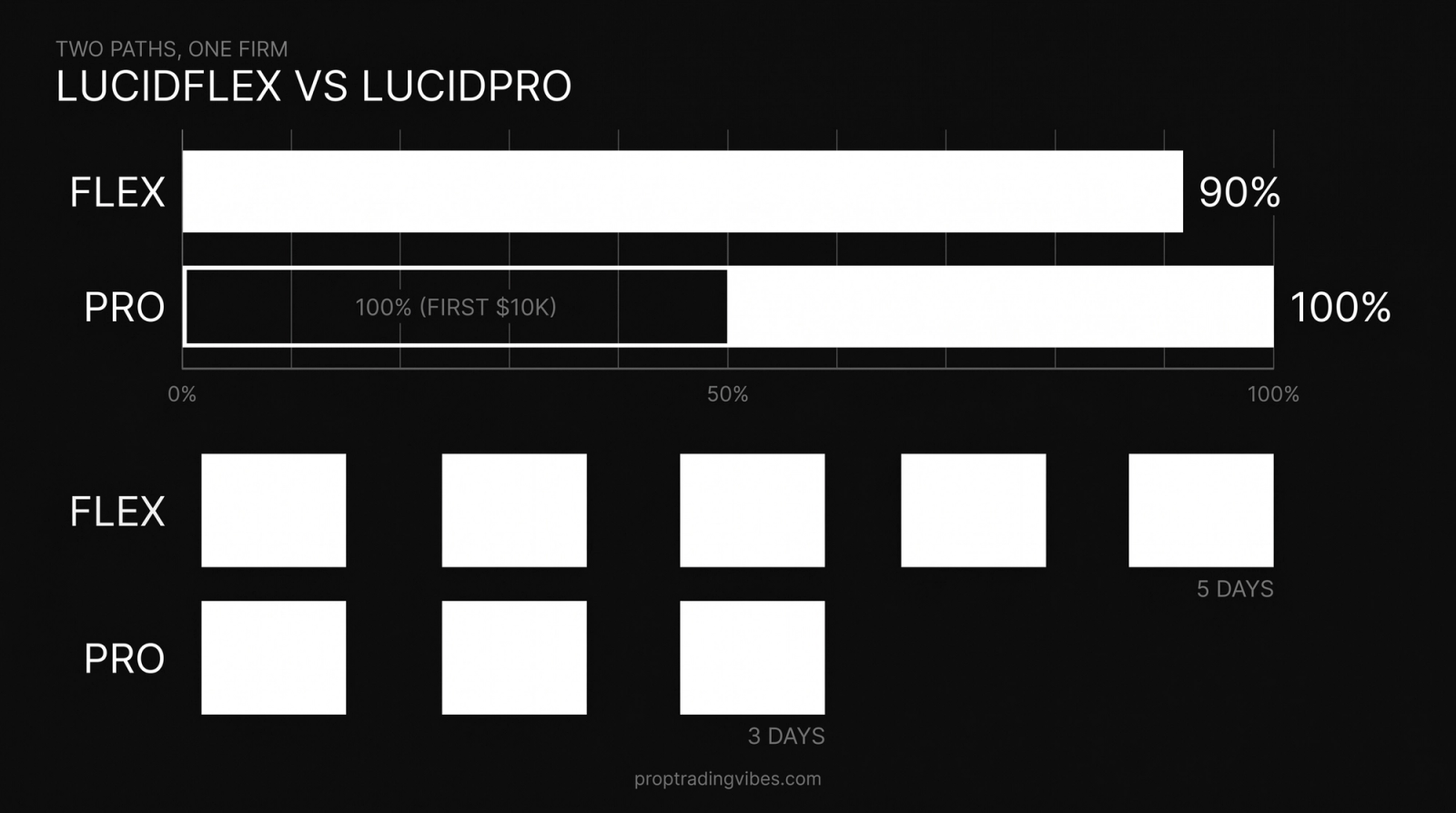
LucidFlex is the forgiving option. No daily loss limit. No funded consistency rule. 5 profitable days per payout cycle. 90/10 profit split. EOD trailing drawdown. Most traders should start here. The rules give you room to breathe, and the one-time fee means you're not bleeding money while you learn the structure.
LucidPro is the aggressive option. 1-day pass evaluation (yes, you can get funded in a single trading day). 3-day payout cycles. DLL active. Per-cycle consistency rule. 90/10 from day one (accounts before Nov 28, 2025 received 100% on first $10K, grandfathered only). 5 payouts to reach LucidLive. This is for traders who already know their edge and want the fastest possible withdrawal cadence.
LucidDirect skips the sim-funded phase entirely. You pass the evaluation and go straight to a live-funded account. 20% consistency rule. 90/10 from day one (pre-Nov 28, 2025 accounts: 100% first $10K, now grandfathered). DLL with soft breach levels. The February update removed the old 8-day minimum trading requirement and added a new 100K account size.
LucidMaxx is the newest tier, launched February 2026. Daily payouts. No caps. No DLL. EOD drawdown. Up to 5 accounts. Instant live capital with no sim phase. The catch: it's invite-only for proven PayoutMaxx traders. No public pricing, no application form. You get in when Lucid decides you've earned it.
Full Pricing Table (All Sizes, All Types)
Fee structure: Every account type uses one-time fees. No monthly subscriptions. Pay once, trade until you pass or breach. Topstep charges $49-$109/month. TakeProfitTrader charges $170/month for a 50K. Tradeify charges $139/month. If you need 3 months to pass an evaluation at Topstep, you've paid $147-$327. At Lucid you paid $185 once (or $92.50 with VIBES).
Activation fees: $0 across all account types. TakeProfitTrader charges $130 activation. Topstep charges $0-$149 depending on the plan.
Why I Trade the 50K LucidFlex (and Sometimes Pro)
The 50K is the sweet spot. The drawdown at $2,000 gives enough room to trade NQ and ES with reasonable position sizes without constantly worrying about a single bad candle killing your account. Smaller accounts (25K with $1,500 drawdown) are too tight for NQ in my experience. Larger accounts (100K, 150K) are more expensive and the drawdown doesn't scale proportionally enough to justify the extra cost for most traders.
I keep LucidFlex as my primary because no DLL and no funded consistency rule mean I can trade my way. Bad day? Walk away. Three losses in a row? Still fine, no daily limit to breach. I only switch to Pro when I want to stack fast payouts using the 3-day cycle and the first $10K bonus.
Trading rules you need to know
What Gets Your Account Killed
Exceeding the Maximum Loss Limit (MLL). Your account equity drops below the MLL and it's over. Instant breach. On a 50K account, the MLL starts $2,000 below your starting balance. This is an EOD trailing drawdown, so it only updates at market close, not intraday. Huge difference from firms like TakeProfitTrader that use intraday trailing.
Hitting the Daily Loss Limit (DLL) on Pro and Direct. LucidFlex has no DLL. That's a feature. LucidPro and LucidDirect have daily loss limits that act as a soft breach on Direct (account pauses, doesn't terminate) and a hard limit on Pro. On a 25K LucidDirect, the DLL soft breach levels are $600, $1,200, $1,800, and $2,700.
Trading restricted instruments. Stick to the approved futures contracts. Lucid publishes the list on their help center.
Holding through market close on sim-funded accounts. All positions must be flat before the session closes. No overnight holds. No weekend holds. Only LucidLive allows open positions across sessions.
The Rules That Actually Help You
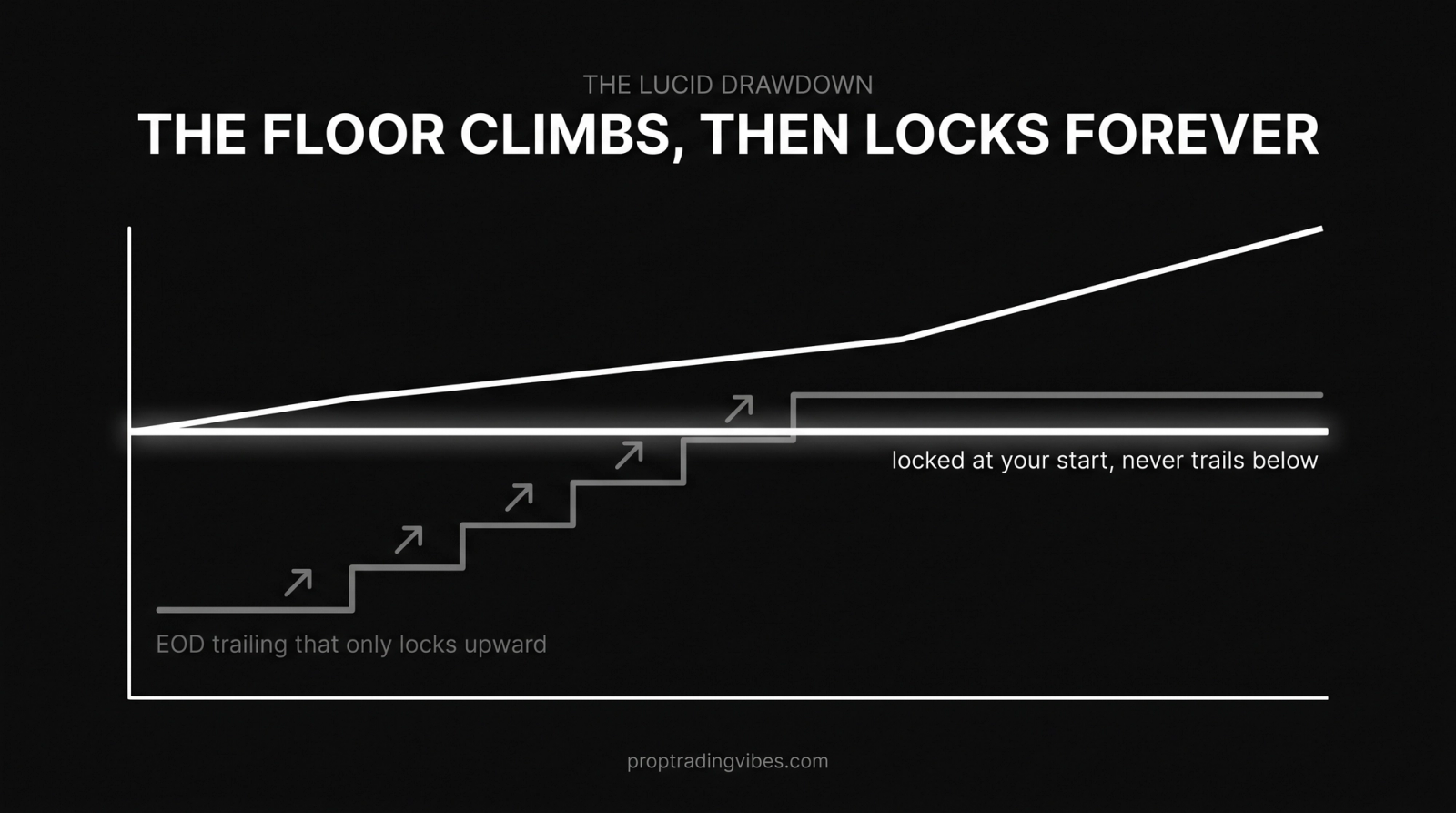
EOD trailing drawdown is the single best rule at Lucid for traders who experience intraday volatility. Here's why: if you're up $1,500 during the session but close the day up $300, your MLL only trails based on the $300 close, not the $1,500 high. At firms with intraday trailing (TakeProfitTrader), that $1,500 peak would have moved your drawdown permanently. EOD trailing protects you from the psychological mistake of watching profits evaporate and having your drawdown lock in at the worst moment.
No funded consistency rule on LucidFlex. Most firms cap how much of your total profit can come from a single day. Topstep enforces 40% consistency. Tradeify enforces 35%. LucidFlex: 0%. If you make $3,000 on Monday and $50 on Tuesday, that's a valid payout.
One-time fees with free resets during promos. When you breach an evaluation, you don't restart a monthly subscription. You buy a new one, often at a discount during Lucid's frequent promos. Some periods include free resets.
EOD Trailing Drawdown: How It Really Works (with math)
Let me walk through a real scenario on a 50K LucidFlex.
Day 0: Starting balance $50,000. MLL = $48,000 ($2,000 below).
Day 1: You trade NQ and close the day at $50,800. MLL trails up to $48,800.
Day 2: Bad day. You close at $50,200 (down $600 from yesterday's close). MLL stays at $48,800. It only trails UP, never down.
Day 3: Great session. You hit $52,000 intraday but close at $51,400. MLL trails to $49,400 (based on the $51,400 close, NOT the $52,000 high).
Day 4: You close at $51,500. MLL trails to $49,500.
Lock point: Once MLL reaches $50,000 (your starting balance), it locks. From here, you trade with house money. Your account can never be breached by the trailing drawdown again (unless you lose below $50,000).
The key insight: the MLL locks at your starting balance, not at some arbitrary level. Once locked, you have permanent downside protection. This takes about $2,000 in accumulated end-of-day profits to reach.
Compare this to intraday trailing at TakeProfitTrader. Same scenario on Day 3: your MLL would trail to $50,000 based on the $52,000 intraday high, not the $51,400 close. That $600 difference in drawdown protection matters on volatile instruments like NQ.
Platforms you can trade with
What I Use (Tradovate + TradingView)
I run Tradovate as my execution platform with TradingView as my charting frontend. The connection is seamless. TradingView's charting is the best in the industry, and routing orders through Tradovate means I get Lucid's standard execution and data feed.
Setup takes about 10 minutes. You create your Tradovate account, connect it to your Lucid evaluation or funded account through the dashboard, then link TradingView to Tradovate. Orders placed on TradingView execute through Tradovate.
Full Platform Support by Account Type
Lucid supports 9 platforms, which is more than most competitors. Topstep is locked to Tradovate and NinjaTrader. TakeProfitTrader supports NinjaTrader, Tradovate, and a few others. Lucid gives you the full Rithmic ecosystem plus Tradovate's native options.
LucidPro supports DLLs (Dynamic Link Libraries) as of the February 2026 update. If you use custom indicators or automated tools on NinjaTrader or Sierra Chart, that matters. LucidFlex has always supported them. Some firms restrict DLL usage entirely.
Mobile and Web Access
Tradovate has a solid web app and mobile app. I've placed trades from my phone during lunch when I spotted a setup on ES. It works. It's not ideal for scalping, but for managing existing positions or taking swing entries, it's functional.
TradingView's mobile app is excellent for chart monitoring, and you can execute trades through the Tradovate connection directly from TradingView mobile. NinjaTrader doesn't have a true mobile app, so if you're a NinjaTrader user, you're limited to desktop.
My strategy to regular payouts
On a 50K LucidFlex, I have $2,000 of drawdown to work with. My approach:
Max risk per trade: $400 (20% of total drawdown). On NQ, that's roughly 2 points of adverse movement per contract, or 4 points with a micro. On ES, it's 8 points per contract. I rarely take full-size risk on a single trade.
Daily loss limit I set for myself: $600. Lucid doesn't enforce a DLL on Flex, but I enforce my own. Three losing trades at $200 each and I'm done for the day. This keeps me from revenge-trading into a hole that would take a week to recover.
Payout target per cycle: a comfortable number, not the maximum. I don't try to maximize the cap. I hit a comfortable number, request the payout, and start the next cycle fresh. Grinding for the maximum cap leads to overtrading in my experience.
The approach is different on LucidPro. The DLL is enforced by the firm, so I size down. I trade 1 NQ contract maximum and aim for 10-15 points per session. The 3-day payout cycle means I don't need huge daily wins. Consistent days compound fast when you're withdrawing every 3 days.
Handling the Payout Cycle
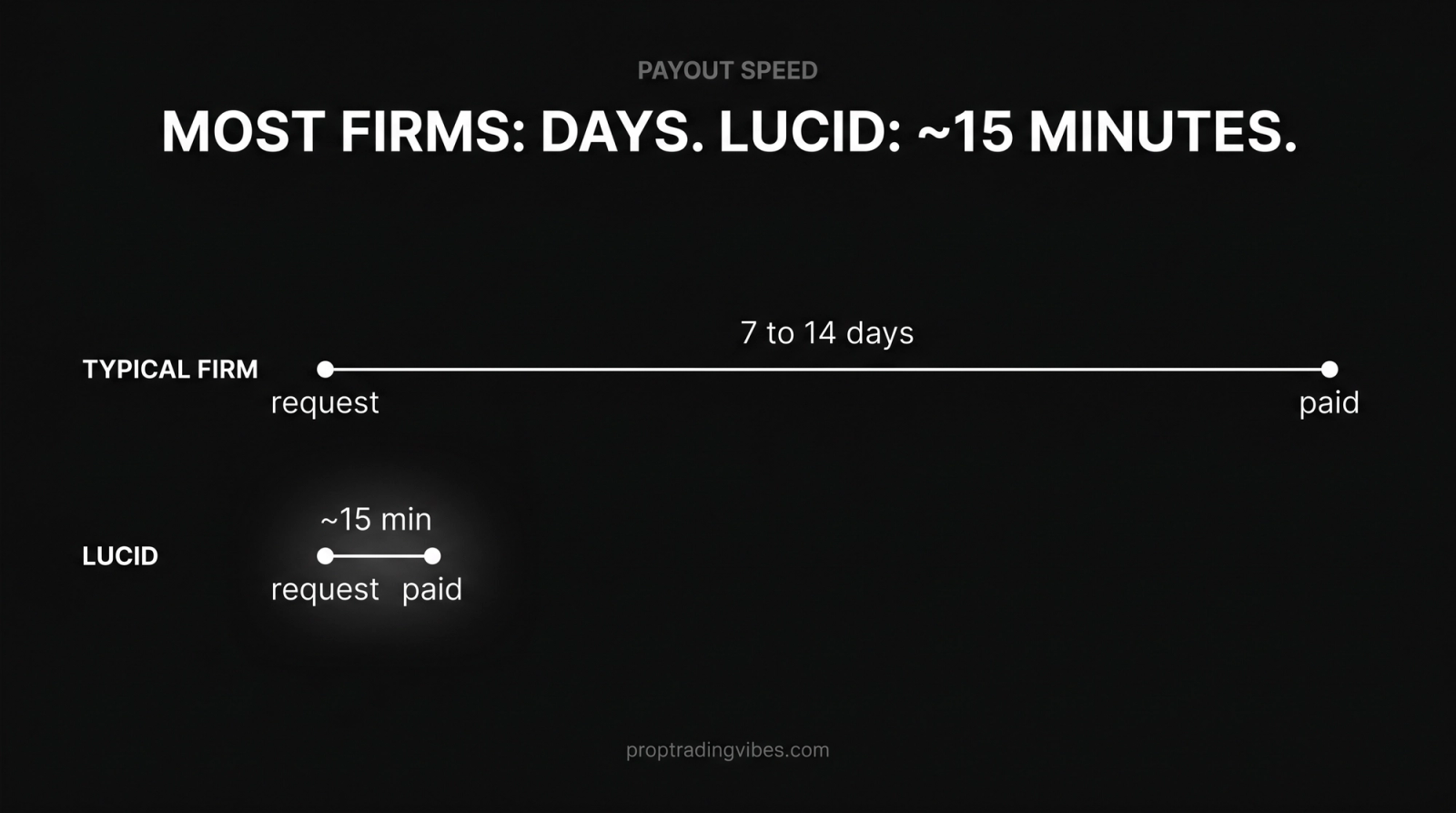
LucidFlex cycles work like this: you hit the payout minimum, request a withdrawal, Lucid processes it (usually 15 minutes), and your balance resets to start a new cycle. You need 5 profitable days within the cycle to be eligible for a withdrawal.
LucidPro cycles are 3 days. Trade for 3 days, meet the per-cycle consistency requirement, request a payout. The consistency rule on Pro means no single day can make up too large a percentage of your cycle profit. I handle this by spreading my trading across all 3 days rather than trying to hit a home run on day 1.
After 5 payouts on Pro (or 6 on Flex), you become eligible for LucidLive. That's the transition from sim-funded to real capital. LucidLive was updated to 90/10 in March 2026, matching sim-funded. The transition decision is now about account size, not split rate. But the daily payouts on Live are attractive for traders who want immediate access to profits.
Common Mistakes I See Traders Make
Oversizing on day 1. The evaluation has the same drawdown as the funded account. If you blow 50% of your drawdown in the first session, you've put yourself in a terrible position. Start with half your planned size and scale up after you've got a profit cushion.
Ignoring the DLL on LucidPro. Traders who switch from Flex to Pro forget they now have a daily loss limit. One bad trade that would be survivable on Flex can trigger the DLL on Pro and either breach (Pro) or pause (Direct) the account.
Holding through news on funded accounts. FOMC, CPI, NFP. These events create 20-50 point NQ candles in seconds. EOD drawdown doesn't help you if a single candle wipes out your entire $2,000 buffer in real-time. The MLL only trails at end-of-day, but the breach happens intraday if your equity hits it.
Chasing the maximum payout cap on Flex. The caps on Flex range from $1,500 to $4,000 depending on account size and payout number. Some traders keep trading to fill the cap when they've already hit a solid number. That extra trading isn't worth risking a $35,000 account.
Trust & legitimacy
I've completed 30 payout cycles with Lucid. Every payout processed in under 4 hours, with most completing in 15 minutes. Plaid ACH deposits for US traders, WorkMarket for international, PayPal, and crypto options.
The Lucid community on Discord is active with regular payout screenshots and proof. Lucid publishes payout milestones publicly. The firm has a 4.8/5 on Trustpilot, which places it above Topstep (4.3/5) and TakeProfitTrader (4.4/5).
I've had zero payout disputes with Lucid. Zero rejected withdrawals. Zero "under review" holds. That's across 30+ payouts over several months. Contrast that with some firms where traders report multi-week delays or unexplained rejections.
Company Background (AJ Campanella, US-based)
Lucid Trading was founded by AJ Campanella in 2025. US-based operation. AJ is active on social media and in Lucid's Discord, which is unusual for a prop firm founder. Most founders hide behind support desks.
The firm launched with LucidFlex and has been iterating rapidly. LucidPro, LucidBlack, LucidDirect, and LucidLive all launched within the first year. LucidMaxx arrived in February 2026. The pace of innovation is fast, possibly the fastest in the industry.
Lucid uses standard industry infrastructure: Tradovate and Rithmic for trade execution, established payment processors for payouts, and a custom dashboard for account management.
Red Flags and Concerns: Being Honest
Age. Lucid launched in 2025. Topstep has been operating since 2012. TakeProfitTrader since 2021. Tradeify since June 2024. Lucid is the youngest serious competitor in the space. Younger firms carry more risk. They haven't been tested by a prolonged bear market, regulatory changes, or years of scaling pressure.
Rapid changes. Four account type overhauls in less than a year. While I've framed these changes positively (because they genuinely improved the product), frequent structural changes can also signal that the firm hasn't figured out its model yet. Stable firms don't need to rebuild their programs every quarter.
Invite-only tier opacity. LucidMaxx has no public pricing, no qualification criteria, and no application process. That's unusual. It means Lucid controls who gets access based on undisclosed metrics. For a firm that otherwise operates transparently, this is a blindspot.
LucidLive's 90/10 split. Dropping from the 100 percent first-\$10K bonus (sim-funded) to the flat 90/10 split (live) when you've already proven yourself through 5-6 payout cycles feels like a step backward. Tradeify and MyFundedFutures maintain 90/10 on live capital.
I'm being direct: none of these are dealbreakers. They're areas where Lucid has room to improve. My 30 payout cycles tell a different story than a list of concerns. But you should have the full picture.
How Long Lucid Has Operated vs Competitors
Lucid's Trustpilot score is the highest despite being the youngest. That's worth something. But longevity and a good review score measure different things. Topstep has survived 13 years of market conditions, regulatory scrutiny, and competitive pressure. Lucid hasn't been tested by any of that yet.
My take: trade with Lucid, but don't put 100% of your prop firm capital into a single firm. I run accounts at Lucid, TakeProfitTrader, and Tradeify simultaneously. Diversification applies to prop firms too.
How this firm compares
Where Lucid Wins
One-time fees. No other firm in this comparison offers one-time evaluation fees across the board. Tradeify, TakeProfitTrader, and Topstep all charge monthly subscriptions. If you need more than one month to pass (most traders do), Lucid's cost advantage grows every month.
Payout speed. 15 minutes average. Tradeify takes about an hour. TakeProfitTrader processes same-day. Topstep takes 1-3 business days. If cash flow matters to you (and it should), Lucid is the fastest.
No funded consistency on Flex. Only TakeProfitTrader matches this at 0% consistency on funded accounts. Topstep enforces 40%, Tradeify enforces 35%. If your trading style produces uneven daily P&L (which most scalping strategies do), Flex removes a major obstacle.
EOD trailing drawdown. Most firms have moved to EOD trailing, but TakeProfitTrader still uses intraday trailing. That difference alone makes Lucid's drawdown mechanics more forgiving for active day traders.
Platform variety. Nine supported platforms versus Topstep's two (Tradovate, NinjaTrader). If you use Sierra Chart, Bookmap, Quantower, or MotiveWave, Lucid supports it. Most competitors don't.
Where Lucid Loses
Company history. Topstep has 13 years of track record. TakeProfitTrader has 4+. Lucid has about 1 year. That's not nothing, and it's the primary risk factor I'd flag for cautious traders.
LucidLive profit split. Lucid updated LucidLive from 80/20 to 90/10 in March 2026, matching the industry standard. Tradeify and Topstep also offer 90/10. This was previously a disadvantage; now that the split matches the industry standard, the daily payout frequency more than offsets accepting 10 percent less per dollar earned.
Subscription firms can be cheaper short-term. Topstep's 50K starts at $49/month. If you pass in month 1, you spent $49 versus Lucid's $185 (Pro) or $140 (Flex). The one-time fee model only wins if you take more than a month. Most traders take more than a month. But fast passers pay more upfront at Lucid.
Payout caps on Flex. Tradeify offers 100% of your first $15K with no per-cycle cap. Lucid Flex caps payouts at $1,500-$4,000 per cycle depending on the payout number. If you're consistently profitable and want to withdraw large amounts quickly, Tradeify and LucidPro are better options than LucidFlex.
My Recommendation by Trader Type
The cautious beginner: Start with LucidFlex 50K ($140). No DLL, no funded consistency, EOD trailing. The most forgiving rule set in futures prop trading. You'll make mistakes. Flex won't punish most of them.
The aggressive scalper: LucidPro 50K ($185). 1-day pass evaluation. 3-day payout cycles. 100% of your first $10K. If you already have a profitable strategy and want the fastest path to withdrawals, Pro is built for you. Just respect the DLL.
The experienced trader who wants real capital: LucidDirect. Skip the sim-funded phase entirely. 20% consistency rule and DLL soft breaches, but you're trading with real money from day one. The 100K account size added in February makes this viable for larger position sizing.
The budget-conscious evaluator: If you're working through multiple evaluations and want to minimize costs, Topstep at $49/month is cheaper if you pass within 3 months. But if you expect to need time, Lucid's one-time fee protects you from accumulating monthly charges.
The proven profitable trader: Wait for a LucidMaxx invitation. Daily payouts, no caps, no DLL, instant live capital. It's the best deal in prop trading, if you can get access to it. Until then, LucidPro with 3-day cycles is the closest alternative.
Frequently asked questions
What is Lucid Trading?
Lucid Trading is a US-based futures prop trading firm founded by AJ Campanella in 2025. The firm offers funded trading accounts where traders pass an evaluation, then trade with the firm's capital and keep 80-100% of profits. Lucid supports four account types (Flex, Pro, Direct, Maxx) with sizes from 25K to 150K and one-time evaluation fees.
What makes Lucid Trading different from other prop firms?
Three things stand out. First, one-time evaluation fees instead of monthly subscriptions. Second, LucidFlex has zero daily loss limit and zero funded consistency rule, which no other firm matches as a combination. Third, payout processing averages 15 minutes, faster than Tradeify (60 min), TakeProfitTrader (same day), and Topstep (1-3 business days).
What is the profit split at Lucid Trading?
It depends on the account type. LucidFlex pays 90/10 (you keep 90%). LucidPro and LucidDirect pay 100% of your first $10,000 in withdrawals, then 90/10 after that. LucidLive pays 90/10 (updated March 2026 from 80/20) on real capital. LucidMaxx terms are not publicly disclosed.
How does the EOD trailing drawdown work at Lucid?
Your Maximum Loss Limit (MLL) starts $1,500-$3,500 below your starting balance (depending on account size). It trails upward based on your end-of-day balance, not your intraday high. Once the MLL reaches your starting balance, it locks permanently. This means a profitable morning session that you give back by close doesn't move your drawdown, unlike intraday trailing at firms like TakeProfitTrader.
What happened to LucidBlack?
LucidBlack was discontinued in February 2026. Its best features (3-day payout cycles, fast evaluations, 100% first $10K) were merged into the upgraded LucidPro. If you had an active LucidBlack account, resets were available through March 6, 2026. After that date, Black accounts are fully retired.
What is LucidMaxx?
LucidMaxx is an invite-only account type launched in February 2026. It offers daily payouts, no caps, no DLL, EOD drawdown, up to 5 accounts, and instant live capital with no sim-funded phase. Eligibility is limited to proven PayoutMaxx traders. There's no public pricing or application process.
How fast are payouts at Lucid Trading?
Payout processing averages under 15 minutes. US traders using Plaid ACH typically see same-day bank deposits. International traders receive funds through WorkMarket. PayPal and crypto are also available. I've personally never waited more than 4 hours for a payout, and most of my 30 payout cycles arrived within 20 minutes.
What platforms does Lucid Trading support?
Lucid supports 9 platforms: Tradovate, TradingView (via Tradovate), NinjaTrader, Sierra Chart, MotiveWave, Quantower, Bookmap, Tradesea, and Rithmic-compatible platforms. All platforms work across all account types. LucidPro and LucidFlex both support DLL (Dynamic Link Library) usage for custom indicators and automation tools.
Is Lucid Trading legit?
Based on my personal experience: yes. I've completed 30 payout cycles with zero rejections or delays. Lucid has a 4.8/5 Trustpilot rating, an active founder (AJ Campanella) who communicates directly with traders, and a growing community with verified payout proof. The main concern is age. Lucid launched in 2025, making it the youngest firm in the competitive set.
How does LucidLive work after the February 2026 update?
LucidLive was completely overhauled. The old system ($30K starting balance, 60-day escrow vesting, "Make 5, Take 5" structure, Safety Net) is gone. New LucidLive starts at $0 balance with a one-time bonus ($1K for 25K accounts, $2K for 50K, $3K for 100K, $4.5K for 150K). You get daily payouts, EOD drawdown, and an 90/10 (updated March 2026 from 80/20) profit split on real capital. Onboarding targets days instead of weeks.
Can I hold positions overnight at Lucid Trading?
On sim-funded accounts (Flex, Pro), no. All positions must be flat before market close. No overnight holds, no weekend holds. LucidLive and LucidMaxx allow open positions across sessions since you're trading real capital. If you need swing trading capability during the evaluation or sim-funded phase, Lucid won't work for that.
How much does a Lucid Trading evaluation cost?
Prices vary by account type and size. LucidFlex 50K costs $140 one-time ($70 with VIBES at 50% off). LucidPro 50K costs $185 one-time ($92.50 with VIBES). LucidDirect 25K costs $340 one-time ($170 with VIBES). See the account types guide for the full breakdown across all sizes. All fees are one-time payments with no monthly subscriptions. Lucid runs frequent promotions, and you can get up to 50% off with code VIBES.
What is the minimum account size at Lucid Trading?
The minimum is 25K, available across LucidFlex ($100), LucidPro ($135), and LucidDirect ($340) regular pricing. The 25K account has a $1,500 drawdown on Flex and Pro. I recommend the 50K for most traders because the $2,000 drawdown gives more room to trade NQ without constant breach anxiety.
Should I choose Lucid Trading in 2026?
If you want one-time evaluation fees, fast payouts, and flexible trading rules, Lucid is a strong choice. LucidFlex is the best option for beginners because of the zero DLL and zero consistency rule. LucidPro is ideal for experienced traders who want fast payout cycles. The main reason to look elsewhere: if longevity and company track record are your top priority, Topstep (13 years) and TakeProfitTrader (4+ years) have longer histories.
Key details
- Founded
- 2025
- Asset classes
- Futures
- Platforms
- Tradovate, NinjaTrader, TradingView, Sierra Chart, Quantower, MotiveWave, Bookmap, Tradesea, Rithmic
- Profit split
- 90%
- Payout frequency
- 8 Days
- Drawdown
- EOD trailing
- Max funding
- $750,000
- Restricted countries
- 11 (Iran, North Korea, Cuba, Syria…)
- Discount code
- VIBES · 50% off
All 31 Lucid Trading guides
Every article in our Lucid Trading cluster, grouped by topic.
Rules
- Lucid Trading Allowed Trading Times: Session Rules and Close Times
- Lucid Trading Approved Products Explained: What You Can Trade & Why
- Lucid Trading Buffer Balance: How Much Do You Need to Keep in Your Account
- Lucid Trading Consistency Rules Explained (2026)
- Lucid Trading Max Drawdown Explained (2026)
- Lucid Trading Position Sizing: Maximum Contracts by Account Size
- Lucid Trading News Trading Policy (2026): What’s Allowed and What Isn’t
- Lucid Trading Payout Caps by Account Type (2026)
- Lucid Trading Payout Methods: How to Withdraw Your Profits
- Lucid Trading Payout Rules: All Accounts Compared (2026)
- Lucid Trading Reset Cost: Reset vs Buy New (2026 Math)
- Lucid Trading Restricted Countries: Complete 2026 List
Accounts
- LucidPro vs LucidFlex vs LucidDirect vs LucidMaxx: Full Comparison (2026)
- Lucid Trading 25K Account Rules: Test vs Direct (2026)
- Lucid Trading 50K Account Rules Explained (Test vs Direct)
- Lucid Trading Discount Code VIBES (2026 Pricing)
- Lucid Trading Live Account Transition (2026)
- LucidPro vs LucidFlex: Full Comparison (2026)
- LucidDirect Account: Skip the Eval, Start Funded (2026)
- LucidFlex Account Rules: Drawdown, Payouts & Eval Guide (2026)
- Lucid Trading Multiple Accounts: Limits & Strategy (2026)
- LucidPro Funded Account Rules 2026: 3-Day Payout Cycles Explained
Platforms
- Lucid Trading Dashboard Guide: How to Track Your Consistency Score
- Lucid Trading Platforms: 5 Options Ranked (2026)
- Lucid Trading Setup Guide: Complete Account Creation Steps
- Lucid Trading x Tradesea: Free Copy Trading (2026)
- Lucid Trading + TradingView: Setup & Connection Guide (2026)
- Lucid Trading Tradovate & NinjaTrader Setup Guide
Review changelog: Feb 1, 2026 (RULES): LucidBlack discontinued and its best features merged into the upgraded LucidPro.
PTV may earn a commission if you sign up through our link. It never changes our rating or verdict. Paul tested this firm with his own money.