
Table of contents
Quick Answer — Is prop trading worth it?
- • Prop trading is worth it if you are already consistently profitable on a small live account and want access to larger size without risking your own capital. It is a leverage tool for existing skill, not a way to acquire skill.
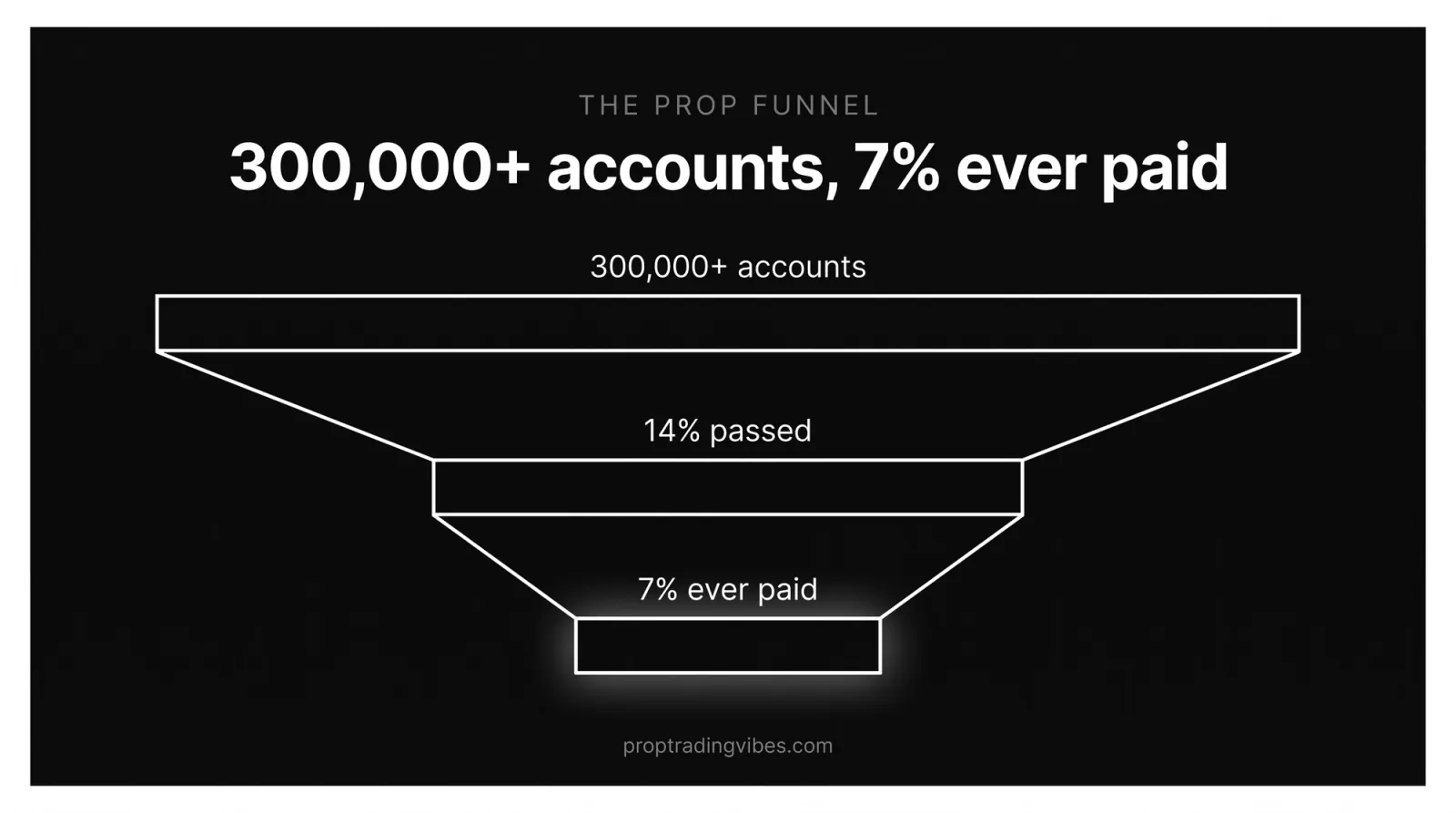
- • An FPFX Tech study of more than 300,000 accounts across 10 firms, reported by Finance Magnates in September 2024, found only 7% of accounts ever reached a payout and 14% passed a challenge.
- • The real costs are eval fees, resets, and (at some firms) monthly activation fees, averaging about $800 per account across roughly three challenges before a result.
- • The real upside is capital access and downside protection: you trade firm size and a breach costs you the fee, not your savings, which removes the account-blowup risk a personal account carries.
- • If you are not yet profitable, the honest alternative is a small personal account or a sim, where the only cost is your own losses and there is no eval fee, time limit, or trailing drawdown.
Prop trading is worth it if you are already consistently profitable on a small account and want larger size without risking your own capital. It is not worth it as a way to learn how to trade. That is the honest one-line answer, and most of the disagreement about prop firms comes down to people doing one job with a tool built for the other.
The numbers set the frame. An FPFX Tech study of more than 300,000 accounts across 10 prop firms, reported by Finance Magnates in September 2024, found that only 7% of accounts ever reached a payout. About 14% passed a challenge. The average account spent roughly $800 on challenges, usually across three attempts, before a result either way. Those are not encouraging numbers, and any honest take has to start with them.
I have spent 5+ years trading prop accounts across more than a dozen firms. I have collected dozens of payouts and I have also lost accounts that I had no business buying in the first place. So this is not a pitch. It is a cost-benefit breakdown of when the fee is worth paying and when it is not.
What does "worth it" actually mean in prop trading?
"Worth it" in prop trading means the expected value of the access and downside protection you buy exceeds the fees you pay to get them. It is a leverage question, not a magic question. The firm is renting you size and absorbing your position risk. You are paying an eval fee and a profit split for that. Whether the trade is good depends entirely on one variable the marketing never mentions: do you already have an edge?
If you are a profitable trader who is capital-constrained, the answer skews strongly toward worth it. You pay a small fee, you trade firm size, and your worst case is losing the fee rather than your savings. If you are not yet profitable, the answer skews strongly toward not worth it, because no amount of firm capital fixes a strategy that loses money. You are just losing the firm's money faster, and paying for the privilege. This is also why a prop firm is not a hedge fund: the comparison in prop trading vs a hedge fund shows you are renting a simulated account, not managing pooled outside capital.
The one question that decides it
Before you buy anything, answer this honestly: are you already profitable on a small live or sim account over a meaningful sample? If yes, prop trading is a scaling tool and probably worth it. If no, the eval fee is tuition for a lesson a free sim teaches for nothing. The 7% payout rate is mostly a story of under-prepared accounts meeting rules that do not forgive.
What are the real costs of prop trading?
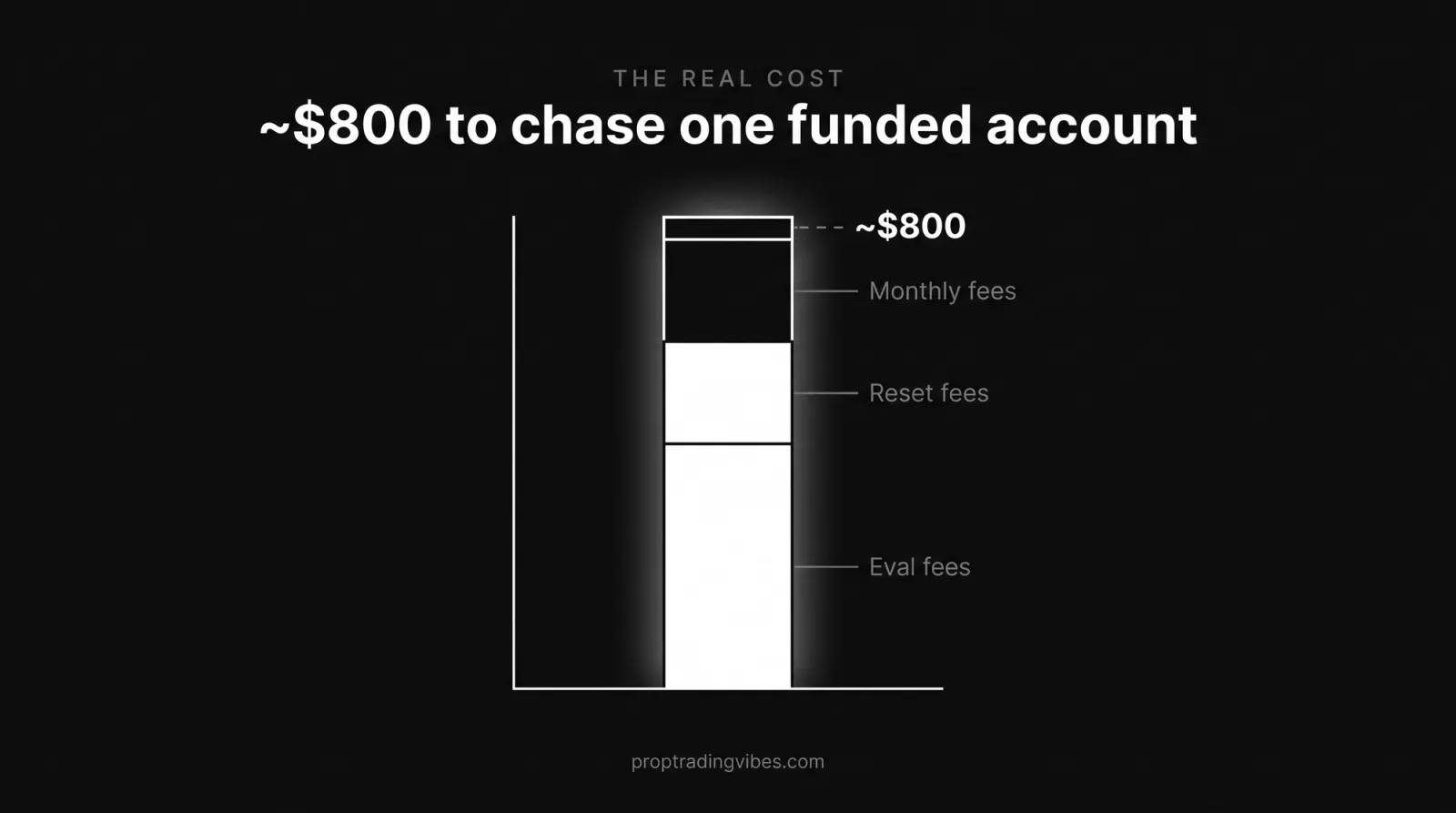
The real costs of prop trading are eval fees, reset fees, and at some firms a monthly activation fee, totaling about $800 per account on average across roughly three challenges, per the FPFX Tech study reported by Finance Magnates in September 2024. The fee on the box is rarely the fee you actually pay, because most traders buy more than one attempt.
Here is how the costs stack up in practice for futures evals as of September 2026:
| Cost type | Typical range | When you pay it |
|---|---|---|
| Evaluation fee | $100 to $400 per account by size | Upfront, per attempt |
| Reset fee | A fraction of the eval, often $50 to $100 | Each time you breach mid-eval |
| Monthly activation (some firms) | $0 to ~$150/mo | Monthly on funded accounts, varies by firm |
| Average lifetime spend | ~$800 across ~3 attempts | Spread over the account's life |
The dangerous cost is not the first eval. It is the reset-and-retry loop. A trader who is not ready will buy a $150 eval, breach it, reset for $80, breach again, buy a fresh account, and quietly spend $800 chasing a pass that was never coming. That is exactly how the average gets to $800.
Time and tilt are costs too
The fees are the visible cost. The invisible costs are the time spent on challenges that compress real trading into a pass-or-die window, and the tilt that compression creates. Evals push traders to oversize and revenge-trade in ways they never would on a relaxed personal account. Good risk management for prop trading and a handle on the mental game of funded trading are the difference between the fee being a one-time cost and a recurring subscription to failure.
What is the real upside of prop trading?
The real upside of prop trading is capital access with capped personal downside: you trade firm size, and a blown account costs you the fee rather than your savings. This is the part that is genuinely, mathematically good, and it is why I have kept doing it for 5+ years despite knowing the 7% number.
Three concrete benefits, in order of how much they matter:
- Downside protection. On a personal account, a blowup costs you the full balance. On a funded trading account, a breach costs you the eval fee. The position risk belongs to the firm, not to you. That asymmetry, much like a favorable risk-reward ratio in trading, is the core of the value.
- Size without your own capital. A $50K or $150K firm account lets a profitable trader express an edge at a scale their personal balance could never fund. The whole point is leverage on skill you already have.
- Scaling on performance. Most firms let you add accounts or scale account size as you produce, so a working edge compounds into more capital over time rather than being capped at your savings.
The upside only exists if you are profitable
None of these benefits help a losing trader. Firm capital does not turn a negative-expectancy strategy positive. It just changes whose money disappears first. The upside of prop trading is real, but it is leverage on an edge, and leverage on zero is still zero. That is the whole game in one sentence.
Is prop trading worth it compared to trading your own money?
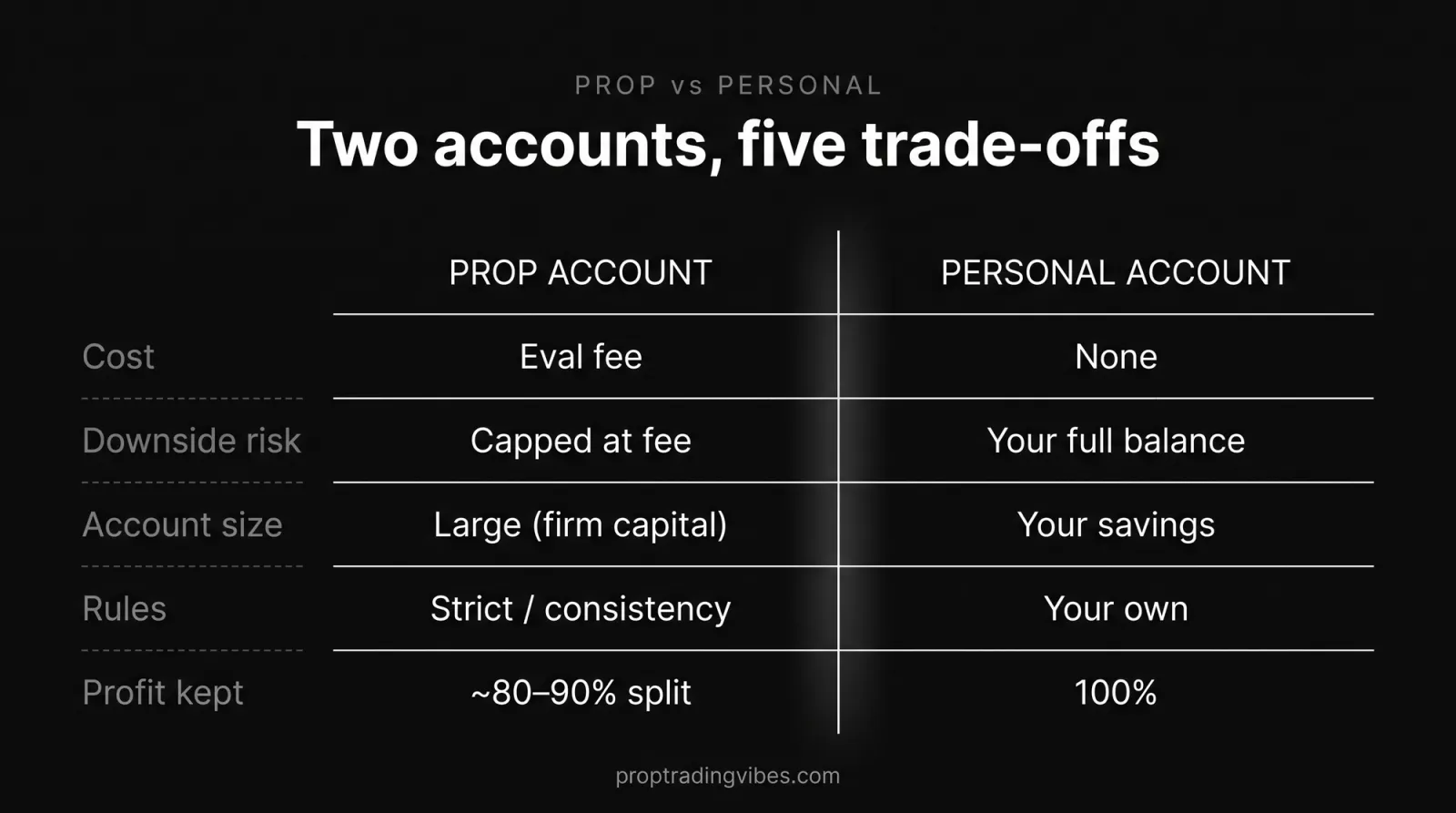
Prop trading is worth it over a personal account when your binding constraint is capital, not skill, and you are willing to trade a profit split and a rulebook for larger size and capped downside. If your constraint is skill, a personal account or sim is the cheaper teacher. The two paths solve different problems.
| Factor | Prop account | Personal account |
|---|---|---|
| Upfront cost | Eval fee ($100 to $400) | None beyond your deposit |
| Downside risk | Capped at the fee | Your entire balance |
| Size available | Firm capital ($25K to $450K+) | Your real capital |
| Rules | Loss limits, trailing drawdown, split | Only your own rules |
| Profit kept | 80% to 100% on first tier | 100% |
| Best for | Profitable, capital-constrained traders | Learning, or fully self-funded traders |
The split looks like a downside until you remember it only applies to money you actually withdraw, which most accounts never do. A 90% split on real payouts beats 100% of a personal account you blew up. The honest alternative to prop trading is not "trade your own money and keep everything." It is "trade your own money, risk all of it, and cap your size at your balance." For some traders that is the right call. For a capital-constrained profitable trader, it usually is not.
Why do most prop accounts never get paid?
Most prop accounts never get paid because the trader breaches a loss limit or trailing drawdown before reaching a payout, not because they fail to hit the profit target. Only 7% of accounts ever reach a payout and 14% pass a challenge, per the FPFX Tech study reported by Finance Magnates in September 2024. The funnel leaks at every stage, and it leaks hardest at the rules.
The failure pattern is consistent across firms. A trader is profitable in theory, buys an eval, and then the compression of a pass-or-die window changes their behavior. They size up to pass faster. They hold a loser through a daily loss limit. They give back an unrealized profit spike that ratcheted the trailing floor up underneath them. Understanding what drawdown is in trading and exactly how your firm's floor moves is not optional reading. It is the single mechanic that decides whether you join the 7% or fund it.
The funnel, stage by stage
- 300,000+ accounts entered, across 10 firms.
- ~14% passed a challenge and got funded.
- ~45% of funded accounts then received at least one payout.
- ~7% of all accounts ever saw a single payout.
That is the real shape of the industry. Most of the loss happens between buying the eval and passing it, which is a rules-and-discipline problem more than a strategy problem. The path through it is documented in how to become a funded trader, and it starts with treating the loss floor as the only number that matters.
Which firms make prop trading worth it?
The firms that make prop trading worth it are the ones with a real payout track record, survivable loss-limit mechanics, and no retroactive rule changes. The firm matters as much as your edge, because a forgiving drawdown mechanic and a fast payout cycle materially change your odds of reaching the 7% outcome. As of September 2026, a few I have direct experience with show the spread.
| Firm | Why it can be worth it | Code / access |
|---|---|---|
| Lucid Trading | EOD trailing that locks up only, fast payout cycles, flagship for forgiving mechanics | Code `VIBES` |
| Alpha Futures | EOD-trailing MLL on all accounts, no intraday floor tightening | `Paul001554` for 25% off |
| Apex Trader Funding | 4.0 update resolved many past pain points, deep promo cycles on evals | No PTV code |
I have traded all three. Lucid Trading is the one I point new funded traders to first, because the EOD trailing floor only updates on the daily close and locks at starting balance, which removes the cruelest version of the trailing-drawdown trap. Alpha Futures runs the same forgiving EOD mechanic on every account. Apex Trader Funding is where I leaned into running multiple parallel accounts, and the 4.0 overhaul fixed a lot of what used to make it frustrating. If you are still shortlisting, the roundups of the best funded trader programs, the best prop firms for day trading, and the best prop firms for swing trading compare the mechanics that actually matter. The point is not which logo you pick. It is that the firm's rules either give a disciplined trader room or quietly take it away.
Read the mechanics before the marketing
The discount on an eval is the least important number. The drawdown mechanic, the daily loss limit, the payout cycle, and the firm's actual payout history are what decide whether prop trading is worth it at that firm. A cheap eval at a firm with a brutal intraday-trailing floor is worse value than a full-price eval at a firm whose floor leaves you room to trade. Cheap access to a near-impossible rulebook is not a deal.
The bottom line
Prop trading is worth it for a trader who is already profitable on a small account and wants firm size without risking personal capital. The fee buys you leverage on an edge you already have, plus downside protection that a personal account cannot offer, and for that specific trader the math is genuinely favorable. Firms like Lucid Trading, with its locks-up-only EOD drawdown, make that trade about as fair as the industry gets.
Prop trading is not worth it for a trader who is still learning, who is not yet profitable, or who buys evals to find out whether they can trade. For that trader, the honest alternative is a free sim or a small personal account, where the only cost is your own losses and there is no eval fee, time limit, or trailing drawdown working against you. The 7% payout rate is not a conspiracy. It is mostly a room full of people paying to skip the step that prop trading was never built to provide. Get profitable first. Then the fee starts paying you back.
Frequently Asked Questions
Is prop trading worth it?
Prop trading is worth it for a trader who is already consistently profitable on a small live or sim account and wants larger size without risking personal capital. It is not worth it as a way to learn to trade, because an FPFX Tech study of more than 300,000 accounts found only 7% ever reached a payout. The fee buys you access to firm size and downside protection, not a skill you do not yet have. If you are profitable, the math is favorable. If you are not, you are paying eval fees to discover that on someone else's clock.
What percentage of prop traders actually get paid?
Only about 7% of prop-trading accounts ever achieved a payout, according to an FPFX Tech study of more than 300,000 accounts across 10 firms, reported by Finance Magnates in September 2024. Roughly 14% of accounts passed a challenge and got funded, and of those funded accounts about 45% received at least one payout. The single biggest reason accounts fail is breaching a loss limit or trailing drawdown, not failing to hit the profit target.
How much does prop trading cost?
A single prop account spends an average of about $800 on challenge purchases over its full activity cycle, typically across three different challenges, per the FPFX Tech study reported by Finance Magnates in September 2024. The visible costs are the evaluation fee, reset fees when you breach, and at some firms a monthly activation fee on funded accounts. Futures evals commonly run $100 to $400 per account depending on size, and resets are usually a fraction of that. The hidden cost is the accounts you buy and lose before one works.
Is prop trading better than trading my own money?
Prop trading is better than trading your own money if you want size you cannot personally fund and you accept paying a fee for it. A personal account has no eval fee, no time limit, no trailing drawdown, and no profit split, but every dollar of loss is your own and your size is capped by your real balance. Prop trading caps your downside at the fee and gives you firm capital, but adds rules, a split, and a pass requirement. The better choice depends on whether your constraint is capital or skill.
Who is prop trading actually worth it for?
Prop trading is worth it for a trader who is already profitable on a small account, has a tested edge and risk plan, and is capital-constrained rather than skill-constrained. It suits someone who can respect a fixed loss floor and a daily loss limit without tilting. It is genuinely a fit for traders who want to scale beyond what their personal balance allows, because the firm absorbs the position risk in exchange for a split.
Who should NOT do prop trading?
Prop trading is not worth it for a trader who is still learning, who is not yet profitable on any account, or who treats an eval fee as a lottery ticket. If you cannot hold a tested edge on a sim or a small live account, paying $100 to $400 per challenge to fail faster is the most expensive way to learn. It is also a poor fit for traders who cannot psychologically handle a trailing drawdown that moves the goalposts under them mid-trade.
Why do so many prop traders fail the challenge?
Most prop traders fail the challenge because they breach a loss limit or trailing drawdown, not because they cannot hit the profit target. The FPFX Tech study reported by Finance Magnates found only 14% of accounts passed. The eval compresses real trading into a pass-or-die window, which pushes traders to oversize, revenge-trade after a red day, or hold through a drawdown they would normally cut. The rules are designed to be survivable for disciplined traders and lethal for impulsive ones.
Do you keep all the profit in prop trading?
No. Prop firms keep a share of profit through a profit split, commonly between 80% and 100% to the trader on the first tier, with the firm taking the rest. The trade-off is that the firm provided the capital and absorbed the loss risk, so the split is the price of not using your own money. A personal account gives you 100% of profit but also 100% of every loss. The split only matters once you are actually withdrawing, which most accounts never reach.
Is prop trading a scam?
Prop trading is not inherently a scam, but the industry's economics mean most accounts are profitable for the firm even when the trader loses, because the firm keeps the eval fee. The legitimate firms pay real payouts and run a sustainable simulated-funding model. The risk is firms that change rules retroactively, delay payouts, or design evals to be near-impossible. Checking a firm's payout track record and reading the loss-limit mechanics before buying is how you separate a real opportunity from a fee mill.
How long does it take to make money in prop trading?
There is no fixed timeline, and most accounts never reach a payout at all, since only about 7% of accounts ever do per the FPFX Tech study. For a trader who is already profitable, passing an evaluation can take anywhere from the firm's minimum trading days (often 1 to 10) to several weeks, followed by a payout cycle that ranges from same-day at some firms to a 14-day or longer first window at others. The realistic answer is that prop trading rewards consistency over time, not a fast payday.
What is the cheapest way to start prop trading?
The cheapest way to start prop trading is a small futures evaluation on a heavy promo, often a $25K or $50K eval discounted 30% to 90% during sale cycles, which can drop a $150 eval well below $100. The cheaper move before that, if you are not yet profitable, is a free sim or a small personal account where the only cost is your own learning curve. Buying the smallest eval on the deepest discount limits how much you risk while you find out whether prop rules suit your style.
Is prop trading worth it for beginners?
Prop trading is generally not worth it for beginners, because the model rewards an existing edge rather than teaching one. A beginner paying eval fees to fail challenges is paying tuition to a firm that keeps the fee whether you learn or not. The honest path for a beginner is to build consistency on a sim or a small personal account first, then use a prop firm to scale that proven edge. The 7% payout rate is largely a story of under-prepared accounts meeting unforgiving rules.
What are the real alternatives to prop trading?
The real alternatives to prop trading are a small personal trading account, a free or paid simulator, or simply not trading leveraged size until you are profitable. A personal account removes the eval fee, the time limit, the trailing drawdown, and the profit split, but caps you at your real capital and puts your own money at full risk. A sim removes financial risk entirely but also removes the psychological pressure that makes real money behave differently. Each trades a different cost for a different benefit.
Does prop trading risk my own money?
Prop trading limits your financial risk to the fees you pay, not your trading capital. When you breach a loss limit on a funded prop account, you lose access to that account and the fee you paid for it, but you do not owe the firm the simulated losses. This downside protection is the core reason prop trading can be worth it: a personal account blowup costs you the full balance, while a prop blowup costs you the eval fee. The capital at risk on the position belongs to the firm.