
Table of contents
Quick Answer, Trading edge
- • A trading edge is any repeatable reason your trades have positive expectancy over a large sample.
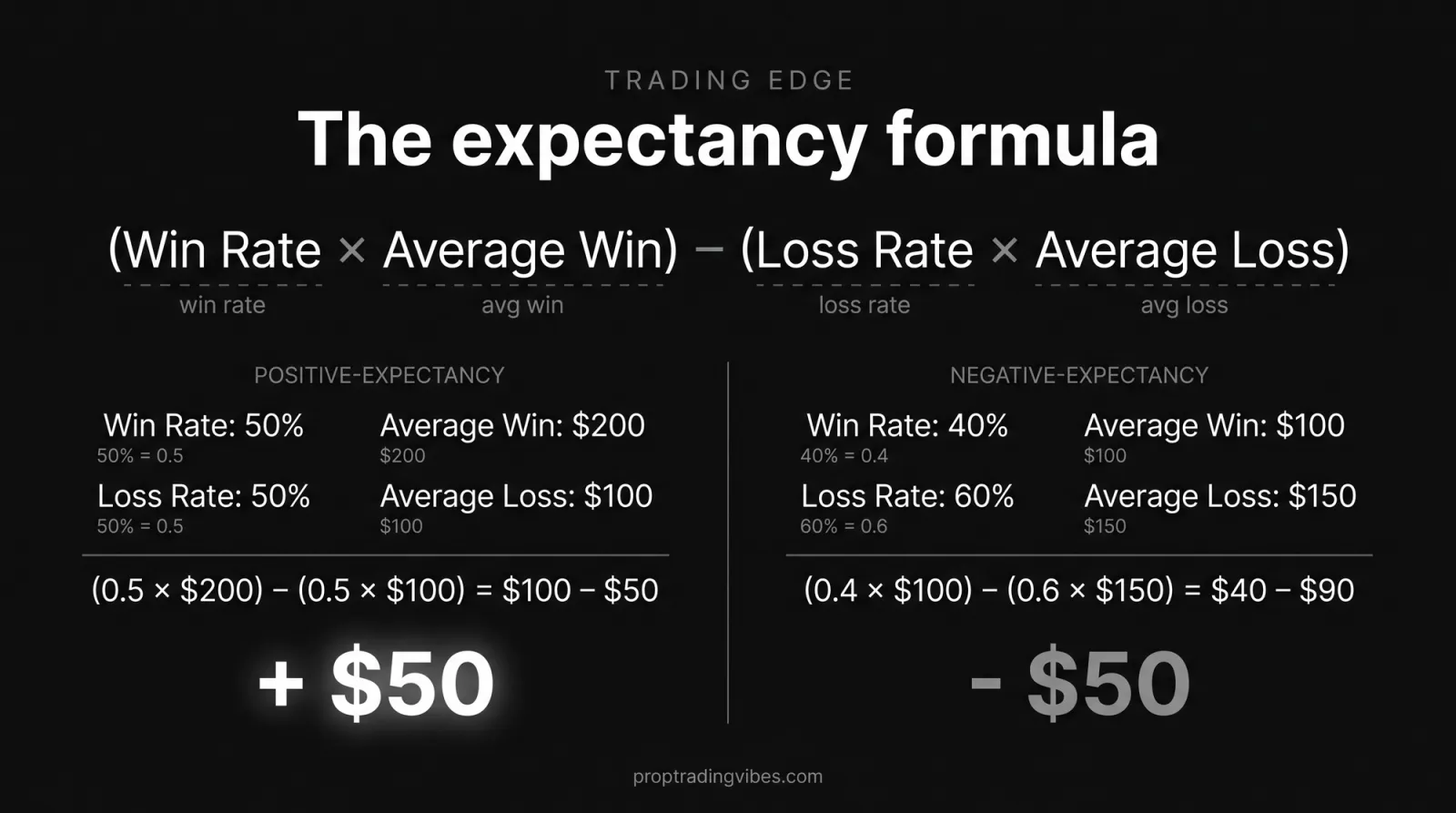
- • Expectancy = (Win% x Average Win) minus (Loss% x Average Loss). If that number is positive, you have an edge.
- • An edge has five parts: entry signal, exit and trade management, risk sizing, psychology and discipline, and clean execution.
- • You find an edge by forming a hypothesis, backtesting it across 100+ trades, then forward testing it on live data before you size up.
- • An edge is not a single indicator and not a win rate. A 40% win rate can be highly profitable if the winners are bigger than the losers.
A trading edge is a repeatable source of positive expectancy. In plain terms, it is any reason your trades make money over a large sample, where your average outcome across hundreds of trades is a gain rather than a loss. It is not a single indicator, not a secret setup, and not a hot streak. It is the whole system, entry, exit, risk sizing, and discipline, producing a net positive result that you can measure.
Most traders talk about an edge as if it were a thing they own. The honest version is narrower. You have an edge when you can write down your rules, apply them to a large number of trades, and show that the math comes out positive. Everything else is a story.
What is a trading edge?
A trading edge is positive expectancy over a large sample of trades. Expectancy is the average amount you expect to win or lose per trade once you account for both how often you win and how big your wins are versus your losses.
The cleanest way to think about it: if you could clone your exact setup and trade it 1,000 times, would the account end up higher or lower? If higher, you have an edge. If lower, you do not, no matter how good the last five trades felt.
An edge is statistical, not anecdotal. One good trade proves nothing. One bad trade disproves nothing. The edge lives in the aggregate.
The expectancy formula
Expectancy is the math behind every real trading edge. The formula:
Expectancy = (Win% x Average Win) − (Loss% x Average Loss)
If that number is positive, the strategy makes money on average. If it is negative, it loses money on average, even if it feels like it is working in the short term.
A worked example: low win rate, positive edge
Say you win 40% of your trades. Your average winner is $300 and your average loser is $100.
- Win side: 0.40 x $300 = $120
- Loss side: 0.60 x $100 = $60
- Expectancy: $120 − $60 = +$60 per trade
You lose more often than you win, and you still make $60 per trade on average. Over 100 trades that is roughly $6,000 of expected return, before costs. This is why traders who chase win rate miss the point.
A worked example: high win rate, negative edge
Now flip it. You win 70% of your trades, but your average winner is $100 and your average loser is $300.
- Win side: 0.70 x $100 = $70
- Loss side: 0.30 x $300 = $90
- Expectancy: $70 − $90 = −$20 per trade
You win most of the time and still lose money. The few big losers swamp the many small winners. A high win rate with poor risk-reward ratios is one of the most common ways traders fool themselves into thinking they have an edge.
The five components of a trading edge
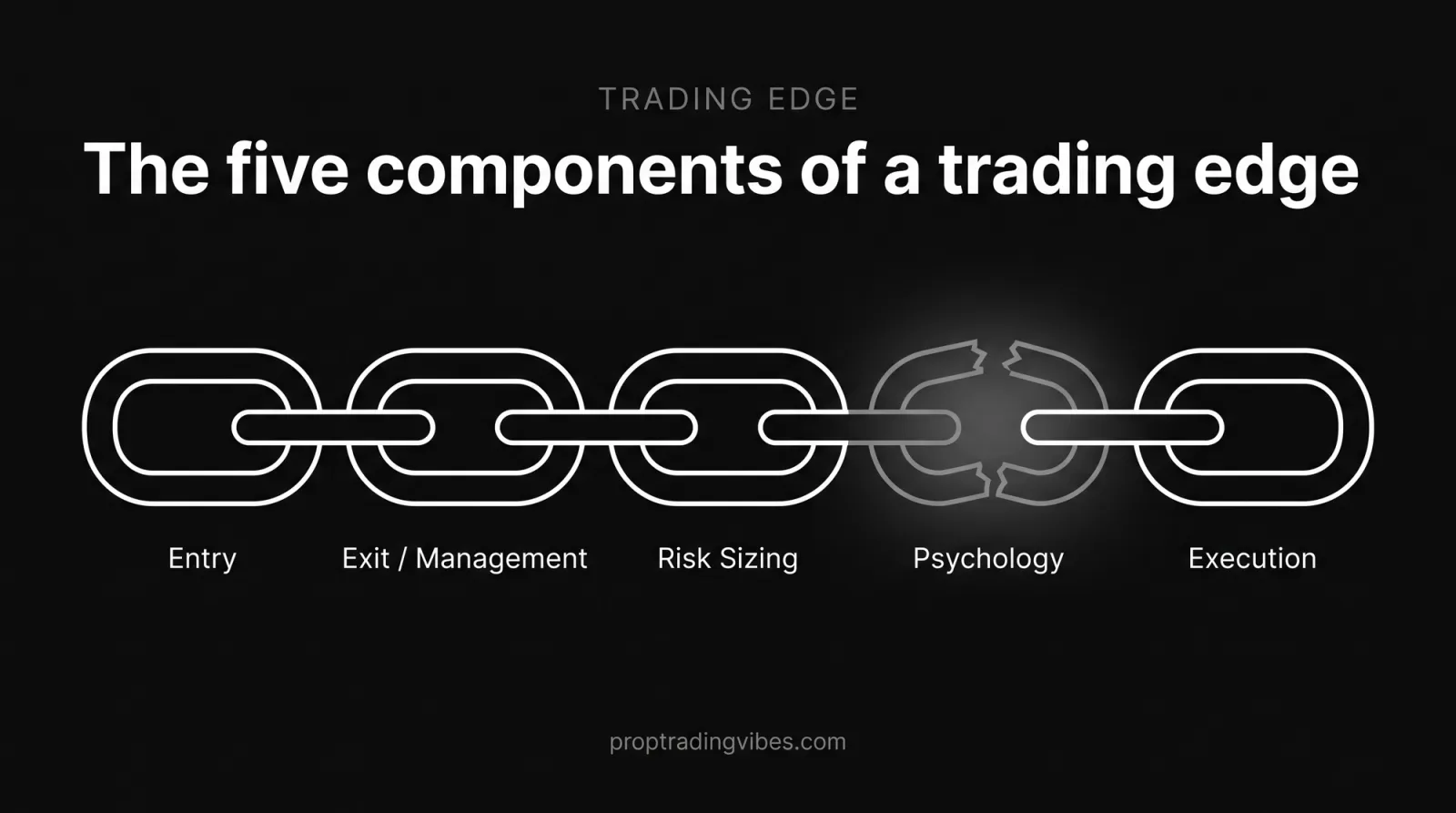
An edge is never one thing. It is five parts working together, and weakness in any one of them can cancel the rest.
| Component | What it controls | Failure mode |
|---|---|---|
| Entry signal | When you take a trade | Vague rules, chasing, no consistency |
| Exit and management | When you take profit or cut | Holding losers, cutting winners early |
| Risk sizing | How much you stake per trade | Oversizing, no fixed risk unit |
| Psychology and discipline | Whether you follow the plan | Revenge trades, fear, skipping setups |
| Execution | Getting filled at planned prices | Slippage, late entries, fat fingers |
Entry signal
The entry is the condition that tells you to act. It can be a price pattern, a level, a moving average cross, a breakout, or a mean reversion trigger. What matters is that it is specific enough to be repeated and tested. "I buy when it looks strong" is not an entry signal. "I buy the first pullback to VWAP after a higher high" is.
Exit and trade management
The exit usually matters more than the entry. Where you take profit and where you cut a loss define your average win and average loss, which are two of the four inputs in the expectancy formula. A trailing stop loss approach manages winners differently than a fixed target, and the choice directly changes your expectancy.
Risk sizing
Risk sizing is how much of the account you put at risk on a single trade. Many traders use a small fixed percentage so no single loss can do real damage. This is the bridge between having an edge and surviving long enough to trade it, which is why risk management is inseparable from the edge itself.
Psychology and discipline
An edge you cannot execute is not an edge. If you skip the valid setups and take the invalid ones, your live results will not match your tested numbers. The mental game of trading is where most validated strategies quietly break down. A deeper breakdown lives in the trading psychology guide.
Execution
Execution is the gap between the price you planned and the price you got. Slippage, hesitation, and late fills all erode expectancy. On fast markets, a few ticks of slippage per trade can turn a positive edge into a flat one.
How to find a trading edge
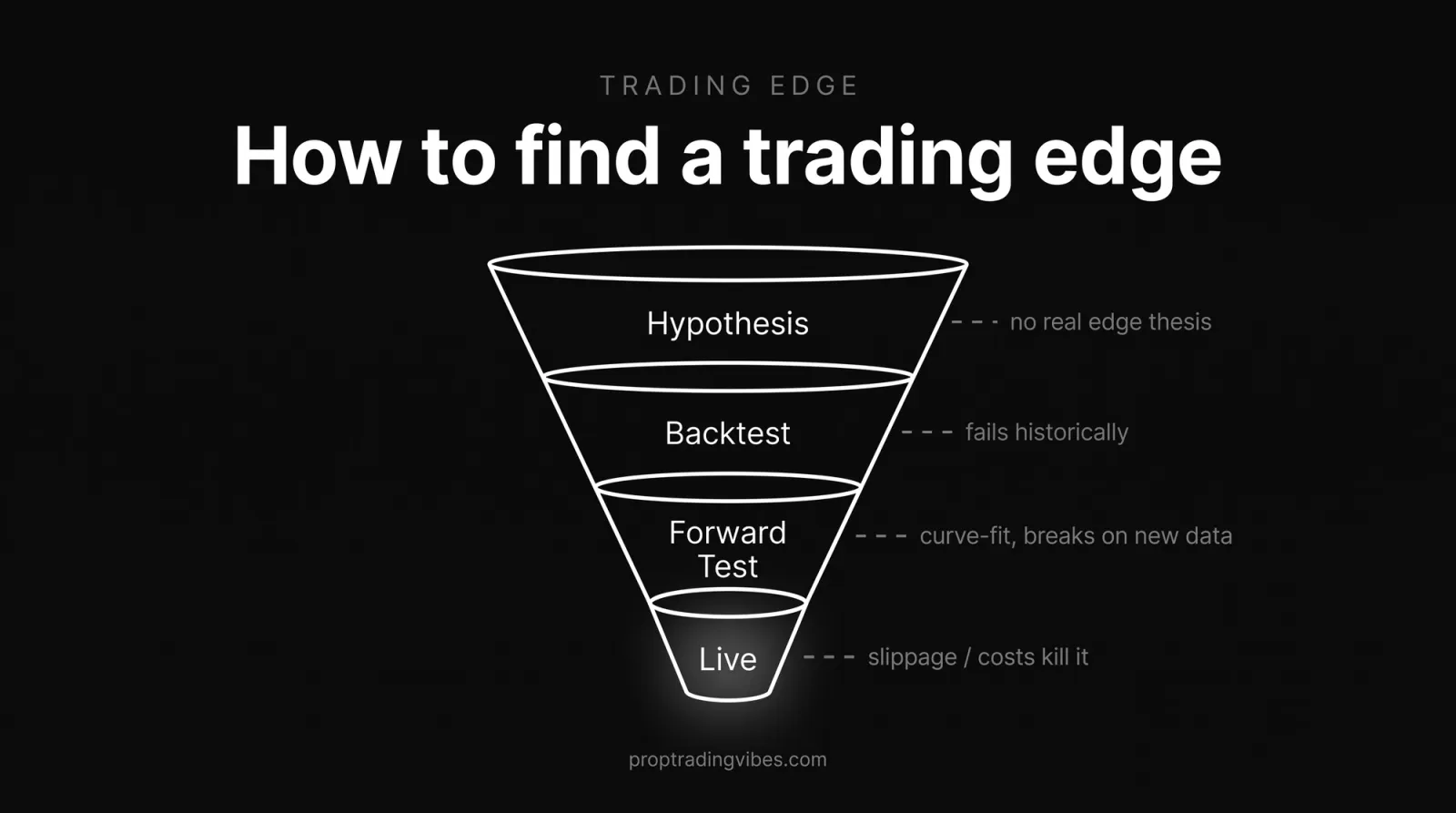
You find an edge through a loop: hypothesis, backtest, forward test, then live confirmation. Each stage filters out approaches that only looked good on the surface.
Step one: form a hypothesis
Start with a clear, testable rule. Pick a market, a timeframe, an entry, an exit, and a risk unit. The rule has to be specific enough that two people reading it would take the same trades. Strategy families like trend following, opening range breakouts, and VWAP-based entries are common starting points, but the source matters less than the precision.
Step two: backtest across a large sample
Apply the rules to historical data and record every trade the rules would have taken. You are looking for two things: a positive expectancy and a sample large enough to trust. A common floor is 100 trades, and many traders want 200 to 300 before they believe the number.
Step three: forward test on live data
Backtests are optimistic. They assume perfect fills and hindsight-free decisions. Forward testing runs the same rules on live market data in real time, without real money, so you see whether you can actually execute the plan under live conditions. Strategies that look great in a backtest and fall apart in forward testing usually had hidden assumptions baked in.
Step four: confirm live, then size up
Once a strategy survives forward testing, trade it live at small size and keep measuring expectancy over a rolling window. Only scale up after the live numbers confirm the edge. Sizing up before confirmation is how a lucky streak gets mistaken for a system.
Why most traders never build an edge
Most traders never define their rules precisely enough to measure expectancy, so they never know whether they have an edge at all. They jump between setups, change sizing on emotion, and judge their trading by the last few outcomes instead of a large sample.
The pattern looks like this:
- No written rules, so nothing can be tested.
- A handful of trades treated as proof instead of a large sample.
- Sizing that moves with confidence and fear instead of a fixed rule.
- Strategy hopping after every losing streak, which resets the sample to zero.
- Confusing a good week with a real edge.
Without a testable rule set, there is nothing to validate, and randomness fills the space where an edge should be. The fix is unglamorous: write the rules, log the trades, run the math.
Edge, variance, and risk of ruin
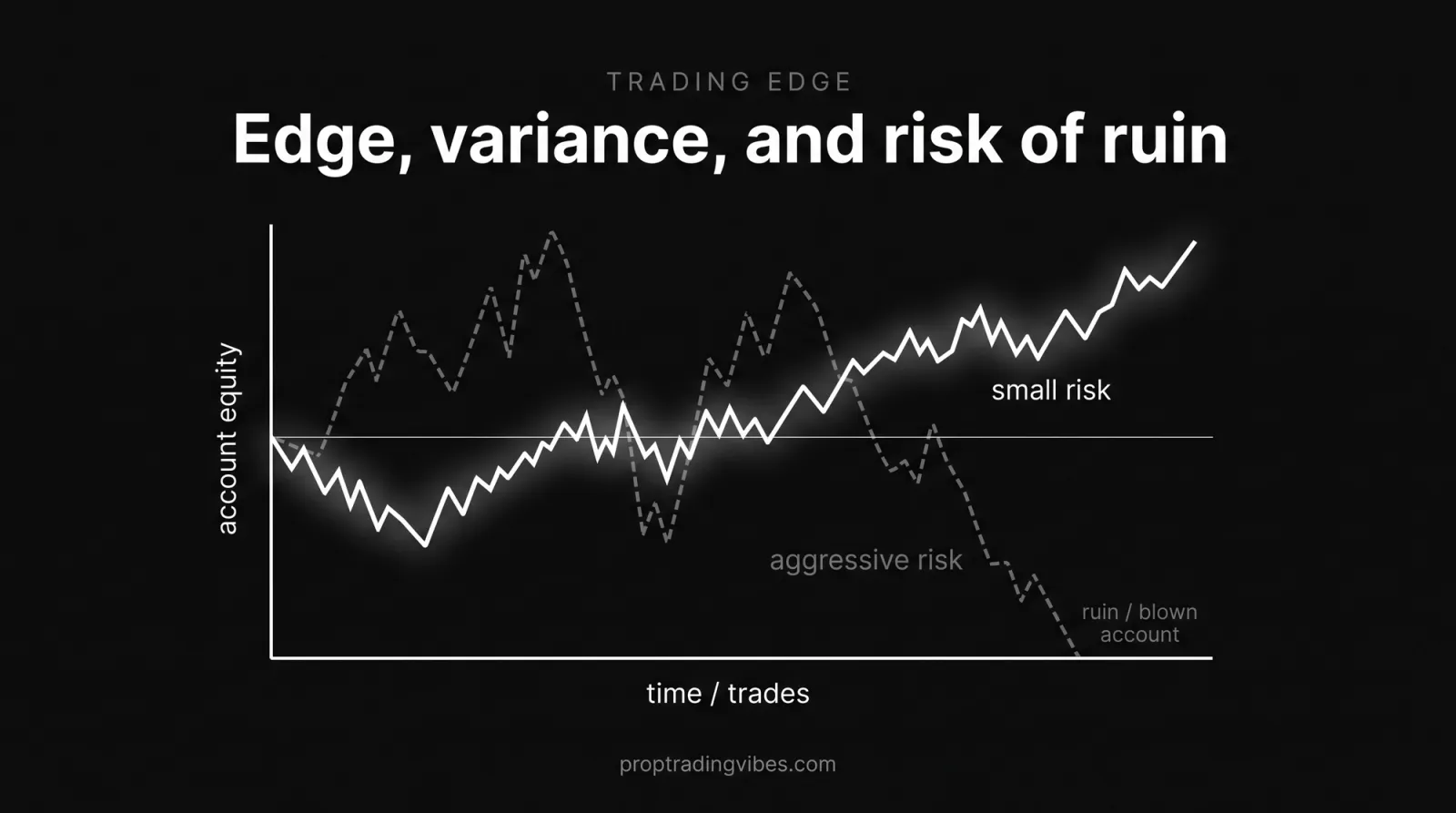
A positive expectancy does not mean every trade or every week is a winner. Even a real edge has losing streaks, and that is where most accounts die.
Risk of ruin is the chance that a string of losses drains the account before the edge can produce its expected return. The more aggressively you size relative to your edge and account, the higher that chance climbs.
This is why sound risk management in prop trading is not a separate skill from having an edge. It is what keeps the edge alive through variance.
The practical takeaway: smaller, consistent risk per trade lets a genuine edge compound. Aggressive sizing can wipe out a positive-expectancy system before it ever pays.
How an edge plays out in funded trading
In a funded account, the edge has to fit inside the firm's rules. Trailing drawdowns, daily loss limits, and consistency requirements all constrain how an edge can be expressed. An approach that needs wide stops or heavy sizing can breach a tight drawdown rule before the expectancy has room to work.
Firms structure their accounts differently, which changes the calculus. The drawdown mechanics at Lucid Trading, the account structures at MyFundedFutures, and the multi-account approach many traders take at Apex Trader Funding each reward a slightly different expression of the same underlying edge.
What I have seen, both in my own funded accounts and across the traders I talk to, is that the funded traders who last are not the ones with the flashiest setups. They are the ones who matched a measured edge to the rules in front of them, then traded it small and consistently enough that variance never had the chance to end them. The edge gets you the expectancy. The discipline lets you survive long enough to collect it.
The bottom line
A trading edge is a repeatable source of positive expectancy, measured as (Win% x Average Win) minus (Loss% x Average Loss) over a large sample. It is right for traders who are willing to write down precise rules, log their trades, and validate the math through backtesting and forward testing before they trust it. If you are still hunting for the one indicator or the perfect setup that will fix everything, you are looking in the wrong place. The edge is not a single tool. It is the whole system, entry, exit, risk sizing, psychology, and execution, producing a positive number over hundreds of trades, and then the discipline and risk management to survive the variance long enough to collect it.
Frequently Asked Questions
What is a trading edge in simple terms?
A trading edge is a repeatable reason your trades make money over a large number of attempts. In math terms it is positive expectancy: over hundreds of trades, your average outcome is a gain rather than a loss. It is not a single setup or indicator. It is the whole system, entry, exit, risk sizing, and discipline, producing a net positive result.
How do I calculate my trading edge?
Use the expectancy formula: Expectancy = (Win% x Average Win) minus (Loss% x Average Loss). Take at least 100 of your past trades, calculate your win rate, your average winning trade, and your average losing trade, then plug them in. A positive number means you have a statistical edge. A negative number means your current approach loses money over time regardless of how the last few trades felt.
Is a trading edge the same as a high win rate?
No. Win rate is only one input. A strategy that wins 40% of the time can be highly profitable if the winners are two or three times the size of the losers, and a strategy that wins 70% of the time can still lose money if the losers are large. Expectancy combines win rate and the size of wins versus losses, which is why a trading edge is about expectancy, not win rate alone.
What are the components of a trading edge?
A trading edge has five components: an entry signal that defines when you act, exit and trade management rules that define when you take profit or cut a loss, a risk sizing rule that controls how much you stake per trade, psychology and discipline that let you follow the plan, and clean execution that gets you in and out at the prices you planned. Weakness in any one of them can cancel the edge.
How many trades do I need to validate an edge?
A common practical floor is 100 trades, and many traders prefer 200 to 300 before they trust the numbers. Small samples are dominated by luck. Twenty trades can show a positive result purely by chance even when the underlying approach is a loser. The larger the sample, the more your measured expectancy reflects the real edge rather than a lucky streak.
What is the difference between backtesting and forward testing an edge?
Backtesting applies your rules to historical price data to see how the strategy would have performed in the past. Forward testing, also called paper trading or demo trading, applies the same rules to live market data going forward, in real time, without risking money. Backtesting checks the idea against history. Forward testing checks whether you can actually execute it under live conditions before you commit capital.
Why do most traders not have an edge?
Most traders never define their rules precisely enough to measure expectancy, so they cannot tell whether they have an edge at all. They jump between setups, change sizing on emotion, and judge their trading by the last few outcomes instead of a large sample. Without a written, testable rule set, there is nothing to validate, and randomness fills the gap where an edge should be.
Can a single indicator be a trading edge?
On its own, almost never. An indicator like RSI or a moving average is one input. It does not tell you how much to risk, when to exit, or how to handle a losing streak. An edge is the full system. The indicator might be part of your entry signal, but the edge comes from how the entry, exit, risk sizing, and discipline combine to produce positive expectancy over many trades.
How does risk management relate to a trading edge?
Risk management protects the edge. A positive expectancy only pays off if you survive long enough to trade the sample. Oversizing, ignoring stop losses, or risking too much on one idea can blow up an account before the edge plays out. Sound risk sizing, often a small fixed percentage of the account per trade, is what lets a real edge compound instead of getting wiped out by variance.
Does a trading edge stop working over time?
It can. Markets change, volatility regimes shift, and approaches that exploit a specific behavior can decay as conditions change or more participants crowd the same trade. This is why traders track their live expectancy over rolling samples rather than assuming a validated edge lasts forever. A drop in measured expectancy over a recent window is a signal to re-test and adjust.
What is risk of ruin and how does it connect to an edge?
Risk of ruin is the probability that a string of losses drains your account before your edge can produce its expected return. Even a positive-expectancy system has losing streaks. If your position sizing is too aggressive relative to your edge and account size, the chance of hitting a fatal drawdown rises sharply. Smaller, consistent risk per trade lowers risk of ruin and lets a genuine edge survive variance.
How do prop firm rules interact with a trading edge?
Prop firm rules like trailing drawdown, daily loss limits, and consistency requirements shape how an edge has to be expressed. An edge that needs wide stops or large position sizing may breach a tight drawdown rule before it has room to work. The strongest funded traders match their edge to the firm's rules, often by trading smaller and more selectively so their expectancy plays out inside the account constraints.
Can I copy someone else's trading edge?
You can copy the rules, but not always the edge. Execution, discipline, and the ability to take the same setups through losing streaks are part of the edge, and those do not transfer with a screenshot of someone's strategy. Copying a rule set is a starting hypothesis at best. You still have to backtest it, forward test it, and confirm it produces positive expectancy in your own hands before you trust it.
How long does it take to develop a trading edge?
There is no fixed timeline, but the process is real and not quick. Forming a hypothesis, backtesting across a large sample, forward testing on live data, and accumulating enough live trades to confirm positive expectancy typically takes months, not days. Traders who rush this skip the validation and end up trading on belief rather than evidence, which is the most common reason an apparent edge turns out to be a losing approach.

Where to go next
The most useful next decision from this page.