

 TESTED WITH REAL MONEY
 Breakout
80% standard; verify checkout upgrades split · Requests available weekdays and weekends when eligible payouts
Visit firmAffiliate link. It never changes my rating or verdict.
⌄Inside the platform
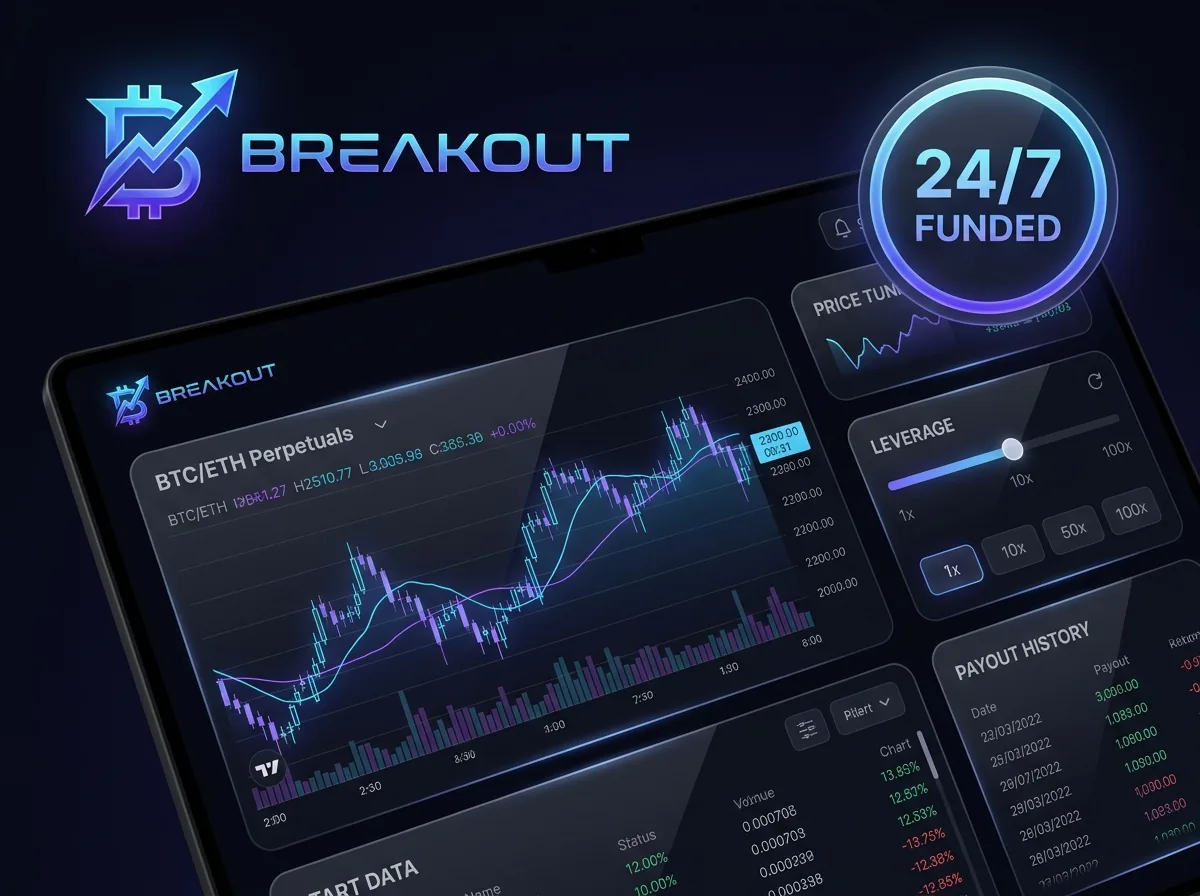
Breakout has three current one-step paths: Classic, Pro and Turbo. The current leverage owner is symbol-specific, so position sizing must use the exact instrument rather than a crypto-wide shortcut.

Rules checked against Breakout current product and leverage owners on
Ratings & Reviews
Classic, Pro and Turbo all use static maximum drawdown.
What is structurally useful?
Static maximum drawdown makes the total-loss floor easier to model, and the official leverage owner gives an exact symbol table.
What needs extra care?
The daily-loss budget is tight, fees apply to turnover and the terminal remains the owner for the individual account setting.
What I personally tested at Breakout
My direct Breakout experience comes from an earlier Classic 1-Step account and a legacy 2-Step route. I used the trading environment and evaluated the rule structure, but I did not complete a personal payout. I therefore do not write “Breakout paid me,” and I do not use the old 2-Step mechanics to describe today's lineup.
What I learned from the platform
The interface makes crypto feel familiar, but an evaluation account still has a separate risk contract. Exchange habits such as using more leverage because it is available or letting an unprofitable position breathe can collide quickly with a daily loss ceiling. The terminal needs to be treated as the execution layer; the account dashboard remains the risk owner.
Why the no-payout result matters
It limits my conclusion. I can speak about onboarding, platform use and the practical feel of the risk model. I cannot use my own history to score withdrawal speed or dispute handling. Those claims remain source-based and should be checked against the current agreement.
What I would do differently now
I would choose the product only after converting the daily and total loss limits into a fixed dollar risk per trade. I would then include commission and overnight financing in the same model. A strategy that is profitable before costs can still run out of account room if turnover is high.
Which Breakout evaluation is current?
Breakout names Classic, Pro and Turbo as purchasable one-step evaluations. Classic uses a 10% target and 6% static maximum drawdown. Pro uses 12% and 5%. Turbo uses 9% and 3%. All three use a 3% daily loss limit. Read the current product owner and the loss-limit matrix.
PTV does not publish a fixed current checkout price here. The dashboard and checkout remain the commercial owner.
What leverage does Breakout currently publish?
Breakout's schedule is symbol-specific. BTC is listed at 10x. ETH sits in the 5x group. Some lower-liquidity crypto symbols are 2x or 3x. XYZ100 and S&P500 are 10x; crude oil and silver are 5x. Check the current leverage table before sizing a trade.
The terminal controls the account-level value. A general review cannot override the live instrument setting.
Which costs reduce the usable loss budget?
Breakout documents a 0.04% notional fee for each buy or sell order and a 0.033% daily swap rate per open position. Those costs matter most on Turbo because the static maximum loss is only 3%. Read the funded-account fee owner.
How does the Breakout trading platform affect the decision?
Breakout uses its own terminal experience, with the exact account setup remaining account-dependent. That reduces the setup burden for a trader who wants to start quickly, but it also means you should test the available order types and risk controls instead of assuming they match a personal exchange account.
Run a minimum-size platform test
- Confirm the contract or notional size shown before sending an order.
- Test stop, limit and reduce-only behavior.
- Check whether unrealized profit or loss changes the displayed daily budget.
- Confirm the session or daily-reset time used by the account.
- Compare the account leverage for the exact symbol, not for crypto as a category.
Breakout publishes symbol-level leverage. That is the right level of detail because BTC, ETH, lower-liquidity tokens and non-crypto contracts do not carry the same exposure. The live terminal and account agreement take priority if the general table and the issued account differ.
If your strategy depends on a specific exchange API, third-party bot or custom execution tool, verify support before paying. A browser terminal can be clean and fast without supporting the workflow you use elsewhere.
Which Breakout account should you choose?
Classic, Pro and Turbo should be compared by usable risk, not by which name sounds fastest. Classic gives the widest static maximum-loss room. Pro sits between the two. Turbo pairs the smallest target with the tightest total floor.
Classic
Classic is the natural starting point for a trader who values more room for variance. The larger target is only a disadvantage if you expect to reach it by increasing size. If the strategy needs several independent trades to express its edge, the wider floor can be worth the longer path.
Pro
Pro is the middle route. It makes sense only when both its target and total-loss budget fit your actual distribution. Do not choose it simply because it appears balanced on a table.
Turbo
Turbo reduces the target but leaves less room for a losing sequence. It suits a selective strategy with controlled turnover. It is unforgiving for a trader who averages down, trades many correlated symbols or treats the account's available leverage as a sizing recommendation.
My sizing rule
I would reserve part of the daily budget for fees and slippage, cap the number of correlated positions, and stop before the account's hard limit becomes the stop-loss. The account should never be one normal losing trade away from failure.
Is Breakout legitimate and what still needs proof?
Breakout publishes current product, drawdown, leverage, fee and payout documentation. That is enough to analyze the offer, but it is not the same as a personal payout record. My own test stopped before that point.
I separate three types of evidence. The official Help Center owns the general rule. The issued dashboard and agreement own the individual account. A completed withdrawal owns the personal outcome. None of those should be used as a substitute for the others.
The current use of symbol-level leverage is a positive transparency signal. The main remaining user-side risk is assuming that a general table guarantees the same setting on every issued account. Save the dashboard and agreement, and get written support confirmation when they disagree.
I would also judge Breakout by how it handles a real support case, KYC and withdrawal review—not by a competitor Trustpilot score copied into this page. Those external scores age quickly and do not answer whether your account followed its contract.
Breakout vs other crypto prop firms
Breakout's clearest advantage is focus. It is a crypto product first, with a current three-plan structure and symbol-level exposure. That is different from a multi-asset CFD firm where crypto is one market inside a broader rulebook.
HyroTrader is the closer comparison when platform environment and crypto-native execution matter most. Hyro currently separates real exchange data from simulated evaluation trading and has a different consistency model. Breakout is easier to compare when you prefer static maximum drawdown and a simple one-step product family.
FTMO is the alternative when you want a longer-tested operator and a wider CFD ecosystem rather than a dedicated crypto evaluation. The trade-off is a different market structure, platform stack and product logic.
I would pick Breakout for a focused crypto workflow that already fits the terminal and risk limits. I would pick another firm when automation, a specific exchange connection, a verified personal payout record or broader asset coverage is the deciding factor.
What remains account-specific?
Checkout price, any optional upgrade and the dashboard leverage for the exact symbol remain account-level facts. Save those values before paying and before opening a position.
Key details
- Founded
- 2023
- Asset classes
- Crypto
- Profit split
- 80% standard; verify checkout upgrades
- Payout frequency
- Requests available weekdays and weekends when eligible
- Drawdown
- Static drawdown
- Max funding
- $200,000
I may earn a commission if you sign up through my link. It never changes my rating or verdict. I tested this firm with my own money.