
Table of contents
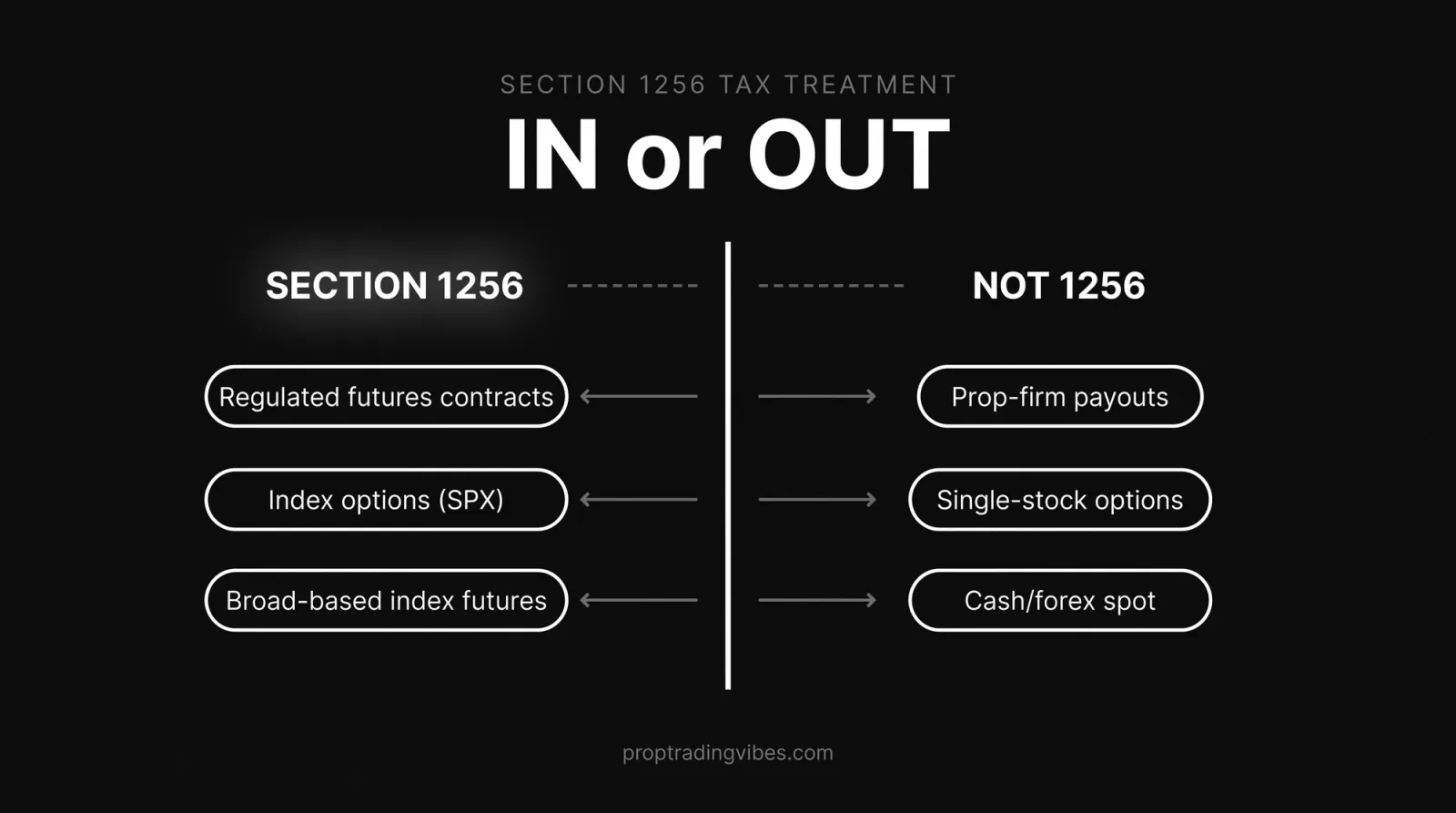
Quick Answer, Taxes on futures trading (US), 2026
- • Regulated US futures are Section 1256 contracts: gains get the 60/40 split, 60% long-term plus 40% short-term capital gains, no matter how long you held the trade
- • At the top 2026 bracket the blended 60/40 rate works out to about 26.8%, versus 37% on ordinary short-term gains
- • Section 1256 positions are marked to market on the last business day of the year, so unrealized open gains and losses count even if you did not close them
- • You report the net 60/40 result on IRS Form 6781, which feeds Schedule D, and 1256 losses can be carried back up to 3 years
- • Prop-firm payouts are usually 1099 contractor income on Schedule C with self-employment tax, NOT Section 1256, this is the distinction most funded traders get wrong
Taxes on futures trading in the US run on Section 1256 of the tax code, which applies the 60/40 rule: 60% of your net gain is treated as long-term capital gain and 40% as short-term, no matter how long you actually held the contract. You report the net result on IRS Form 6781, your open positions are marked to market at year-end, and net losses can be carried back up to 3 years.
That is the whole engine in one paragraph. The part most traders miss sits one layer down: this favorable treatment applies to your own futures account. A prop-firm payout is almost always a different kind of income with a different, less friendly tax path.
This is educational background, not tax advice. Everyone's situation is different, and a CPA who understands trader taxation should sign off on your actual return.
What is the Section 1256 tax treatment for futures?
As of 2026, regulated US futures are Section 1256 contracts, and Section 1256 contracts get two things at once: the 60/40 capital gains split and year-end mark-to-market. Both are automatic. You do not elect them and you do not opt out.
Section 1256 was designed for exchange-traded derivatives where holding period is a weak signal of intent. Instead of forcing the IRS to track whether you held a contract for ten seconds or ten months, the rule just assigns a fixed split to your net annual result.
Which contracts qualify as Section 1256
The Section 1256 class is broader than just futures. Per the IRS, it covers:
- Regulated futures contracts traded on US exchanges, the core category for most traders
- Foreign currency contracts meeting the statutory definition
- Nonequity options, such as broad-based index options
- Dealer equity options
- Dealer securities futures contracts
For a retail futures trader, the line that matters is the first one. Standard exchange-listed contracts, including E-mini and micro index futures, are regulated futures contracts and fall inside Section 1256.
How does the 60/40 rule work?
The 60/40 rule splits your net Section 1256 gain into 60% long-term and 40% short-term, regardless of holding period. A contract you scalped in 90 seconds and a contract you held for three months are treated identically: 60% of the net goes in the long-term bucket, 40% in the short-term bucket.
The long-term portion is taxed at long-term capital gains rates, which top out at 20% federally. The short-term portion is taxed at ordinary income rates, which top out at 37%. Blend those and you get the headline benefit.
The maximum blended rate
At the highest 2026 federal bracket, the blended 60/40 rate works out to about 26.8%. The math:
| Portion | Share of gain | Top federal rate |
|---|---|---|
| Long-term | 60% | up to 20% |
| Short-term | 40% | up to 37% |
| Blended result | 100% | ~26.8% |
The takeaway is the comparison, not the decimal: a top-bracket trader pays roughly 26.8% on futures versus 37% on an equivalent short-term-only gain. That gap, around 10 percentage points, is the entire reason the 60/40 rule gets so much attention. Your real rate depends on your full income picture, so let a CPA run your actual numbers.
Why the rule favors active traders
Short-term stock trading is fully ordinary income. Hold a stock for under a year and the whole gain is short-term, taxed up to 37%. Futures break that link entirely. Even a same-day scalp gets 60% at the lower rate. For traders who turn over positions constantly, that structural difference can matter more than any single strategy tweak.
What is mark-to-market at year-end?
Mark-to-market for Section 1256 contracts means your open positions are treated as if you sold them on the last business day of the year, usually December 31, at fair market value. Any unrealized gain or loss on those open contracts becomes taxable for that year, even though you never closed the trade.
So if you are holding a profitable contract into the new year, that paper profit still hits your current-year return. The cost basis then resets for the new year so you are not taxed twice on the same move.
Section 1256 mark-to-market vs Section 475 election
Two different things share the name "mark-to-market," and traders mix them up constantly.
| Section 1256 MTM | Section 475(f) election | |
|---|---|---|
| Applies to | All Section 1256 contracts, automatically | Securities or commodities, only if you elect Trader Tax Status |
| What you elect | Nothing, it is built in | You must formally elect it |
| Effect | Year-end mark on open futures | Converts gains/losses to ordinary, removes wash sales |
The year-end mark on your futures happens whether or not you ever hear the words "Trader Tax Status." The Section 475 election is a separate, optional choice with very different consequences, and it is exactly the kind of decision to take to a CPA rather than DIY.
How do you report futures on your tax return?
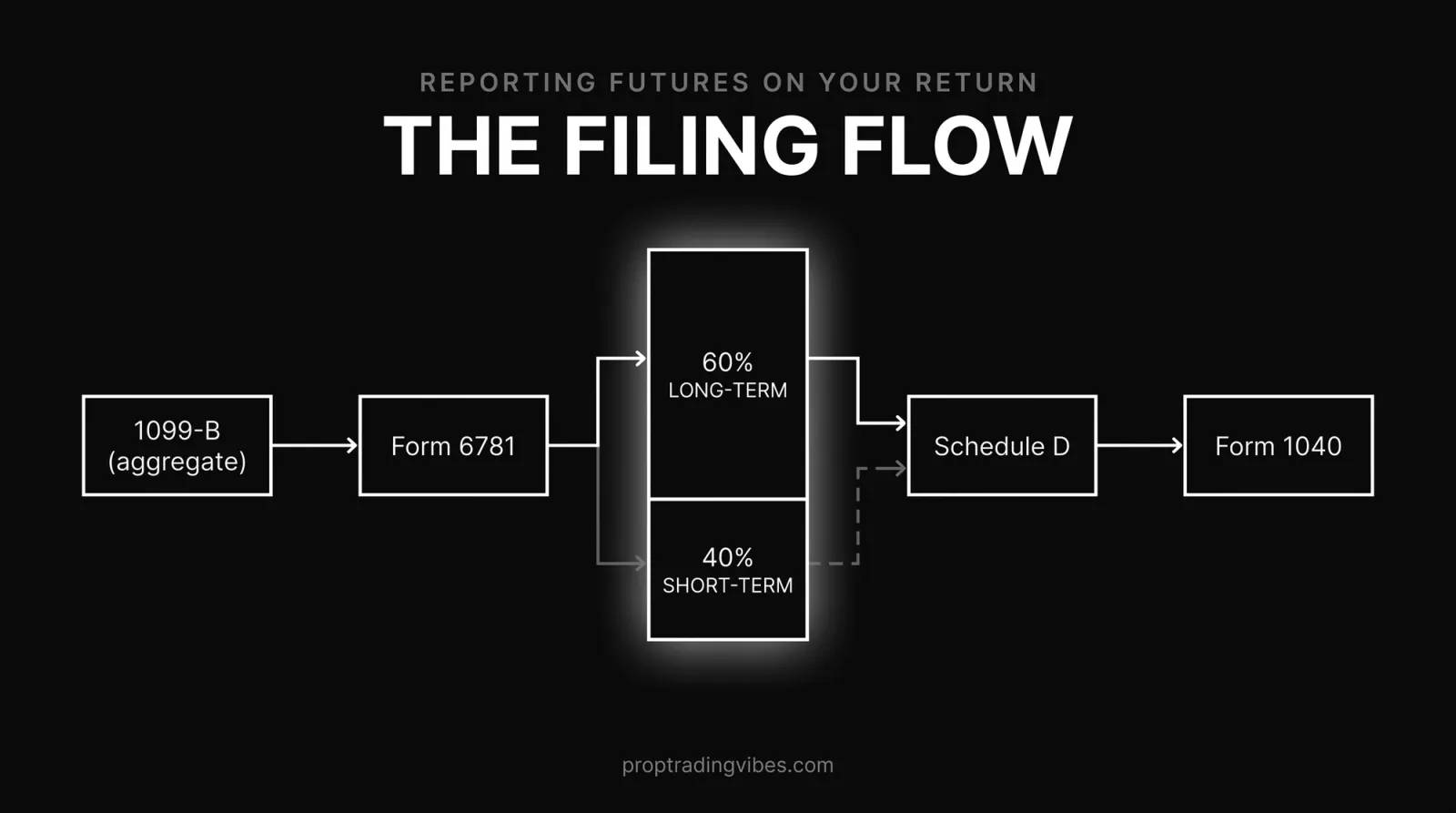
You report net Section 1256 results on IRS Form 6781, Gains and Losses From Section 1256 Contracts and Straddles. Part I calculates the 60/40 split, and the resulting long-term and short-term amounts flow to Schedule D, which feeds your Form 1040.
Starting from your 1099-B
If you trade your own account, your futures broker typically issues a 1099-B showing an aggregate profit or loss for your Section 1256 contracts for the year. That single net figure is your starting point on Form 6781. You are not listing every individual trade the way you might for stocks on Form 8949, the aggregate number does the work.
Carrying back Section 1256 losses
A net Section 1256 loss can be carried back up to 3 prior tax years and applied only against Section 1256 gains in those earlier years. That can generate a refund for a bad year, which is unusual and genuinely useful. You make the election on Form 6781, and any loss not absorbed by the carryback carries forward instead. Whether the carryback beats a straight carryforward depends on your prior-year results, another CPA conversation.
Why are prop firm payouts taxed differently?
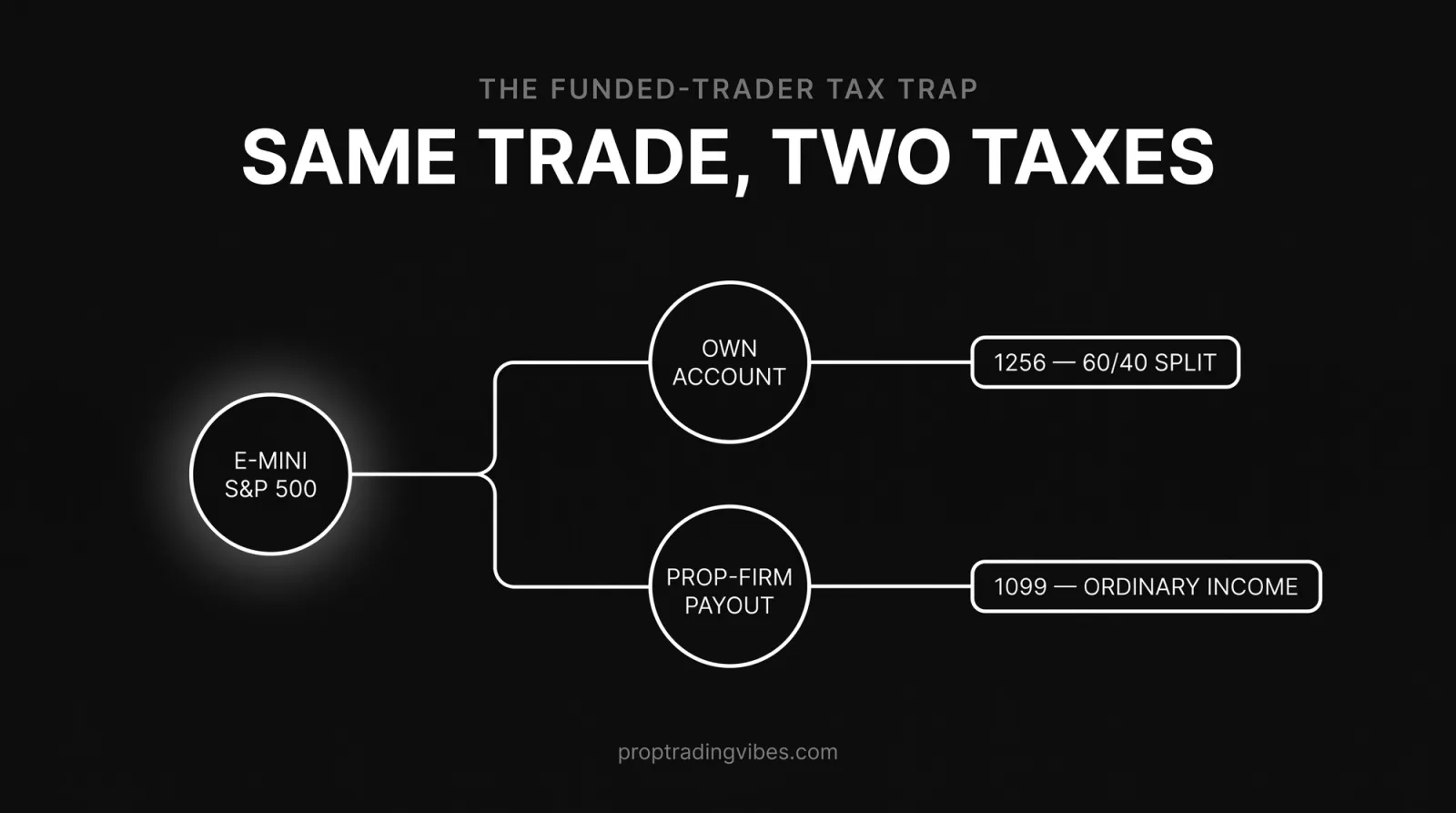
Prop-firm payouts are usually 1099 contractor income, not Section 1256 futures gains, and this is the single most common tax mistake funded traders make. When you trade a prop-firm account, the contracts sit on the firm's simulated account, not yours. Section 1256 attaches to your futures positions. It does not follow a payout the firm sends you for hitting a profit split.
In practice that means a funded trader's payout typically gets reported as ordinary self-employment income on Schedule C, often with self-employment tax on top via Schedule SE, rather than getting the 60/40 capital gains split. The income that felt like "futures profit" is, on paper, service income.
Two income buckets, two tax paths
| Your own futures account | Prop-firm payout | |
|---|---|---|
| Income type | Capital gains (Section 1256) | Contractor / self-employment income |
| Tax form | Form 6781 to Schedule D | Schedule C (often with Schedule SE) |
| 60/40 split | Yes | No |
| Self-employment tax | No | Often yes |
| Whose account traded | Yours | The firm's simulated account |
If you run both, a personal brokerage account and one or more funded accounts, you genuinely have two streams that get taxed two different ways. Keeping them cleanly separated in your records before tax season saves a lot of pain. If you are still deciding whether the funded route fits your situation at all, our breakdown of what a funded trading account actually is is a good starting point, and our day trading taxes guide goes deeper on the active-trader side.
Why traders get this wrong
The confusion is understandable. You are trading the exact same instruments, an E-mini is an E-mini whether it is on your account or the firm's. But the tax code follows ownership and income character, not the ticker. Profit you make on your own positions is capital gains. A payout the firm pays you for a service is contractor income. Same screen, two tax worlds. A CPA can confirm exactly how your specific firm's payouts should be reported, since firms structure their agreements differently.
How is futures tax treatment different from stocks?
Futures are generally more tax-efficient than short-term stock trading because of the 60/40 rule. A stock held under a year is 100% short-term, taxed at ordinary rates up to 37%. A futures gain is automatically 60% long-term, producing the blended rate near 26.8% at the top bracket regardless of how briefly you held it.
There are other differences worth knowing:
- Wash sale rules apply to securities but not to Section 1256 contracts, so the wash-sale headache that haunts active stock traders does not hit your futures the same way
- Reporting volume is lighter for futures, an aggregate 1099-B figure on Form 6781 versus potentially thousands of stock lines on Form 8949
- Mark-to-market is automatic for futures but optional and election-only for securities
None of this makes futures universally "better" to trade, that is a strategy question, not a tax one. But for an active trader in a high bracket, the tax structure of futures is a real, measurable advantage over churning short-term equities.
The bottom line
Taxes on futures trading in the US come down to Section 1256: the 60/40 rule gives you 60% long-term and 40% short-term treatment regardless of holding period, you mark to market at year-end, and you report it all on Form 6781. For a high-bracket active trader, the blended rate near 26.8% is a genuine edge over the 37% an equivalent short-term stock gain would face.
The trap is assuming a prop-firm payout rides along with that treatment. It usually does not. A payout is typically 1099 contractor income on Schedule C with self-employment tax, an entirely separate bucket from your own Section 1256 futures gains. If you trade both a personal account and a funded account, you are juggling two tax paths, and keeping them clean from day one is the whole game.
This guide is educational and not tax advice. The rules summarized here are general, and your filing depends on your full financial picture. Before you file, take this to a CPA who knows trader taxation and confirm every number against your own situation.
Frequently Asked Questions
How are futures taxed in the United States?
Regulated US futures are taxed under Section 1256 of the tax code, which applies the 60/40 rule. Sixty percent of your net gain is treated as long-term capital gain and 40% as short-term, regardless of how long you actually held each contract. You report the result on Form 6781, and it flows to Schedule D. This is general educational information, not tax advice, so confirm your own filing with a CPA.
What is the 60/40 rule for futures trading?
The 60/40 rule means 60% of your net Section 1256 gain is taxed at the lower long-term capital gains rate and 40% at the higher short-term rate, even on trades you held for a single minute. It exists because regulated futures are Section 1256 contracts. The split is automatic, you do not elect it, and it applies to your net gain or loss for the year on Form 6781.
What is a Section 1256 contract?
A Section 1256 contract is a class of instrument the IRS taxes under the 60/40 rule with year-end mark-to-market. It includes regulated futures contracts traded on US exchanges, certain foreign currency contracts, nonequity options, dealer equity options, and dealer securities futures contracts. Standard exchange-listed futures like the E-mini S&P 500 fall squarely into this category.
What is the maximum tax rate on futures under the 60/40 rule?
At the highest 2026 federal bracket, the blended 60/40 rate works out to roughly 26.8%. That comes from 60% taxed at the 20% long-term rate plus 40% taxed at the 37% short-term rate. It is about 10 percentage points lower than the 37% an equivalent short-term-only gain would face. Your actual rate depends on your full income, so a CPA should run your real numbers.
What is mark-to-market for Section 1256 contracts?
Mark-to-market means your open Section 1256 positions are treated as if sold on the last business day of the year, usually December 31, at fair market value. Any unrealized gain or loss on those open contracts is taxed for that year even though you never closed the trade. It is automatic for Section 1256 contracts and is separate from the trader-status mark-to-market election under Section 475.
What is IRS Form 6781?
Form 6781, Gains and Losses From Section 1256 Contracts and Straddles, is the IRS form where you report your futures results. Part I breaks your net gain or loss into the 60% long-term and 40% short-term portions, and those amounts then carry to Schedule D. If your broker issues a 1099-B with an aggregate profit-and-loss figure for 1256 contracts, that number is your starting point on Form 6781.
Can I carry back futures trading losses?
Yes. A net Section 1256 loss can be carried back up to 3 prior tax years and applied only against Section 1256 gains in those years, which can generate a refund. You make the election on Form 6781. Any remaining loss that is not used up in the carryback is carried forward. A CPA can tell you whether the carryback or a normal carryforward is better for your situation.
Are prop firm payouts taxed the same as my own futures account?
No, and this is the biggest mistake funded traders make. When you trade your own brokerage account, your futures gains get Section 1256 and the 60/40 split. A prop-firm payout is usually paid to you as an independent contractor on a 1099, which is ordinary self-employment income reported on Schedule C, not 60/40 capital gains. The trades happen on the firm's simulated account, not yours, so 1256 treatment does not attach to your payout.
Do I pay self-employment tax on prop firm income?
If your prop-firm payout is reported on a 1099 as contractor income and you treat it as a trade or business on Schedule C, it is generally subject to self-employment tax in addition to income tax. That is a meaningful difference from your own Section 1256 futures gains, which are capital gains and not subject to self-employment tax. Because facts vary by firm and situation, have a CPA confirm how your specific payouts should be reported.
Do I get a 1099 for futures trading?
If you trade your own account, your futures broker typically issues a 1099-B that shows an aggregate profit or loss for your Section 1256 contracts, which you use to fill out Form 6781. A prop firm, by contrast, usually issues a 1099-NEC or similar for your payouts as contractor income. The two 1099s are different forms reflecting two different kinds of income, capital gains versus service income.
Are micro futures and E-mini futures Section 1256 contracts?
Yes. Regulated futures contracts traded on US exchanges, including E-mini and micro contracts on major indices, qualify as Section 1256 contracts and get the 60/40 treatment with year-end mark-to-market. The contract size does not change the tax classification. As always, confirm the specifics of your instruments with a tax professional before filing.
Do I need a CPA for futures trading taxes?
You do not strictly need one to file, but futures taxes involve mark-to-market, the 60/40 split, Form 6781, the loss carryback election, and, for funded traders, the separate 1099 contractor question. A CPA who understands trader taxation is worth it once your volume or payouts are material. Everything here is educational background to make that conversation more productive, not a substitute for personalized advice.
Is futures trading tax treatment better than stock trading?
For active traders, the 60/40 rule often makes futures more tax-efficient than short-term stock trading. A stock held under a year is fully short-term and taxed at ordinary rates up to 37%. A futures gain gets 60% at the lower long-term rate regardless of holding period, producing the blended rate near 26.8% at the top bracket. Whether that benefits you depends on your bracket and overall return, which a CPA can quantify.
Where do I report futures gains on my tax return?
Net Section 1256 gains and losses go on IRS Form 6781 first, where the 60/40 split is calculated. From there the long-term and short-term portions flow to Schedule D, and Schedule D feeds your Form 1040. Prop-firm payout income takes a different route, generally Schedule C with Schedule SE for self-employment tax. Confirm the exact placement for your return with a tax professional.

Where to go next
The most useful next decision from this page.