
Table of contents
Quick Answer, Cheapest Prop Firms
- • The cheapest prop firms by total cost to first payout start around $70-150 all-in for a 50K futures account.
- • Tradeify Growth 50K ($145 one-time) charges no activation fee; Take Profit Trader runs $170/month ($102/month with code NOFEE40, which also waives the $130 PRO activation fee); Lucid Trading is $140 one-time for the 50K and $84 with code VIBES, with the 25K starting at $100 list and $60 with the code.
- • Apex Trader Funding gets competitive during its frequent 80-90% off sales, when Apex discounts the $490 retail evaluation; the final cost also depends on the selected PA option.
- • For forex, FundingPips starts at $29 per its pricing page (checked July 30, 2026), with no activation fee; the registration fee comes back at your 4th reward on 1 Step and 2 Step Standard accounts.
- • The biggest hidden cost is resets. A "cheap" firm with $50-100 paid resets gets expensive fast if you fail and re-attempt.
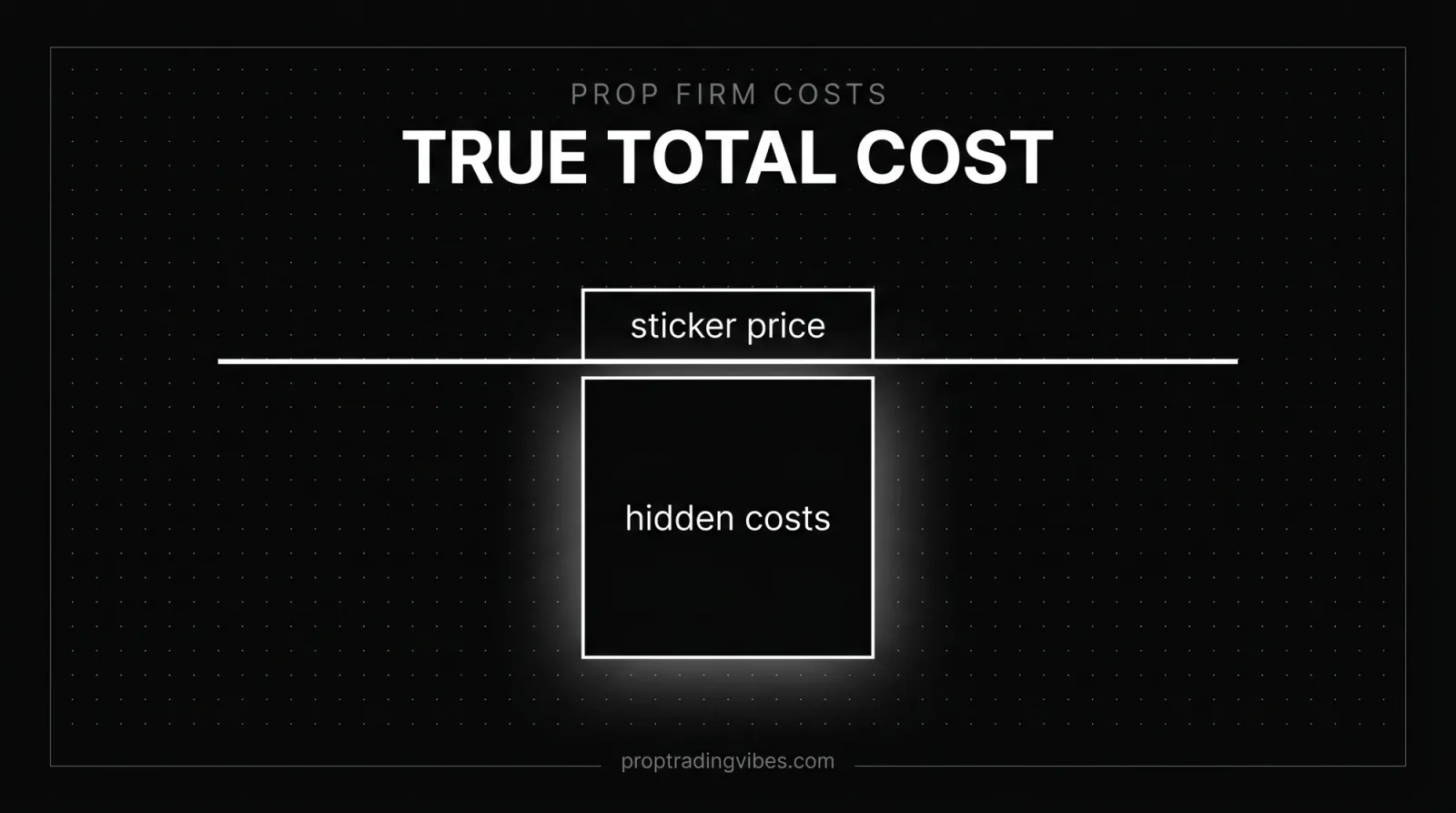
The cheapest prop firm isn't the one with the lowest evaluation fee. It's the one where your total spend from sign-up to first withdrawal is the smallest number possible. That distinction matters more than most traders realize.
I have tested more than 50 prop firms since 2022; this guide does not assert that every test used a paid evaluation. A low entry fee can become expensive after resets and activation costs, while a higher upfront price can still produce the lower total cost to first eligible payout. The sticker price on a firm's pricing page tells you almost nothing about what you'll actually pay.
This guide breaks down cheap prop firms by total cost. Not just the eval fee. The activation fee, the platform subscription, the data feed, the reset fee, the recurring charges. Everything between "I want to try this" and "I got paid."
What Makes a Prop Firm "Cheap"? Total Cost Explained
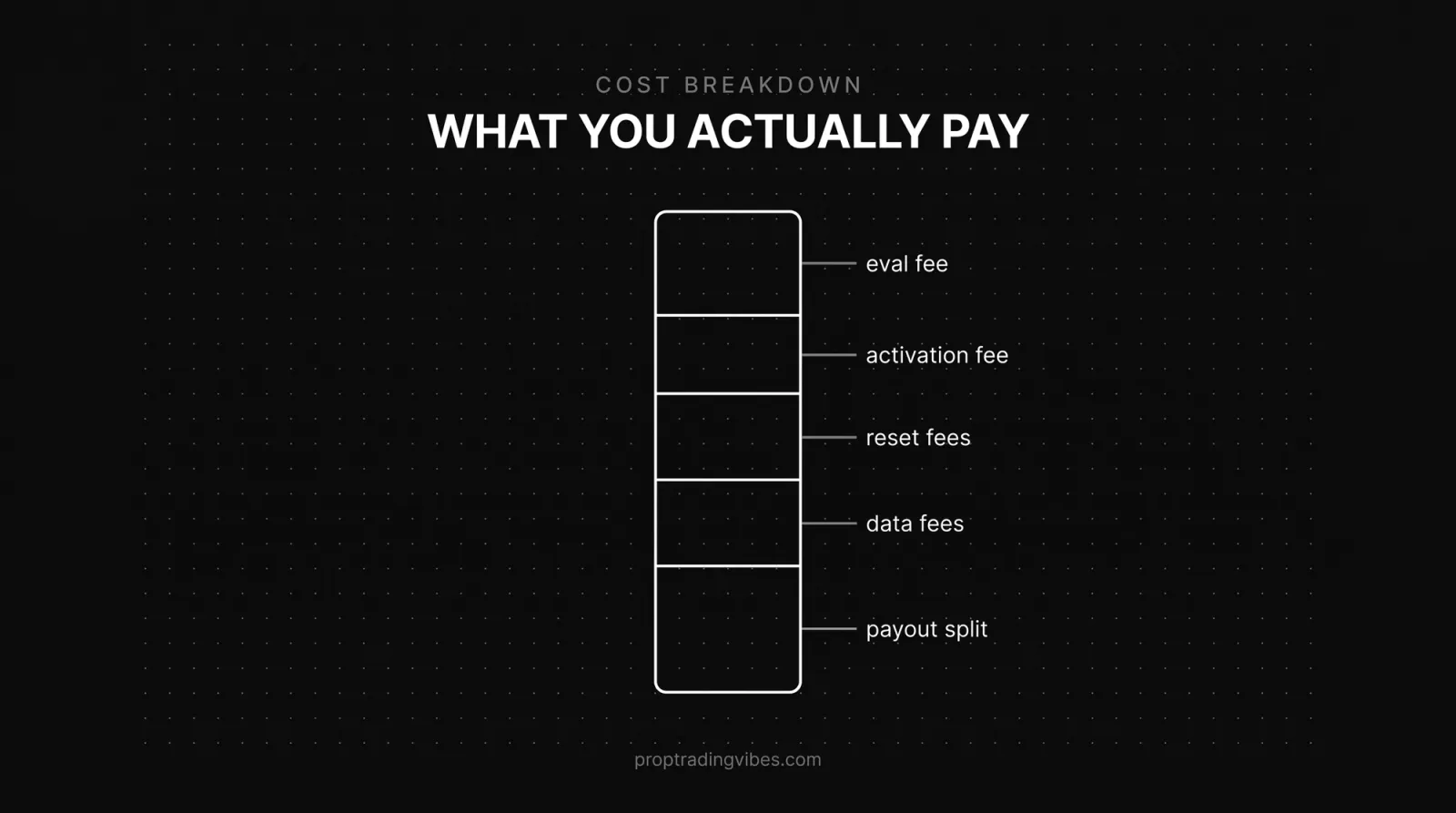
A cheap prop firm is one with a low total cost to first payout, not a low advertised eval fee. Most comparison sites rank firms by evaluation fee alone. That's roughly half the picture. Your real cost includes five separate line items, and some firms hide two or three of them behind asterisks.
Evaluation fee. What you pay upfront to start the prop firm evaluation. Ranges from $50 to $700+ depending on account size and firm. It's the number every firm advertises.
Activation fee. What you pay after passing to unlock your funded account. Some firms call it a "funded account fee." Some don't charge one at all. Ranges from $0 to $250.
Platform cost. Your trading software subscription. A NinjaTrader lease runs $75/month. Tradovate is free on some plans. Some firms include the platform in the eval fee; this cost is often invisible until checkout.
Data feed charges. Real-time market data for CME, CBOT, NYMEX, or COMEX. Some platforms bundle data. Others charge $15-25/month per exchange, and the fees stack if you trade ES and crude.
Reset fees. What you pay to restart after blowing an evaluation. Most firms charge $50-100+ per reset. If you're not a 70%+ pass-rate trader (most of us aren't), you'll pay this more than once.
Add those five together. That's your real number.
Here's why the cheapest sticker price is often the wrong first question. A $99 evaluation with a 3% trailing drawdown is harder to pass than a $175 evaluation with a 6% EOD drawdown. Fail the $99 eval twice and reset twice, and you've spent $297. Pass the $175 eval on your first attempt and you spent $175. Cheaper per attempt, more expensive in practice.
Cheap resets can encourage repeated purchases without improving the underlying process. The real question isn't "which firm is cheapest?" It's "which firm gives me the best chance of getting funded for the least total money?"
Cheapest Prop Firms Compared: The Total-Cost Table
If you want the short version of this prop firm fees comparison, here it is. I've standardized everything on a 50K futures account (the most popular size) and included every cost category, so you're comparing prop firms with the lowest fees on equal terms. The rows are grouped futures first, then forex; the order inside each group is not a ranking.
| Firm | Market | Eval Fee (50K) | Activation Fee | Pricing Model | Best-Case Total |
|---|---|---|---|---|---|
| Lucid Trading | Futures | $140 ($84 with VIBES) | $0 | One-time, 50K reset $95, so a fresh account with the code is cheaper | $84 with VIBES |
| Take Profit Trader | Futures | $170/month ($102 with NOFEE40) | $130 ($0 with NOFEE40) | Monthly until you pass | $300 for one month ($102 with NOFEE40) |
| Tradeify Growth | Futures | $145 | $0 | One-time; 50K reset $95 | $145 |
| Apex Trader Funding | Futures | $490 ($49 on 90% promo) | $99 | One-time per attempt | $589 ($148 on 90% promo) |
| Topstep | Futures | $49/month (Standard) or $95/month (No Activation Fee), $85 with a Daily Loss Limit | $149 Standard, $0 No Activation Fee | Monthly until you pass | $85 for one month on the No Activation Fee path with a Daily Loss Limit ($198 on Standard) |
| FundingPips | Forex | $269 | $0 | One-time; registration fee refunded at the 4th reward on 1 Step and 2 Step Standard | $269 |
| FTMO | Forex | $250 | n/a | One-time, refunded with first profit split | $250 (refundable) |
The table tells the story. Lucid Trading is the cheapest futures entry on the list once the standing VIBES code cuts 40% from the 50K to $84. Topstep undercuts the rest only on a first-month pass, at $85 on its No Activation Fee path with a Daily Loss Limit; by month two that is $170 and every one-time model on the list is cheaper. Take Profit Trader lands at $102 once code NOFEE40 drops the monthly fee and waives the $130 activation, and Tradeify Growth 50K at $145. On Topstep's Standard Path the $49/month Combine looks cheap per month, but the $149 activation fee lands on top: three months plus activation runs $296.
Note that "best-case total" means exactly that: you pass on the first attempt with no resets. Almost nobody does. The expected-cost formula further down adjusts these numbers for realistic pass rates, and the ranking shifts hard once resets enter the picture.
One thing to flag: these are pre-discount prices. Apex frequently runs 80-90% off sales that drop the $490 eval to around $49, and the final cost then depends on the selected PA option. Current promos are listed on the firm review pages.
The Five Hidden Costs Most Comparison Sites Ignore
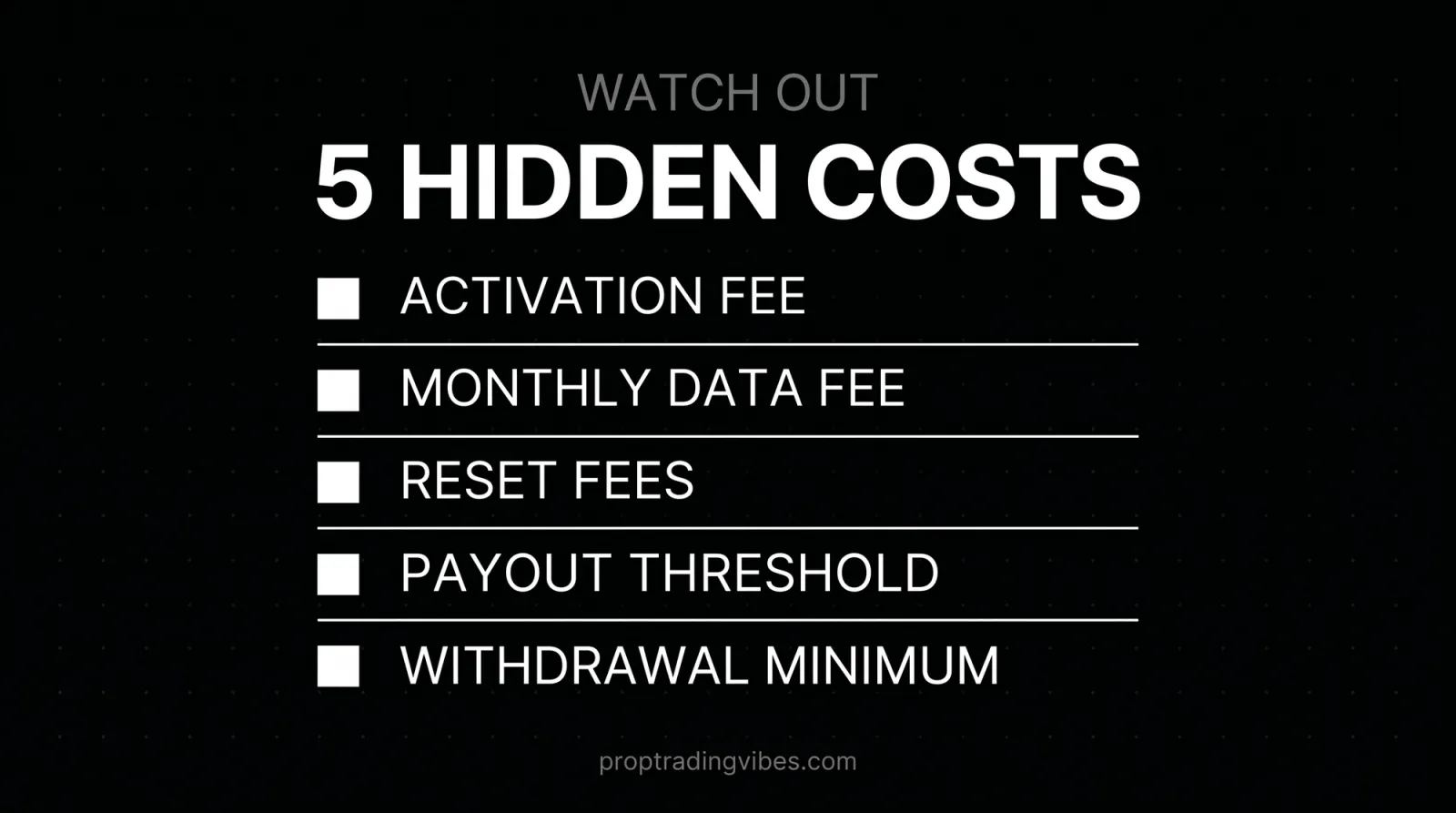
When I first started comparing prop firms, I'd look at the pricing page, pick the lowest number, and sign up. That approach cost me hundreds of extra dollars. These five charges are where cheap firms quietly make their money back, and understanding them explains a lot about how prop firms make money in the first place.
Platform licensing
Some firms lock you into a specific platform. If that platform requires a paid license (NinjaTrader at $75/month, for instance), that adds $75-225 to your total depending on how long you're in the evaluation. Firms that offer Tradovate with free data, or their own proprietary platform, eliminate this entirely.
Data feed charges
CME real-time data isn't free everywhere. At some firms you'll pay $15-25/month for market data, and the charges stack across exchanges (CME for ES/NQ, NYMEX for CL). I've seen traders paying $45/month in data alone on top of their eval fee.
Monthly subscription models
Topstep and Take Profit Trader both charge monthly. Topstep's 50K Combine is $49/month until you pass: three months in, you've paid $147 before the $149 activation fee. That is the Standard Path. Topstep's No Activation Fee path runs $95 a month, $85 with a Daily Loss Limit added at checkout, and the activation fee is $0, so a fast pass costs less there and a long grind costs more. Take Profit Trader runs $170/month at list price ($102/month with code NOFEE40). The monthly model punishes slower, more methodical traders and rewards people who either pass fast or quit fast.
Reset economics
Free resets are rare. Most firms charge $50-100 per reset. If your pass rate is around 30% (which is generous for most traders), you'll need 2-3 attempts on average. That's $100-300 in reset fees alone. while testing more than 50 prop firms, resets have quietly become one of my biggest line items. The silent budget killer in prop trading.
Inactivity and account maintenance fees
A few firms charge inactivity fees if you don't trade for 30 days. Others charge monthly maintenance on funded accounts. These are small ($10-25/month) but they add up if you're juggling multiple accounts or taking a break.
Cheapest Futures Prop Firms in 2026
The cheapest futures prop firms in 2026 are Lucid Trading at $140 list for a 50K account, $84 with code VIBES, Tradeify Growth at $145, and Take Profit Trader at $102/month with code NOFEE40 (list price $170/month, activation waived by the code). For futures traders (which is most of my audience), you want the lowest total cost with the best combination of drawdown rules and payout terms.
Take Profit Trader at $170/month for a 50K account, or $102/month with code NOFEE40. The code also cuts the one-time $130 PRO activation fee to $0. Pass inside your first month and you're funded for about $102 all-in. The drawdown rules are reasonable and the evaluation is one-step. I've withdrawn from TPT multiple times without issues.
Lucid Trading at $136 list for a 50K LucidFlex account, $81.60 with code VIBES. The 25K starts at $79 list and $47.40 with the code. One-time fee, no monthly charges, no activation fee, EOD trailing drawdown, and a $95 reset on the 50K if you fail, which means a fresh account with the code is the cheaper restart. My highest-rated firm on PTV for a reason. I've completed 30+ payout cycles with Lucid across multiple accounts.
Lucid's newest account type, LucidDaily (July 2026), starts at a one-time $100 for the 25K in its cheapest configuration and allows payout requests every eligible day once funded; the LucidDaily breakdown has the full price ladder.
Tradeify Growth at $145 for a 50K account. Clean pricing, no activation fee, solid platform integration. Newer firm but a consistent payout track record so far.
If you're willing to wait for a sale, Apex Trader Funding on a 90% discount drops to around $49 for the 50K eval. Just budget for the Apex Trader Funding activation fee: $99 after you pass, on top of the eval, which puts a promo 50K at roughly $148 all-in. Discounts apply to the evaluation fee, not the activation.
All four firms accept US traders. If that's your situation, my guide to the best prop firms for US traders goes deeper on funding, payout methods, and tax basics.
Cheapest Forex Prop Firms in 2026
The cheapest forex prop firms start lower than futures firms because forex has no data feed costs or platform licensing. MetaTrader 4/5 is free and data is bundled, so your total cost is basically eval fee plus reset fees.
FundingPips starts at $29 for its cheapest challenge, and its 2 Step Standard $5K sits at $32. No activation fee. If you pass, you trade. The registration fee comes back at your 4th reward, and only on 1 Step and 2 Step Standard accounts. For pure entry cost, FundingPips is hard to beat in the forex space.
FTMO charges $250 for their standard challenge but refunds the fee with your first profit split. Pass and get paid, and it's effectively free. Don't pass, and you're out $250. High-stakes coin flip.
The simplified cost structure cuts both ways. With no platform or data line items, the only thing that inflates a cheap forex eval is the reset loop. Three failed attempts at the $29 entry tier put you under $90 in with nothing to show, on the smallest account rather than the 50K, while FTMO's $250 comes back with your first profit split if you pass once. Same total-cost logic, fewer variables.
I'm primarily a futures trader, but the math works the same way: total cost to first payout, not sticker price. If you're trading from Europe, where forex firms dominate the market, my prop trading in Germany guide covers the regional details.
Free Trials and Discount Codes
Free trials and discount codes are the two legitimate ways to cut your entry cost. One of them is worth far more than the other.
Free trials sound great on paper. In practice they're marketing tools with real limitations: reduced account sizes (10K-25K instead of 50K+), tighter drawdown rules, shorter time limits, or instrument restrictions. A free trial is useful for testing rule compatibility; it is not evidence that the paid evaluation will be passed. The example account used a small headline balance and a tight trailing drawdown. That's $200 of max drawdown. One bad trade on ES and you're done. Use trials to test a firm's platform and execution before committing money, not to build a funded trading career.
Prop firm discounts are the better lever. Holiday sales (Black Friday, New Year, July 4th) consistently deliver the deepest cuts. Apex regularly does 80% off during these windows. Some firms offer smaller but permanent codes through affiliates; these sometimes stack with sales, sometimes they don't.
Every firm I cover has its current, verified code on its review page. A commercial partnership is never treated as evidence. First-hand, official, and research-only claims are labeled separately.
One warning. Some "discount" sites list expired codes or codes that redirect to higher-priced plans. If a code doesn't work at checkout, don't force it. Check my page or the firm's official channels for current offers.
How to Calculate Your True Expected Cost
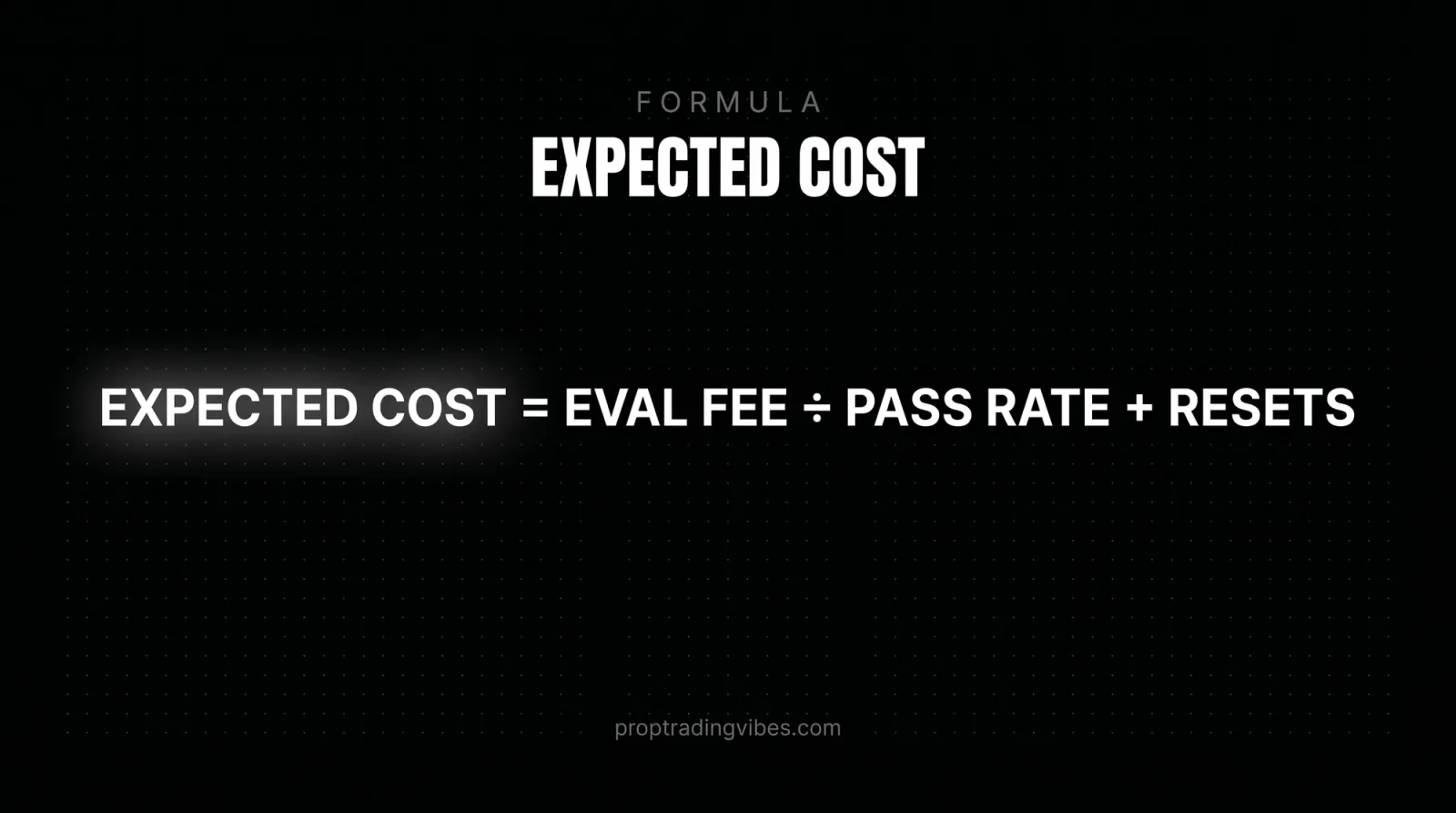
Here's the math I use before signing up anywhere. Take the eval fee and add the activation fee. That's your best-case cost, passing first try. Now multiply the eval fee by 3 to cover expected resets (assuming roughly a 33% pass rate, which is optimistic for most traders), add the activation fee once, and add one month of platform/data costs if they're not included.
(Eval Fee x 3) + Activation Fee + (1 month platform/data) = Expected Total Cost
Run the numbers on three firms from the table:
- Apex at full price: ($490 x 3) + $99 + $0 = $1,569 expected cost
- Lucid Trading with code VIBES: ($84 x 3 attempts) + $0 = $252 expected cost (three fresh 50K accounts with the code, since each one costs less than the $95 reset)
- Topstep on the Standard Path: ($49 x 3 months) + $149 + $0 = $296 expected cost. Same three months on the No Activation Fee path: ($95 x 3) + $0 = $285, or ($85 x 3) + $0 = $255 with a Daily Loss Limit
This formula changed how I think about firm selection. Firms with cheap resets or one-time fees look dramatically different once you account for multiple attempts. It's also the honest way to compare evaluation firms against instant funding models, where you pay more upfront but skip the failure-and-reset loop entirely.
My Value Picks for 2026
After all this analysis, here's where I'd put my money if I were starting fresh today with a limited budget.
If I have $150-200 to spend: Lucid Trading or Take Profit Trader. Lucid is a one-time $140 with zero activation, $84 with code VIBES. TPT is $102/month with code NOFEE40 and no activation fee, so a first-month pass stays comfortably inside that budget. Pass once, get funded, get paid.
If I'm waiting for a deal: Apex Trader Funding on a 90% off sale. At around $49 per 50K eval, it's a no-brainer to grab a few evaluations and attempt them over a month. Budget the size-based Standard PA pricing for each account you pass.
If I want the absolute lowest entry point: FundingPips at $29 for a small forex account gets you in the door for well under $50, though the 50K costs $269.
If I have a bigger budget: I'd spend $175-200 at a firm with proven payouts rather than buy three $60 evaluations at firms with thinner track records. I've tested both strategies. Spreading the budget across cheap unknowns meant more stress, worse rules, and no payouts. The expensive lesson I've already learned, so you don't have to.
Price aside, three things separate a cheap firm worth your money from a cheap firm that wastes it: a verified payout track record, a forgiving drawdown structure (EOD trailing beats real-time trailing), and rules you fully understand before you start trading. I'd rather pay $175 at a firm with a 4.5+ Trustpilot rating and proven payouts than $50 at a firm with 3.2 stars and payout complaints.
New to all of this? Start with my guide to the best prop firms for beginners, then check the current code on the firm review pages before you buy anything. A five-minute search could save you $50-100.
Frequently Asked Questions
What is the cheapest prop firm for futures trading in 2026?
Tradeify Growth offers a 50K futures evaluation at $145 one-time with no activation fee; a reset costs $95. Take Profit Trader and Lucid Trading use the current prices and codes stated above. On-sale Apex totals must include both its promotional evaluation price and activation fee.
Do cheap prop firms actually pay out?
Some do, some don't. The evaluation price doesn't predict payout reliability. Take Profit Trader, Apex Trader Funding, and Lucid Trading all have strong verified payout track records, and each gets you into an evaluation for under $200 (for Apex, during its frequent sales). I've personally withdrawn from all three. Always check Trustpilot reviews and verified payout proof before signing up, regardless of price.
What hidden fees should I watch for at prop firms?
The most common hidden costs are activation fees ($0 to $250 after passing), platform licensing (NinjaTrader at $75/month), data feed charges ($15-25/month per exchange), reset fees ($50-100 per failed attempt), and monthly subscription models that keep charging until you pass. Always calculate total cost to first payout, not just the eval fee.
Is a monthly subscription or one-time fee better?
It depends on the price. Topstep's 50K Combine at $49/month stays affordable even over three months ($147, plus the $149 activation fee), while Take Profit Trader's $170/month ($102 with NOFEE40) stacks faster. Topstep's second path swaps those costs around: $95 a month, $85 with a Daily Loss Limit, and no activation fee at all, so one month to a funded 50K costs $85. One-time models like Lucid Trading ($140 for a 50K, $84 with code VIBES) cap your cost regardless of how long the evaluation takes. Cheap monthly subscriptions can win; expensive ones rarely do.
How much should I budget for prop firm evaluations?
Budget $500-800 for your first year. That covers 2-4 evaluation attempts including resets, and most traders don't pass on their first try. I have tested more than 50 prop firms since 2022; this guide does not assert that every test used a paid evaluation. A focused trader picking one or two good firms should spend far less.
Are free prop firm trials worth taking?
Free trials are useful for testing a firm's platform and execution speed before committing money. They're not realistic paths to getting funded: account sizes are small (10K-25K), drawdown rules are tighter, and time limits are shorter, so pass rates run lower than on paid evaluations. Use them to evaluate the firm, not to build a trading career.
Does a higher eval fee mean better quality?
No. Evaluation fee and firm quality don't correlate directly. FTMO charges $250 and delivers excellent service. Some firms charge $300+ with mediocre support and slow payouts. Lucid Trading charges $140 for a 50K, $84 with the VIBES code, and is my highest-rated firm overall. Judge firms by payout track record, drawdown structure, rule transparency, and support quality.
Is it cheaper to trade forex or futures at prop firms?
Forex evaluations are generally cheaper. FundingPips starts at $29 for its smallest account, and its 50K sits at $269, compared to $150+ for most futures firms at 50K, and forex eliminates platform licensing and data feed costs since MetaTrader is free. The trade-off is different rules and profit splits. Choose based on what you actually trade, not which is cheaper.
Do prop firm costs differ by account size?
Yes. Larger accounts cost more at every prop firm. A 50K account might cost $150 while a 150K account at the same firm costs $350-500, and the cost-per-dollar of buying power is usually worse at larger sizes. Most traders get better value starting with a 50K account, proving consistency, and scaling up after withdrawals.
Can I get a refund if I fail a prop firm evaluation?
Most prop firms do not refund evaluation fees for failed attempts. FTMO refunds the fee with your first funded account profit split, effectively making it free if you pass. Some firms offer partial credits toward your next attempt. A few firms run free-reset promotions (Lucid has run one free reset per five LucidFlex purchases), which is not a refund but softens the cost of a failed attempt. Outside those promotions, Lucid resets start at $60, and with code VIBES a fresh Lucid evaluation is cheaper than the reset at every size. Topstep hands out one free Reset Credit with every monthly rebill, so a failed attempt often costs nothing beyond the subscription you were already paying; a purchased reset costs the same as one month ($49 or $95 on the 50K, depending on path).
The bottom line
A prop firm fees comparison built on total cost to first payout, not sticker price. Eval fees, activation fees, platform and data costs, and resets across the cheapest futures and forex prop firms in 2026.

Where to go next
The most useful next decision from this page.